Clear Sky Science · en
The impact of leisure activities on the subjective well-being trajectory of Chinese residents: an 11-year longitudinal study
Free Time and Feeling Good
Why do some people grow happier over the years while others stay about the same? This study followed thousands of Chinese adults for 11 years to see how everyday leisure activities—like watching TV, listening to music, going to the movies, and using the internet—shape their sense of happiness with life. The findings suggest that what we do in our spare time can slowly, but powerfully, change our long‑term well‑being, and that different groups benefit from different kinds of pastimes.
Two Paths of Happiness Over Time
Using data from the nationally representative Chinese General Social Survey between 2010 and 2021, the researchers tracked how people rated their overall life happiness. They discovered two main patterns, or “trajectories.” One group started out quite unhappy but steadily improved over the years, eventually ending up happier than they began by a large margin. The other group began with relatively high happiness and stayed at that level with only small ups and downs. By around 2018, the initially low but rising group had actually overtaken the always‑happy group, suggesting that changes in daily life—especially leisure habits—can gradually rewrite a person’s emotional story. 
How the Study Was Carried Out
The team combined six large survey rounds covering more than 10,000 adults spread across 32 regions in mainland China. They focused on people who had answered repeated questions about how happy they felt overall and how often they took part in 12 common leisure activities, from shopping and exercising to watching sports and surfing the internet. Advanced statistical methods were used to sort people into the two happiness paths and to test which leisure activities, measured at the start of the study, helped predict whether someone would follow the rising path or the stable‑high path. The analysis also took into account basic background factors such as age, gender, education, marital status, and place of household registration.
Screen Time, Music, and the Internet
Out of all the leisure options studied, four stood out as consistently linked to better happiness trajectories: watching TV or DVDs, going to the movies, listening to music at home, and using the internet. People who did these activities more often in 2010 were more likely to be in the group whose happiness improved strongly over time. But the benefits were not the same for everyone. Younger adults gained the most from going online, likely using the internet for fun, information, and social contact. Older adults seemed to benefit more from quieter home‑based pastimes, especially watching TV and listening to music, which may be easier to access and more emotionally soothing. 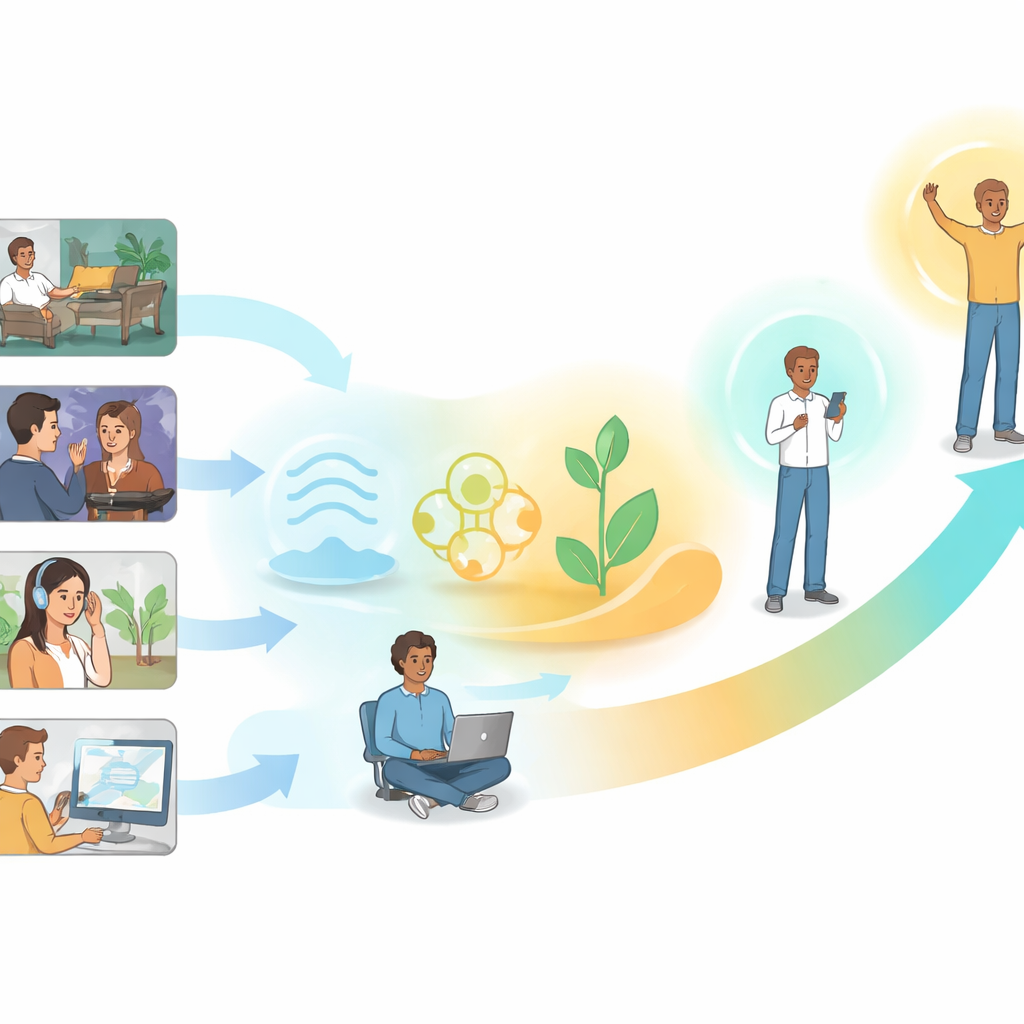
Differences Between Women, Men, and Education Levels
Gender and education shaped how leisure time translated into happiness. For women, all four key activities—TV or DVDs, movies, music, and the internet—were tied to more favorable long‑term well‑being. Men, in contrast, mainly benefited from TV and internet use, while movies and at‑home music listening did not show a clear advantage. Education also mattered: people with less schooling seemed to gain from a broader mix of activities, including TV, music, movies, and internet use. Those with college education and above mainly showed extra benefit from going to the movies, which may serve as a valued social and cultural outing in their lives.
What This Means for Everyday Life and Policy
For general readers, the big message is that ordinary leisure choices can accumulate into real changes in happiness over many years. People who started out less happy but who engaged regularly in certain enjoyable activities were able to close the gap—and even surpass—those who began more content. For policymakers and community planners, the study suggests that promoting accessible leisure options tailored to different ages, genders, and education levels could be a practical way to support a “happier society.” Encouraging healthy internet use among young people, providing easy access to TV, music, and simple cultural activities for older adults, and ensuring affordable entertainment for lower‑educated groups may all help nudge more people onto an upward path of well‑being.
Citation: Wang, G., Sabran, K., Wang, Y. et al. The impact of leisure activities on the subjective well-being trajectory of Chinese residents: an 11-year longitudinal study. Humanit Soc Sci Commun 13, 333 (2026). https://doi.org/10.1057/s41599-026-06588-3
Keywords: subjective well-being, leisure activities, China, longitudinal study, happiness