Clear Sky Science · en
Employers’ perceptions of hiring individuals with disabilities in Saudi Arabia: attitudes, concerns, and practices
Why this topic matters
In every society, having a job is about far more than a paycheck: it shapes identity, independence, and a sense of belonging. Yet in Saudi Arabia, only a small share of people with disabilities are employed compared with the general population. This article looks at what Saudi employers really think about hiring people with disabilities, what worries hold them back, and what practical steps could make workplaces more welcoming and inclusive.

Work and inclusion in a changing country
The article begins by explaining why work is especially important for people with disabilities. A good job can reduce dependence on government support, build confidence, and deepen social ties. Saudi Arabia’s Vision 2030 reform agenda, along with new disability-rights regulations introduced in 2023, has brought fresh attention to employment and inclusion. Yet the employment rate for people with disabilities in the country remains very low—about 14% compared with 84.6% for those without disabilities. Against this backdrop, the study asks three questions: What attitudes do employers hold, what concerns do they have, and which strategies do they actually use or support to improve hiring and retention?
How the study was carried out
To explore these questions, the researcher designed a web-based survey tailored to the Saudi context but informed by international research. The survey included demographic questions about the kind of businesses involved and the types of disabilities represented among their employees, followed by 24 statements rated on a five-point scale from strong disagreement to strong agreement. These statements were grouped into three areas: attitudes toward hiring people with disabilities, concerns about doing so, and practical strategies that might help. After expert review, pilot testing, and quality checks on the responses, data from 52 employers and human resource specialists in Riyadh were analyzed using descriptive statistics.
What employers appreciate and what worries them
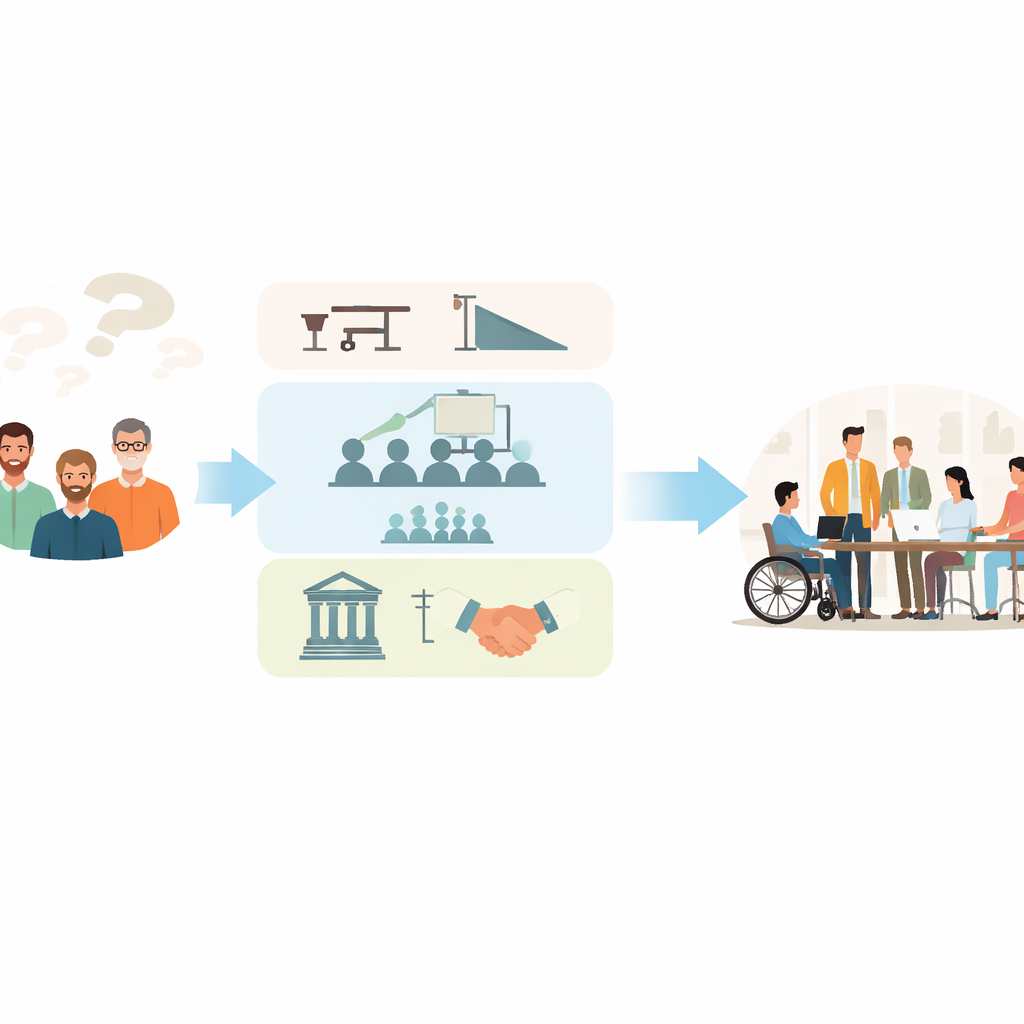
The results show that employers in this sample generally see hiring people with disabilities as the right thing to do. Almost all respondents agreed that employing people with disabilities is a social responsibility and that it raises awareness in society. Many also said that these employees bring fresh, creative skills and can improve morale. At the same time, most employers admitted that their decisions depend heavily on the type and severity of a person’s disability, suggesting that not all disabilities are viewed equally and that some are seen as more “employable” than others.
Barriers inside the workplace
Alongside positive attitudes, employers reported a series of practical worries. The strongest concerns centered on the need to modify workplaces and to provide extra training or supervision. Many were uneasy about whether their organizations were ready, whether safety could be ensured, and whether employees with disabilities would have enough skills and experience. Some also feared negative reactions from customers or coworkers. Interestingly, about half of the respondents pointed to a lack of information as a barrier, revealing that many employers simply do not know what accommodations cost, what support is available, or how to manage inclusion effectively.
Steps that could make a difference
When it came to solutions, employers strongly backed several concrete strategies. They favored vocational training that begins in high school and continues as young people enter the labor market, giving future workers with disabilities more chances to build job-ready skills. They also supported training for managers and supervisors on disability issues, as well as broader education for employers to dispel myths and improve everyday interactions at work. Government assistance and access to outside experts were seen as crucial supports, offering guidance on accommodations and easing financial or legal worries. These preferences highlight that employers are not only aware of barriers, but also open to structured help in overcoming them.
What it all means going forward
Overall, the study paints a picture of employers who are sympathetic to the idea of disability inclusion but still hesitant because of costs, readiness, and uncertainty. The author argues that improving employment for people with disabilities in Saudi Arabia will require coordinated action: better preparation and training for workers, clearer guidance and incentives for employers, and strong leadership from government and civil society. If these pieces come together, the country can move closer to a labor market where people with disabilities are not an exception but a routine part of everyday working life.
Citation: Almalky, H.A. Employers’ perceptions of hiring individuals with disabilities in Saudi Arabia: attitudes, concerns, and practices. Humanit Soc Sci Commun 13, 301 (2026). https://doi.org/10.1057/s41599-026-06587-4
Keywords: disability employment, inclusive workplaces, Saudi Arabia, employer attitudes, vocational training