Clear Sky Science · en
AI adoption among young Indians: an analysis using a MIMIC model
Why this matters for students and parents
Across Indian cities, a new kind of study helper has quietly entered classrooms, hostels, and living rooms: artificial intelligence tools such as chatbots, writing assistants, and recommendation systems. This article explores how young Indians—especially Generation Z students aged 18–24—are choosing to use these tools on their own, even when colleges have not formally built AI into the syllabus. Understanding what draws them to AI, and what holds them back, sheds light on how the country can prepare a fair and future-ready education system.
The digital world young Indians live in
Today’s students have grown up online. They switch easily between messaging apps, streaming platforms, and learning portals. The authors focus on urban Gen-Z students in India, while also including millennials and AI-savvy teachers and professionals to give a fuller picture. Rather than studying only universities that officially deploy AI, they ask: when AI tools are simply available on the open internet, who actually uses them for learning, and why? This question is especially important in a country where many colleges still struggle with basic digital infrastructure and where teachers often have less AI training than their students.
What the research looked at
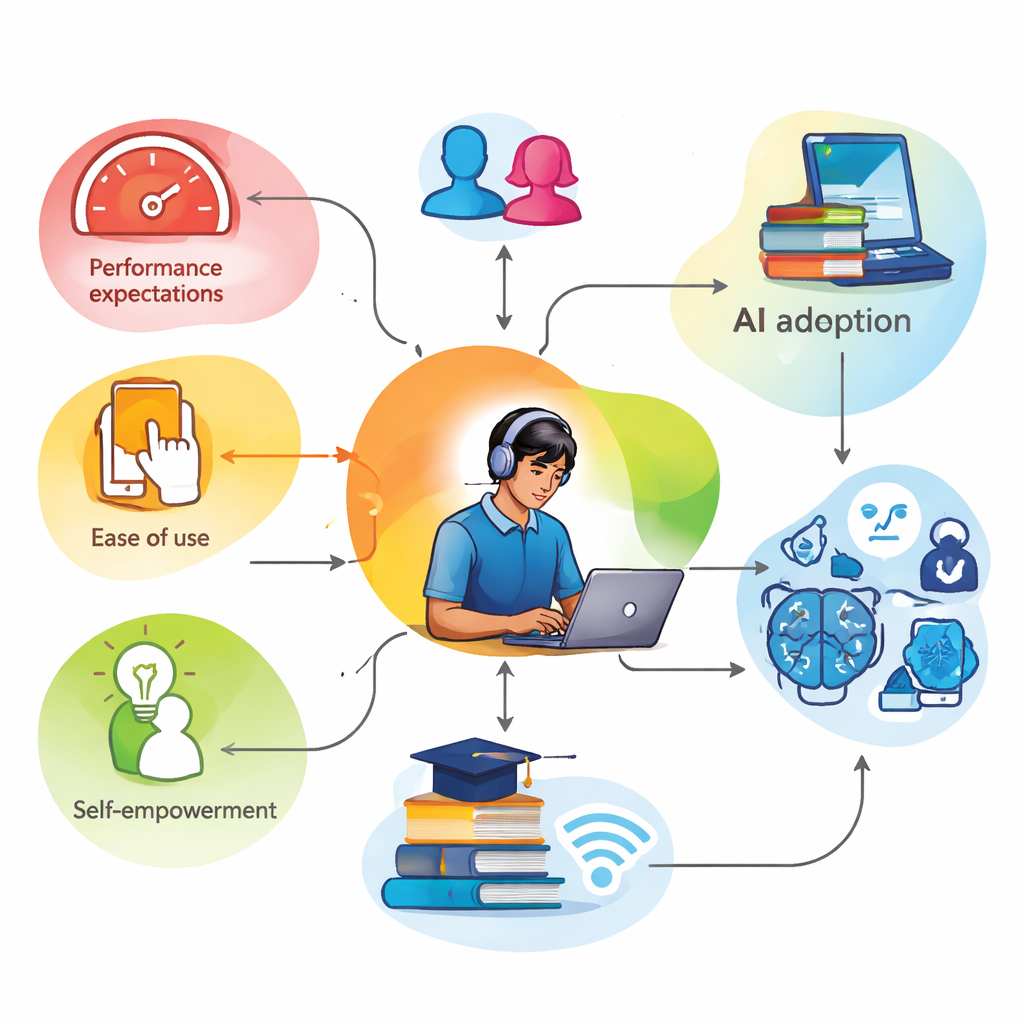
The study blends insights from hundreds of recent education-and-AI papers with a detailed survey of 305 digitally engaged people in Delhi, Kolkata, Pune, and Bengaluru. Using advanced statistical techniques, the authors test an extended version of a well-known technology adoption model. They examine how three main beliefs shape students’ willingness to use AI: whether they expect it to improve their performance, how easy they think it is to use, and whether it makes them feel more capable and in control. They add two more pieces to the puzzle: the social environment around the student—friends, teachers, and online communities—and the practical conditions such as access to devices and stable internet. Finally, they build a “digital engagement profile” that combines gender, education level, and how voluntarily people use the internet, to see how these background traits color every other factor.

How students actually use and judge AI
The results show that students are most likely to adopt AI when three forces pull in the same direction. First, they have to believe that AI really helps them study faster or better—by improving writing, clarifying difficult concepts, or suggesting practice problems. Second, the tools must feel simple and low-friction to use on phones or laptops. Third, and crucially, students must feel that AI strengthens their own abilities instead of replacing them. This sense of self-empowerment—using AI to polish grammar, rephrase answers, or explore new ideas—turns out to be a powerful driver of intent. Social influence is just as important: if friends, classmates, or respected teachers use AI and talk about it positively, students are far more inclined to follow. Surprisingly, mere availability of infrastructure—labs, software licenses, or campus Wi‑Fi—does not, by itself, explain who actually embraces AI.
Hidden patterns behind the screens
When the authors examine the digital engagement profile more closely, a more nuanced story appears. Higher education levels and more voluntary internet use both push students toward seeing AI in a positive light and adopting it more readily. But gender has a consistent negative effect: one gender group reports lower confidence in AI’s usefulness, ease, support, and empowering potential, even when they share similar access. This does not simply mean one group is less “techy”; it hints at deeper social expectations and experiences that shape how safe or welcome different students feel in the AI space. Paradoxically, students who are already very digitally active sometimes show a more cautious stance toward AI, as if their broader experience with technology makes them more aware of its limits, biases, or risks.
What this means for classrooms and policy
The study concludes that young Indians are not blindly embracing AI. They are drawn to it when it clearly boosts their performance, feels easy to handle, and supports their own growth and career plans, and when people around them signal that using AI is normal and acceptable. At the same time, gender gaps and uneven digital readiness mean that not all students benefit equally. For parents, teachers, and policymakers, the message is clear: to make AI a genuine tool for opportunity rather than a new source of inequality, India needs targeted efforts. These include early and balanced AI literacy, support for students who feel less confident or excluded, and practical rules that protect privacy and academic integrity. Done well, AI can become less of a mysterious black box and more of a transparent, everyday companion that helps young Indians learn, create, and compete on their own terms.
Citation: Bera, S., Bera, I. & Rahut, D. AI adoption among young Indians: an analysis using a MIMIC model. Humanit Soc Sci Commun 13, 257 (2026). https://doi.org/10.1057/s41599-026-06583-8
Keywords: AI in education, Generation Z students, technology adoption, digital inequality, India higher education