Clear Sky Science · en
Do employees benefit from a perceived culture of companionate love? An attachment theory perspective
Why kindness at work matters
Many modern workplaces lean heavily on digital tools and strict rules to keep things efficient, but in the process they can forget that employees are human beings with feelings. This study asks a deceptively simple question: when people feel surrounded by everyday kindness and care at work, does it actually change how well they do their jobs and whether they stay or quit—and does it help some people more than others?

A workplace where warmth is the norm
The researchers focus on what they call a culture of companionate love at work. This does not refer to romance, but to a climate where coworkers and leaders routinely show warmth, concern, and tenderness—for example, checking in when someone is struggling or offering comfort during tough times. When employees sense that these caring behaviors are common and expected, they effectively experience an emotional safety net at work. Earlier studies hinted that such a climate boosts satisfaction and helpful behavior; this study digs deeper into how it affects exhaustion, job performance, and the decision to leave.
Drained batteries, job success, and quitting
The team builds on a simple idea: people have limited emotional energy. Heavy workloads, pressure, and conflict drain this inner battery, leading to emotional exhaustion—a state of feeling worn out, detached, and unable to give one’s best. Using survey data from 241 new employees and their supervisors in a Chinese biotech firm, tracked across multiple time points, the researchers show that when employees perceive a strong caring culture, they feel less emotionally exhausted. In turn, those who are less drained receive higher performance ratings from their supervisors and are less likely to quit in the following year. In other words, everyday kindness at work seems to protect people’s energy, which then shows up in better work and greater loyalty.
Why some people soak up care—and others resist it
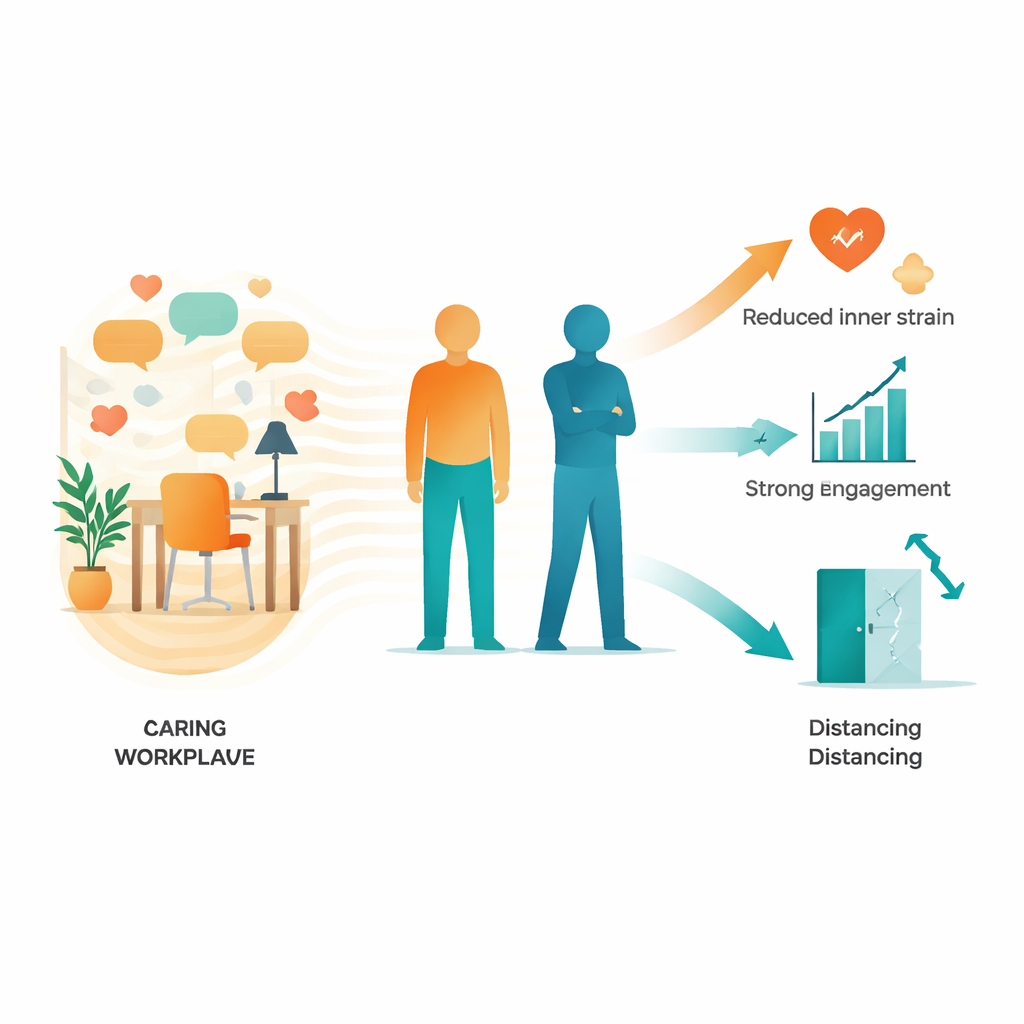
Not everyone responds to a warm culture in the same way. The study turns to attachment patterns—deeply rooted ways people relate to others, shaped by early and repeated experiences. Employees high in attachment anxiety strongly crave closeness and reassurance; those high in attachment avoidance prefer distance and self-reliance. The findings reveal that anxious employees benefit the most from a caring workplace: when surrounded by supportive coworkers, their emotional exhaustion drops sharply, their performance improves, and their likelihood of leaving declines. For avoidant employees, however, a highly caring culture does not automatically help. Because they are uneasy with emotional closeness and often downplay their need for support, they are less able—or less willing—to draw energy from the same caring signals.
When care backfires for the distant
The data reveal a striking pattern. In workplaces low in visible care, anxious employees feel particularly drained, likely because their strong need for connection goes unmet. But when the culture becomes more caring, their exhaustion falls below that of their less anxious peers, suggesting that they can harness the emotional support especially well once it is available. For employees high in avoidance, the pattern flips. In low-care settings they do not feel especially exhausted, perhaps because they expect little from others anyway. Yet in very warm environments, the extra attention and emotional closeness may feel uncomfortable or burdensome, and their exhaustion can actually rise. This means that the same caring climate can be a balm for some and a strain for others.
What this means for real workplaces
The study’s bottom line for a general audience is clear: everyday kindness at work is more than a nice extra—it can protect employees from burnout, lift their performance, and lower costly turnover. But “one-size-fits-all” care will not reach everyone. People who naturally seek closeness are primed to thrive in caring cultures, while those who value distance may need forms of support that respect their autonomy and boundaries. For organizations, the message is to build genuine, visible care into policies and daily interactions, while staying sensitive to different comfort zones. Thoughtful emotional culture, tuned to diverse needs, can help workplaces remain both humane and high-performing in an increasingly digital age.
Citation: Liu, Z., Yang, D., Liu, Y. et al. Do employees benefit from a perceived culture of companionate love? An attachment theory perspective. Humanit Soc Sci Commun 13, 252 (2026). https://doi.org/10.1057/s41599-026-06570-z
Keywords: workplace culture, emotional exhaustion, attachment style, employee performance, employee turnover