Clear Sky Science · en
Understanding the adaptive behaviors of farmers on the Qinghai-Tibetan Plateau: a mixed-methods study on the mediating role of risk perception and the moderating effects of climate change benefits and self-efficacy
Life on a Warming Roof of the World
High on the Qinghai-Tibetan Plateau, often called the “Roof of the World,” millions of farmers are living on the frontline of climate change. Their fields, animals, and family incomes depend directly on rain, snow, and temperature swings. This study looks closely at how these farmers are noticing a changing climate and what they are actually doing about it. By listening to their stories and then surveying hundreds of households, the researchers uncover how beliefs, worries, and confidence shape farmers’ choices—from changing crops to seeking city jobs—offering a window into how ordinary people adapt to a fast-changing planet.
Seeing Change in Everyday Weather
Farmers interviewed across the plateau describe a climate that no longer behaves as it did in their youth. Winters feel milder, mountain snow disappears earlier, and rainfall has become less reliable. Many recall years when snow lingered into early summer; now, the peaks are bare weeks sooner. Droughts, dust storms, and sudden hail are more frequent, threatening harvests and livestock. Yet while farmers clearly notice these shifts, most say they do not fully understand what causes “climate change” or how it fits into the global warming story they occasionally hear about on the news. Their knowledge comes mainly from lived experience rather than science textbooks or official reports.
Risks and Hidden Silver Linings
These weather changes bring serious threats. With much of the farmland dependent on rainfall rather than irrigation, a dry year can mean lost soil fertility, stunted crops, and sharp drops in income. Many farmers describe feeling at the mercy of the sky, aware that a season of poor rain or severe cold can undo months of hard work. At the same time, some have started to notice short-term advantages. Warmer temperatures lengthen the growing season and allow new, more profitable crops—such as wheat, potatoes, and canola—to replace the traditional highland barley in some areas, especially where irrigation is available. For these better-off farmers, hotter weather can translate into fuller granaries and thicker wallets, complicating the simple picture of climate change as an unbroken chain of losses. 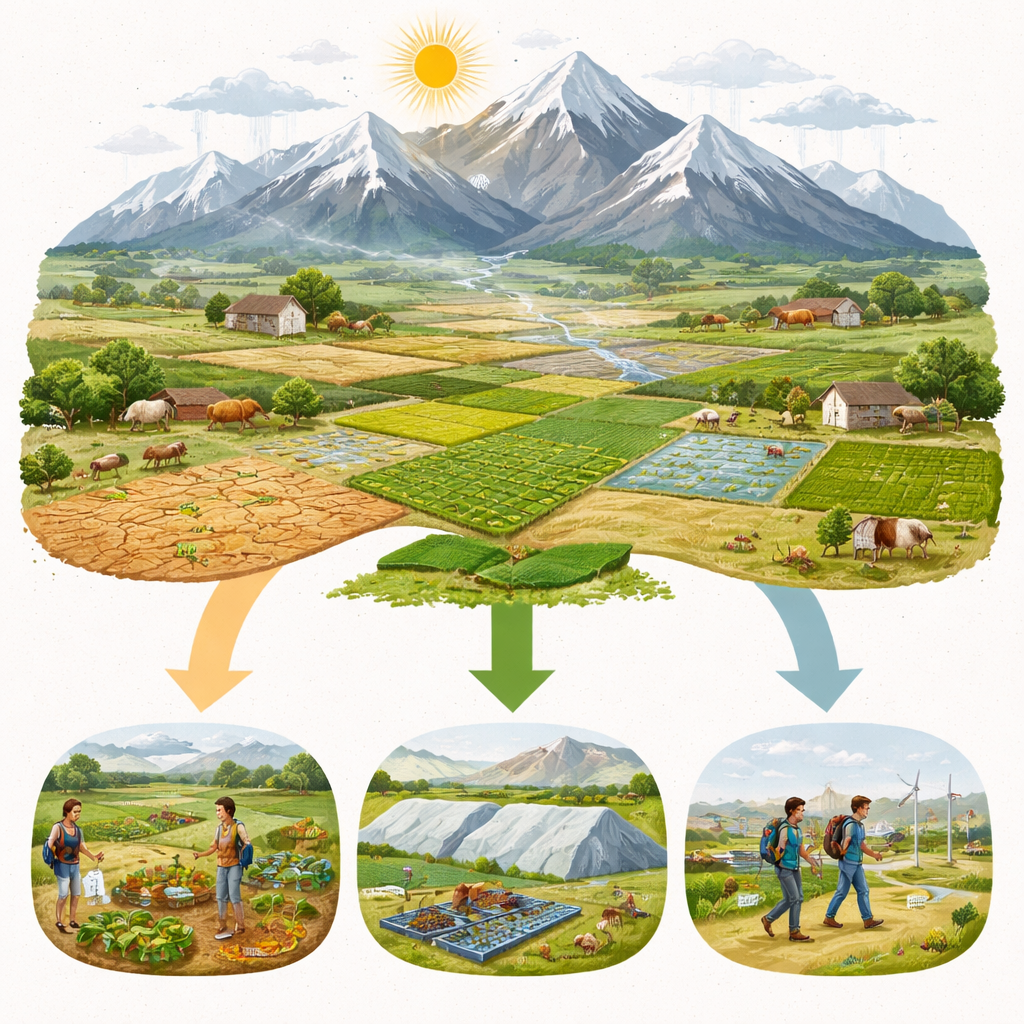
Everyday Strategies for Living with Uncertainty
To cope with this mix of danger and opportunity, farmers have developed a toolbox of practical responses. On the land, they adjust planting dates to match shifting rains, mix crops to spread risk between dry and wet years, and expand livestock herds to add another income stream. Plastic coverings—from simple mulch films to full greenhouses—help trap heat and moisture, letting farmers grow vegetables more reliably or even add extra harvests. Some also buy agricultural insurance to soften the blow of hail, frost, or failed rains. Beyond the fields, many families adopt a “half-farming, half-labor” lifestyle: they cultivate crops during the short growing season, then seek temporary jobs in nearby towns as cleaners, construction workers, or domestic helpers to stabilize their yearly income.
How Minds Turn Worry into Action
After the interviews, the researchers surveyed 476 farmers to test a detailed model of how thoughts and feelings about climate change translate into action. They found that farmers who more strongly believe the climate is changing tend to feel more at risk and, in turn, are more likely to take adaptive steps—such as changing crops, using plastic coverings, or seeking off-farm work. Risk perception acts like a bridge between belief and behavior: noticing climate change raises concern, and concern pushes people toward action. Two other psychological forces reshape this bridge. When farmers feel confident that their skills and measures can handle climate threats (high self-efficacy), strong beliefs about climate change are even more likely to spur action. But if they already feel they are coping well, rising worry adds relatively little extra push. Meanwhile, farmers who have personally gained from warmer conditions—through higher yields or more crop options—tend to downplay risks and take fewer protective steps, showing how short-term benefits can blunt urgency. 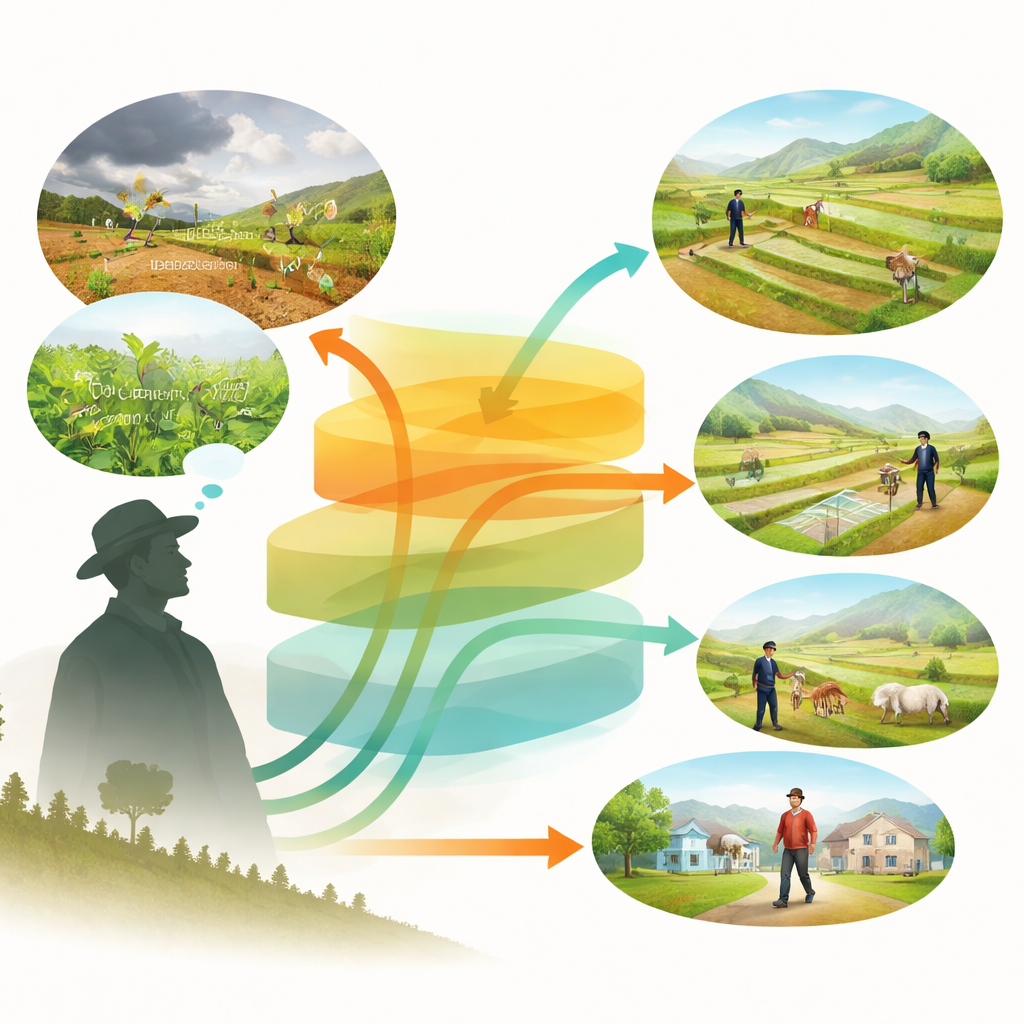
What This Means for the Future
In plain terms, the study shows that plateau farmers are far from passive victims. They are already experimenting, adjusting, and hustling to keep their livelihoods afloat in a shifting climate. However, whether they adapt early and actively depends not just on the weather but also on what they believe, how much danger they feel, how much confidence they have, and whether recent years have brought them hardship or windfalls. For policymakers and communities, this means that supporting adaptation is not only about offering tools like insurance or irrigation; it also requires clear communication about long-term risks and realistic training that builds confidence without breeding complacency. The choices these farmers make today will help determine how well one of the world’s most fragile highland regions weathers the storms—and occasional bright spells—of climate change.
Citation: Li, Z., Sun, Z. & Wang, C. Understanding the adaptive behaviors of farmers on the Qinghai-Tibetan Plateau: a mixed-methods study on the mediating role of risk perception and the moderating effects of climate change benefits and self-efficacy. Humanit Soc Sci Commun 13, 232 (2026). https://doi.org/10.1057/s41599-026-06567-8
Keywords: climate change adaptation, Qinghai-Tibetan Plateau, farmers, risk perception, self-efficacy