Clear Sky Science · en
Pliny the Elder’s discourse on Roman gold mining: The ecological approach of his gold metaphor and the personification of Nature
Why an Ancient Story Still Matters Today
Long before modern debates about climate change and mining, the Roman writer Pliny the Elder was already asking whether tearing mountains apart for gold was worth the cost. This article revisits Pliny’s account of Roman gold mining in northwestern Spain and shows how his words form an early reflection on environmental damage, social suffering, and human greed. By combining literary analysis with modern geology, the authors reveal how a seemingly technical description of mines is also a powerful moral tale that speaks directly to today’s concerns about resource extraction.
Gold, Not Just Wealth but Want
Pliny’s great encyclopedia, the Naturalis Historia, covers almost everything known to the Romans, yet his book on metals returns obsessively to one metal in particular: gold. Instead of praising it mainly as a symbol of wealth and imperial power, Pliny recasts gold as a symbol of greed. He rails against the “hunger” and “thirst” for gold that drive people to dig into the earth for rings, ornaments, and luxury goods rather than basic needs. By choosing his words carefully and repeating these images, he turns gold into a kind of moral mirror: what shines on the surface reveals, in his eyes, a deep decline in Roman values and an unhealthy obsession with excess.
Nature as a Living Victim
Pliny does more than criticize human behavior; he gives nature a voice. He writes as if the earth were a living being whose “womb” is violated by tunnels and whose “indignation” can cause the ground to tremble or collapse. Mountains become “thrones of infernal gods,” mines resemble an underworld, and disasters underground look like acts of revenge. This personification, or giving human qualities to nature, turns anonymous cave-ins and landslides into meaningful events. In Pliny’s framing, accidents are not random misfortune but nature striking back against needless aggression, turning engineering triumphs into warnings.
How the Romans Moved Mountains
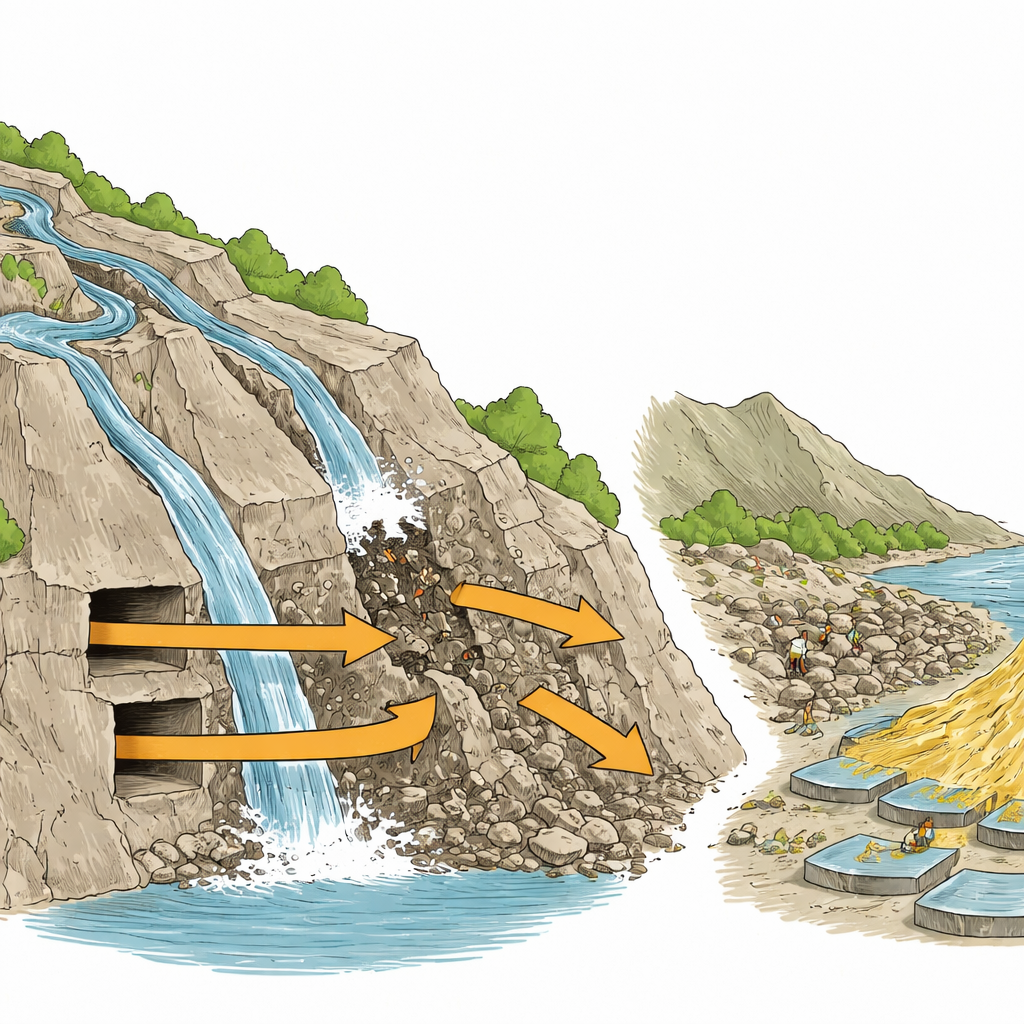
Alongside this moral drama, Pliny preserves a remarkably clear description of how the Romans actually mined gold. He outlines stages that sound very modern: prospecting, evaluation, and extraction. Miners searched for tiny clues in river sands, used pans to separate heavy grains, and followed veins of quartz that trapped flecks of gold. In some places they dug shafts and galleries supported by wooden pillars. In others, they created vast waterworks: channels stretching for hundreds of kilometers, reservoirs cut into rock, and carefully controlled slopes so water could be delivered with just the right force. A spectacular technique known today as ruina montium—the “collapse of mountains”—used stored water released in a sudden rush to tear entire hillsides apart and wash the loosened sediment for gold.
The Hidden Costs to Land and People
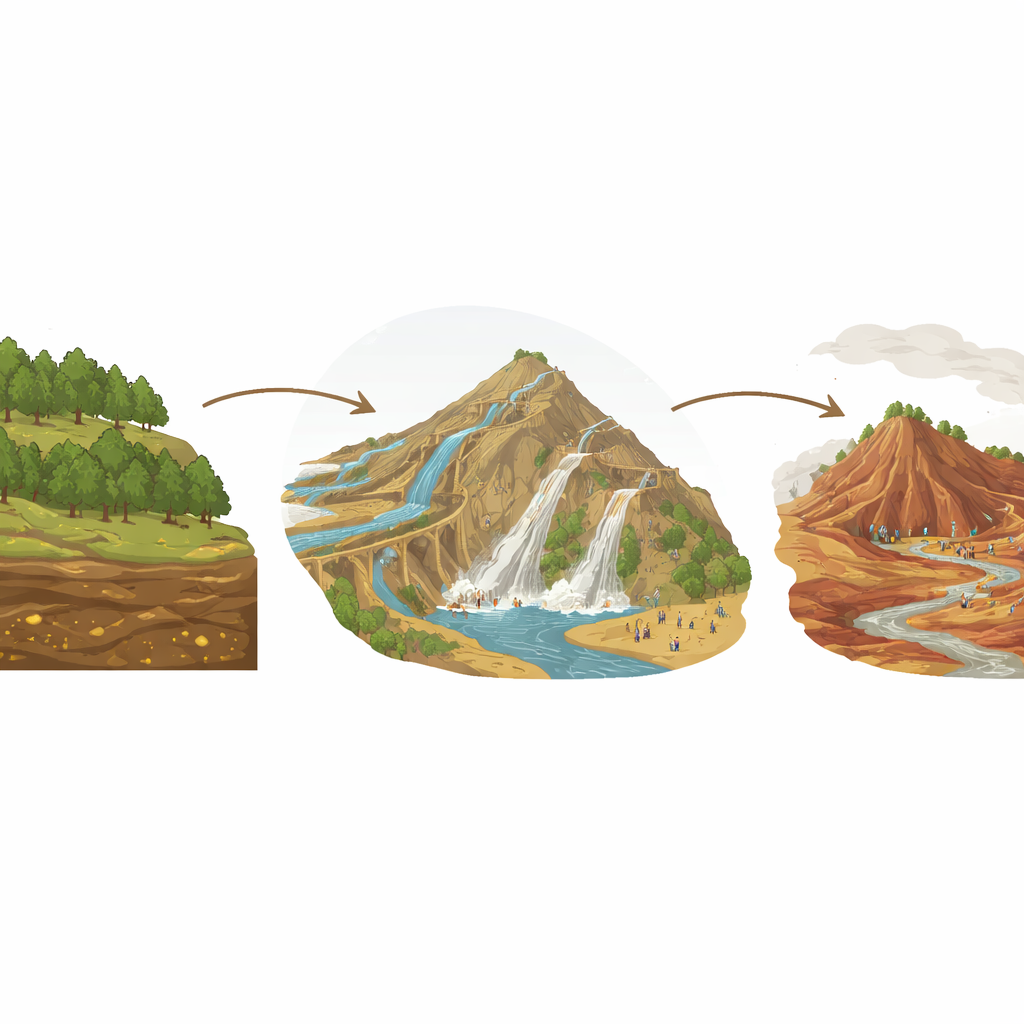
Modern geological and archaeological studies in northwestern Iberia confirm that these operations reshaped entire landscapes. Forests were cleared over thousands of hectares to expose soil and make hydraulic mining possible. Rivers were diverted through tunnels, their courses straightened or shifted, and their waters turned muddy and red with suspended sediment. Enormous volumes of earth were moved, new valleys were carved, and wildlife and water flows were disrupted. Beyond the mines themselves, ore processing and metal smelting released lead, mercury, and other toxic substances into the air and water—traces that scientists can still detect today in lake sediments and peat bogs. At the same time, miners—many free but bound by heavy obligations, others enslaved—faced suffocating dust, rockfalls, darkness, and grueling shifts that ancient writers described as a living hell.
Gold’s Double Face
By reading Pliny through the lens of modern rhetoric and earth science, the authors argue that his contribution goes beyond being a careful reporter of Roman techniques. He offers a way of “framing” mining that holds two truths at once: gold fuels powerful economies and impressive feats of engineering, yet it also stands for greed, damaged landscapes, and human suffering. His metaphor of gold as desire, and his portrayal of nature as a wronged being, help construct a cultural story in which the earth’s limits and possible “revenge” must be taken seriously. For today’s readers, his account can be seen as an early ecological warning: when the drive for wealth ignores both people and planet, the apparent victory over nature may, in the long run, become a kind of self-destruction.
Citation: Fernández-Lozano, J., Ferrari, E. Pliny the Elder’s discourse on Roman gold mining: The ecological approach of his gold metaphor and the personification of Nature. Humanit Soc Sci Commun 13, 228 (2026). https://doi.org/10.1057/s41599-026-06556-x
Keywords: Roman gold mining, Pliny the Elder, environmental history, ancient ecology, mining and society