Clear Sky Science · en
Toward smart cities: analysis of critical factors of new disaster risks in smart cities using a fuzzy DANP-ISM method
Why smarter cities can mean new kinds of danger
As cities wire up everything from traffic lights to hospitals, many of us picture smoother commutes and faster emergency responses. But the same technologies that make a city “smart” can also open the door to new disasters: massive data leaks, paralyzing cyberattacks, or online unrest that spills into the streets. This paper looks under the hood of smart cities to ask a simple question with far-reaching consequences: which hidden weak points could turn tomorrow’s connected metropolis into tomorrow’s crisis hotspot?
How digital cities became double-edged
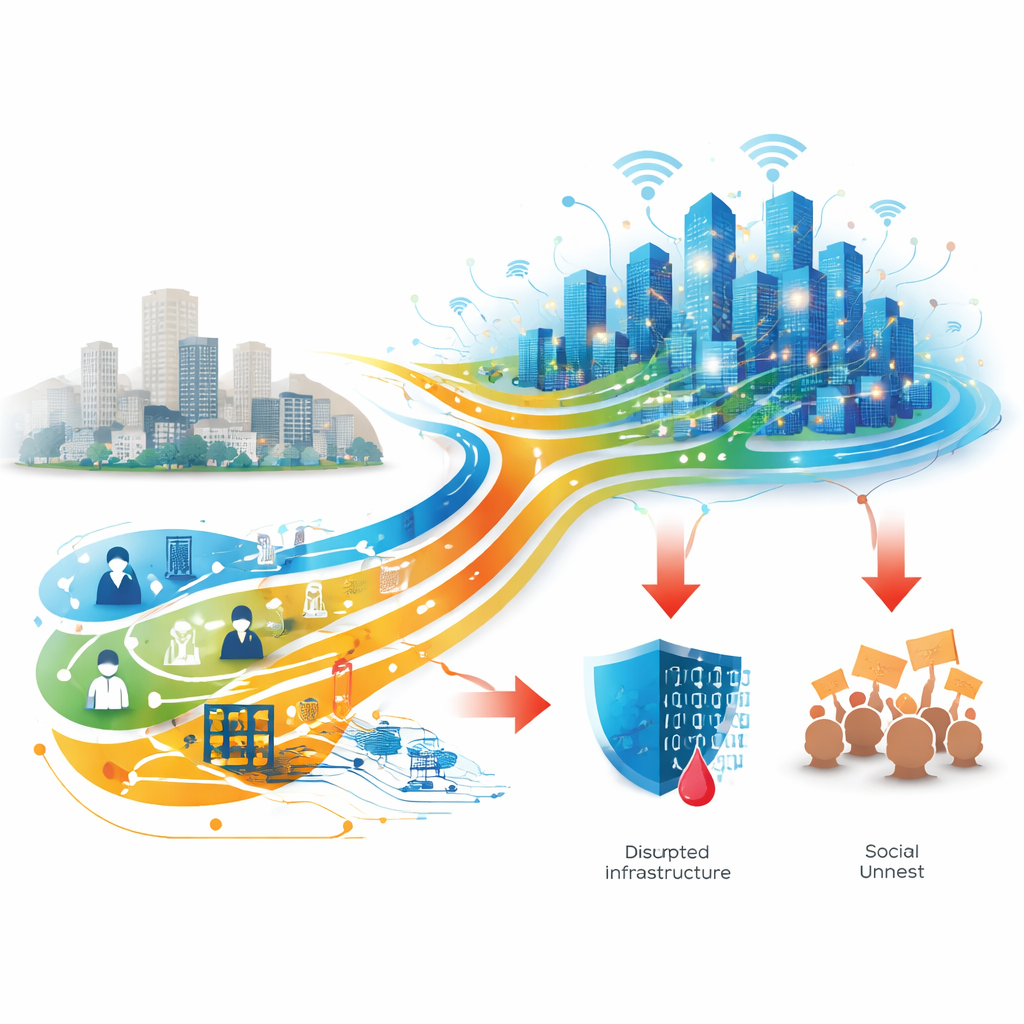
Over the past few decades, smart city projects have promised cleaner air, safer streets and better public services by weaving sensors, data platforms and artificial intelligence into urban life. These systems can indeed help governments spot floods earlier, coordinate emergency vehicles and keep citizens informed. Yet, as the authors explain, the same dense web of people, devices and networks creates fresh vulnerabilities. Data races across many platforms, everyday services depend on complex software, and the boundaries between the online world and physical infrastructure grow thin. When something goes wrong in one layer, the trouble can rapidly jump to others, turning local glitches into citywide shocks.
Six corners where trouble can start
To get a complete picture, the researchers reviewed hundreds of studies and real-world cases, then grouped new disaster risks into six broad areas: people, infrastructure, technology, information, the internet and government rules. Human factors include poor risk awareness, operator error, malicious insiders and psychological stress in an always-online environment. Infrastructure now spans both traditional hardware such as power grids and digital backbones such as data centers and communication networks. Technology risks arise from heavy dependence on a few vendors, the rush to adopt untested tools, side effects like deepfakes, and ethical concerns when algorithms quietly steer decisions that affect jobs, safety and privacy.
From data deluge to online unrest
Information itself has become a source of danger. Smart services often gather huge volumes of personal details—from faces to health records—raising the stakes if that data is overcollected, poorly protected or quietly shared. Once breached, it can fuel fraud, black markets and loss of trust. At the same time, the internet layer hosts cyberattacks on city systems, large waves of online protest, and even cyberterrorism coordinated entirely in the digital realm. Social media can quickly turn a local accident or policy dispute into a nationwide flashpoint, while hostile actors may manipulate connected devices or infrastructure to cause both panic and physical harm.

Mapping hidden chains of cause and effect
Because these risks interact in tangled ways, the authors built a structured model combining three mathematical techniques into what they call a fuzzy DANP-ISM method. Working with emergency-management experts, they scored how strongly different factors influence one another and used the model to trace chains of cause and effect. The analysis singled out eight especially critical factors: online mass incidents, cyberterrorism, technology ethics, information infrastructure, physical infrastructure, information overcollection, cyberattacks and information leakage. It also showed that information and physical infrastructure sit at the base of many risk cascades: when these foundations fail—whether from hacking, design flaws or disaster damage—downstream problems such as data leaks, digital unrest and ethical conflicts become far more likely.
What this means for everyday safety
The study concludes that smart cities must be managed as tightly linked human–digital–physical systems, not just as collections of gadgets. For non-specialists, the core message is straightforward: the biggest threats are no longer only earthquakes, fires or storms, but also invisible failures in data networks, algorithms and rules that govern them. To keep residents safe, city leaders need to strengthen both the physical and information infrastructure, build better early-warning tools for digital threats, involve citizens and organizations in emergency planning, and update laws to protect privacy and guide responsible use of smart technologies. In short, making cities truly “smart” means making them resilient not just to old hazards, but to the new disasters that connectivity itself can create.
Citation: Wang, Y., Gu, X. & Li, S. Toward smart cities: analysis of critical factors of new disaster risks in smart cities using a fuzzy DANP-ISM method. Humanit Soc Sci Commun 13, 245 (2026). https://doi.org/10.1057/s41599-026-06555-y
Keywords: smart cities, cyber risk, infrastructure resilience, data privacy, emergency management