Clear Sky Science · en
Synergistic evolution and transition mechanism of urban resilience and efficiency in the Yangtze River Delta urban agglomeration, China
Cities Under Pressure
Across the world, big city regions are trying to grow their economies, keep residents safe, and protect the environment—all at the same time. Nowhere is this balancing act more intense than in the Yangtze River Delta of China, a mega–urban region that produces about one-fifth of the nation’s economy. This study asks a simple but crucial question: can cities here become both tougher in the face of shocks and smarter in how they use land, energy, and money, instead of trading one goal for the other?
What Makes a City Tough and Smart
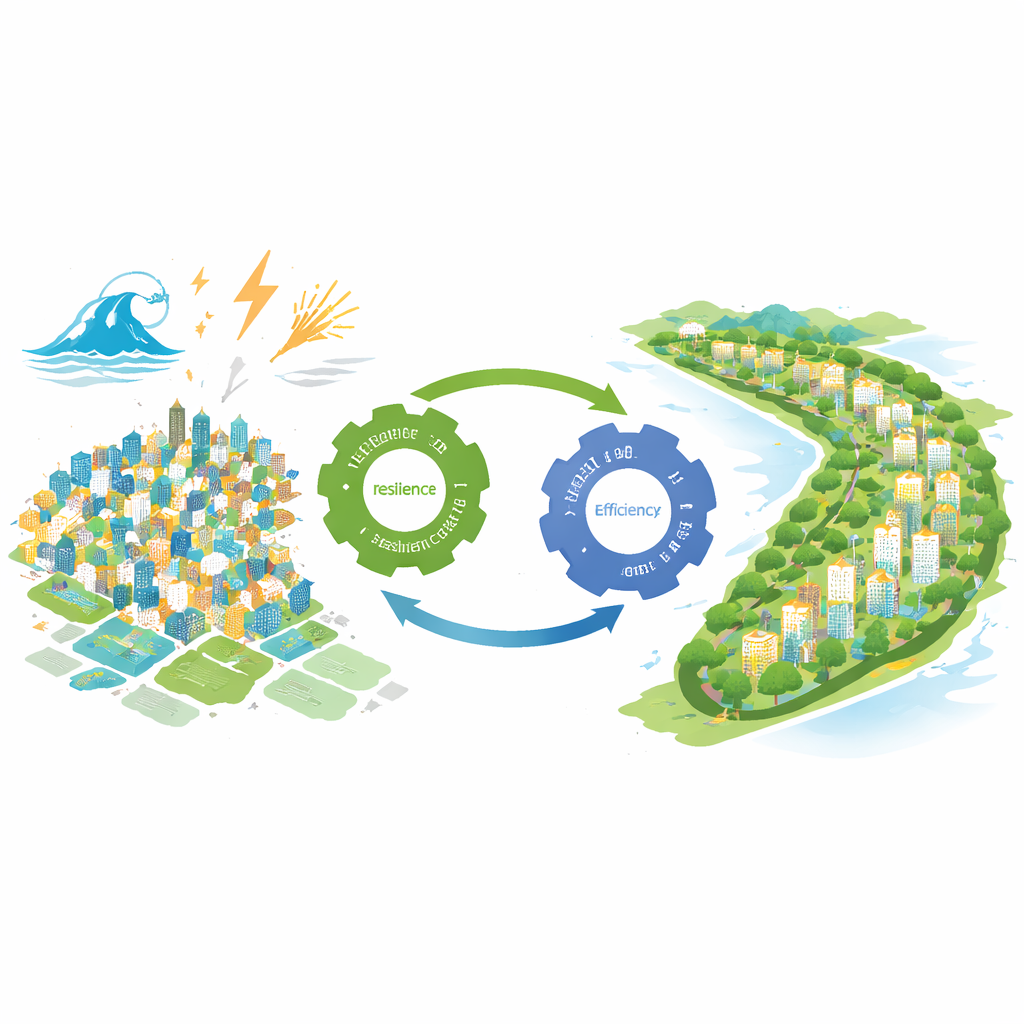
The authors look at two core ideas. “Urban resilience” is a city’s ability to keep functioning and bounce back when it faces disasters, economic downturns, or climate extremes. It depends on people’s welfare, the strength of the economy, the health of ecosystems, and the robustness of infrastructure such as roads, pipes, and communications. “Urban efficiency” describes how well a city turns labor, investment, land, and resources into jobs, income, and environmental benefits, while cutting waste and pollution. In theory, being tough and being efficient should reinforce one another—but in practice they can also clash. This paper explores how those two forces actually interact in one of the world’s densest urban regions.
Measuring the Pulse of a Mega-Region
To track these hidden qualities, the researchers built detailed scorecards for 41 cities in the Yangtze River Delta from 2010 to 2022. For resilience, they combined data on health care, education, social security, green space, habitat quality, industry balance, and infrastructure. For efficiency, they examined how each city used workers, capital, land, water, energy, and electricity to generate economic and social benefits, while limiting carbon emissions and air pollution. They then used advanced mathematical tools to roll dozens of indicators into single resilience and efficiency scores for each city and year, and a physics-inspired model to see how the two scores rise and fall together over time.
The Hidden Engine: Resilience Leads
The analysis shows that resilience acts as the main “order-setting” force in this crowded region. In simple terms, improvements in a city’s resilience tend to pull efficiency up with them, more than the other way around. Over the 12-year period, both resilience and efficiency rose overall, but they did not do so evenly. Strong clusters emerged along the powerful Shanghai–Nanjing–Hangzhou axis and nearby coastal cities. The pattern was described as “core metropolitan-driven, provincial capital-synergized”: Shanghai and a handful of large neighbors became anchors that lifted surrounding cities. Yet many inland and northern cities lagged behind, showing weaker resilience, lower efficiency, or both, and forming persistent “lowlands” in the regional landscape.
Four Pathways Cities Tend to Follow
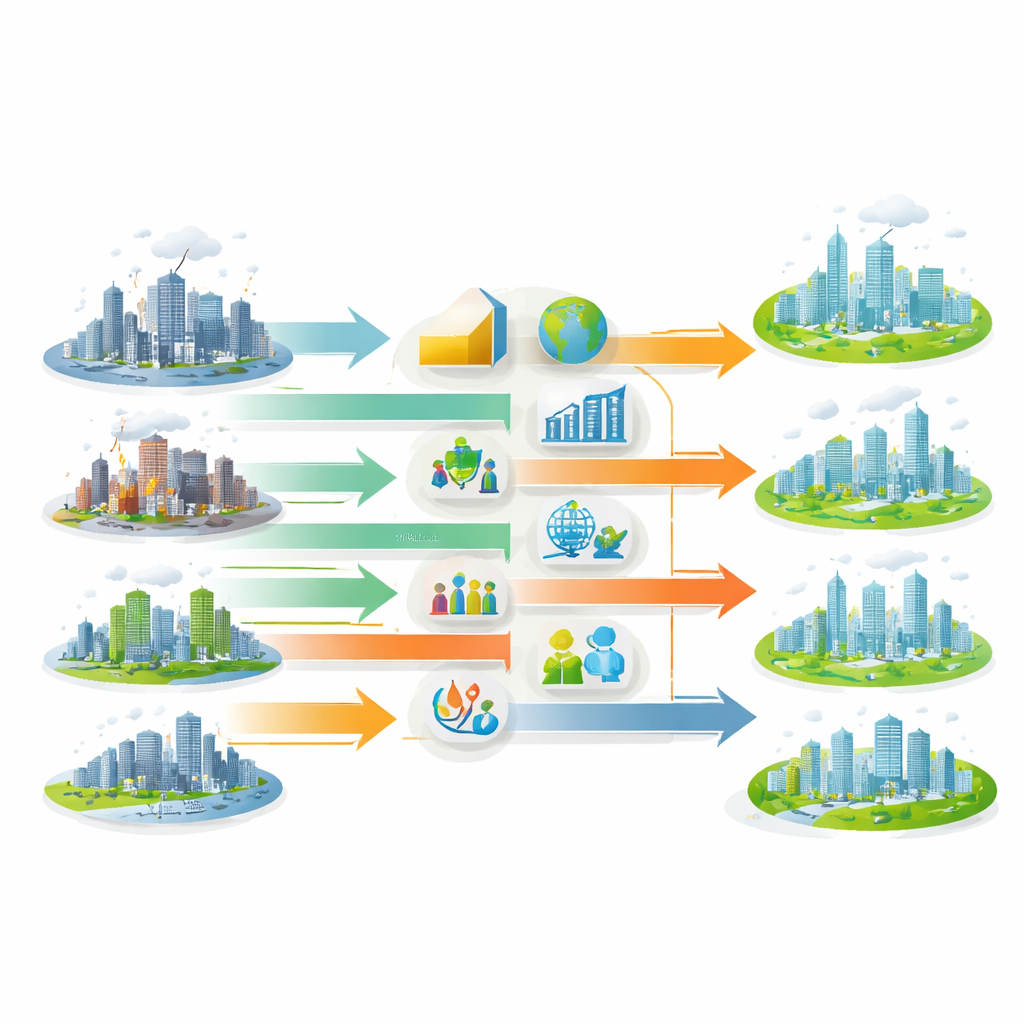
By tracing how each city’s position changed from year to year, and how it moved relative to its neighbors, the authors identified four typical transition paths. In the “industry–economy–openness-driven” pattern, cities with advanced industries, strong economies, and international links improved resilience and efficiency together and often helped nearby cities as well. In the “urbanization–economy–technology-driven” pattern, rising urban populations, income growth, and innovation helped weaker cities climb out of low-synergy states, sometimes pulled along by spillovers from stronger neighbors. On the other hand, two constraining patterns held cities back: in one, high population density and strict but costly environmental rules weighed down poorer cities; in another, in already advanced cities, very high population pressure and risky innovation sometimes undermined stability instead of supporting it.
Why History and Location Still Matter
The study highlights that once a city falls into a high or low state of resilience–efficiency balance, it tends to stay there. Many cities showed strong “path dependence” and “lock-in”: their past development choices, industrial base, and geographic position limited how easily they could shift course. Central coastal cities like Shanghai, Suzhou, Hangzhou, and Ningbo remained highly synergetic and continued to benefit from mutual reinforcement. Northern and many inland cities in Anhui province remained stuck at the bottom, with weak links to the most dynamic corridors. Only a minority of cities managed to move between patterns, suggesting that spontaneous catch-up is rare without targeted help.
What This Means for Everyday Urban Life
For non-specialists, the key takeaway is that making cities both robust and efficient is not just a matter of adding more roads or chasing faster growth. In the Yangtze River Delta, building resilience—through better public services, greener landscapes, more diverse economies, and stronger infrastructure—is the main engine that allows efficiency gains to last and spread. The authors argue that breaking old development habits and sharing the benefits of core cities more widely are essential if the region is to move from uneven, fragile growth toward a more balanced, sustainable future in which everyday life is safer, cleaner, and more prosperous across the entire mega-region.
Citation: Gao, Y., Yang, Y., Wu, B. et al. Synergistic evolution and transition mechanism of urban resilience and efficiency in the Yangtze River Delta urban agglomeration, China. Humanit Soc Sci Commun 13, 285 (2026). https://doi.org/10.1057/s41599-026-06552-1
Keywords: urban resilience, urban efficiency, Yangtze River Delta, sustainable cities, megaregions