Clear Sky Science · en
Advancing social equity and inclusion: how social work and Vision 2030 are shaping Saudi Arabia’s evolving social framework
Why this matters to everyday life
Saudi Arabia’s Vision 2030 is often described in terms of skyscrapers, new industries, and high-tech projects. But behind these headlines lies a quieter revolution: how the country treats its most vulnerable people. This article looks at whether the reforms are truly making life fairer for women, people with disabilities, low-income families, and older adults—and what role social workers play in turning big promises into real change in daily life.
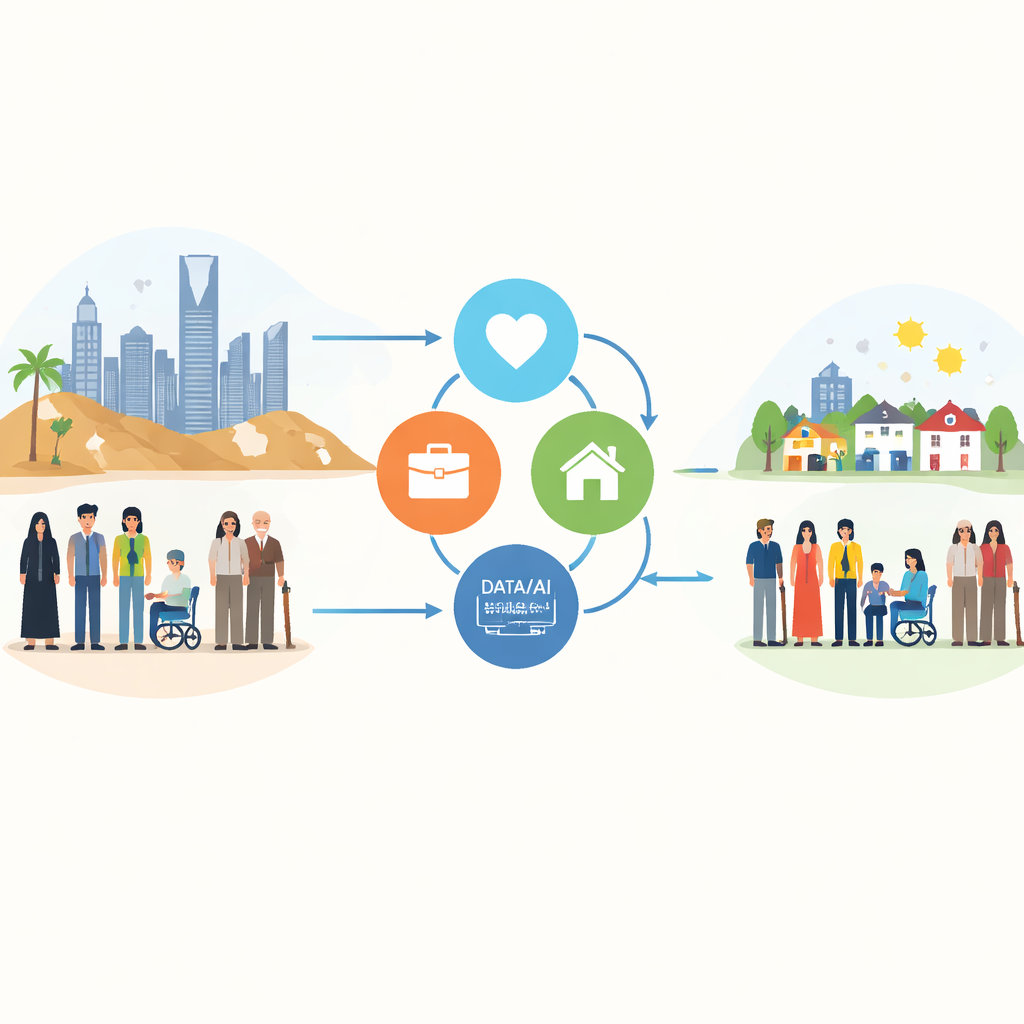
Big national plans and real people
Vision 2030 is a long-term national plan launched in 2016 to reduce reliance on oil and modernize the economy and public services. The government created major programs such as the National Transformation Program and the Quality of Life Program to translate broad goals into concrete steps in jobs, housing, health, and social protection. While many studies have focused on economic growth, this paper asks a more human question: do these reforms reduce unfair gaps in who gets support and opportunity, especially for women, people with disabilities, youth, older adults, and low-income households? To answer this, the author reviews 52 policy documents, statistics, and research papers published between 2010 and 2024.
A fresh lens on fairness
The study uses a social justice lens to judge the reforms along three simple ideas. The first is distributive justice: are money, services, and chances to get ahead shared fairly across society? The second is recognition: are marginalized groups treated with respect, free from stigma and old stereotypes? The third is participation: do ordinary people, especially those most affected, have a say in shaping policies that concern their lives? By reading official plans, program reports, and external studies through this framework, the paper moves beyond counting how many programs exist, and instead asks who benefits, how deeply, and who is still left at the margins.
New programs and stubborn gaps
The review finds that Vision 2030 has clearly pushed Saudi Arabia to expand social support. Cash-transfer schemes such as the Citizen Account Program help offset the impact of subsidy reforms on low-income families. New housing efforts, nonprofit partnerships, and unemployment insurance aim to cushion people through economic shocks. Reforms have encouraged more women to enter the workforce, supported women’s sports and entrepreneurship, and set targets for hiring people with disabilities. Transport subsidies and training programs help women and young graduates get to work and build skills. At the same time, the Saudi Data and Artificial Intelligence Authority is using data systems to better track needs and guide decisions, signaling a shift toward more evidence-based social policy.
When progress does not reach everyone
Yet the picture is far from complete. Access to new services often varies by region, income, gender, and disability status, and rural communities may still be overlooked. Many reforms tackle immediate needs—like getting more women into jobs—but only partially address deeper barriers, such as unpaid care work, transport issues, and hiring bias. Social stigma around disability, rigid gender expectations, and the limited public voice of older adults remain powerful forces. Policies mention inclusion, but practical tools to change attitudes and ensure meaningful participation of affected groups in decision-making are rare. Social workers are present in disability services, family programs, and community outreach, but their roles tend to stay at the frontline level, with little formal influence on how policies are designed, monitored, or refined.
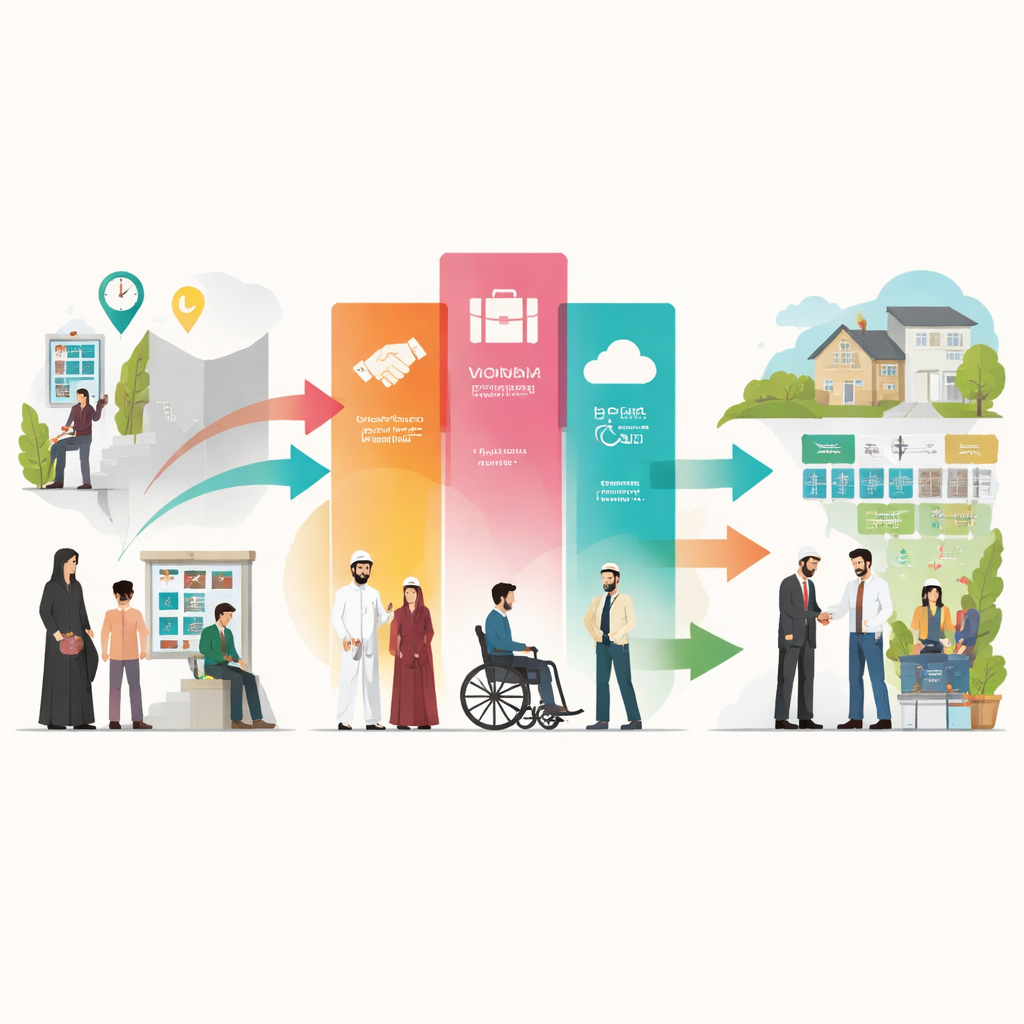
The growing importance of social work
Within this shifting landscape, the paper shows that social work in Saudi Arabia is gaining visibility but still lacks full professional recognition and clear pathways into leadership roles. Social workers help connect people to services, counsel families, and coordinate with charities and community organizations. Their training in advocacy and empowerment makes them natural allies for groups who struggle to navigate complex systems. However, weak evaluation systems, limited independent research, and a reliance on high-level indicators mean that their insights from everyday practice rarely shape national strategies. The author argues that stronger professional structures, improved data, and closer links between ministries, nonprofits, and social workers would allow frontline experience to inform long-term reforms.
What this means for a fairer future
For a lay reader, the takeaway is that Saudi Arabia’s Vision 2030 has done more than launch big construction projects; it has also created a dense web of programs meant to reduce poverty, widen access to services, and bring marginalized people into public life. The article concludes that the direction of change is promising but incomplete. Access has improved, recognition is growing, and participation is slowly emerging, yet gaps in reach, quality, and voice remain. Social workers, if more firmly embedded in policy-making and evaluation, could help turn top-down plans into grounded, lasting gains. In simple terms, the country has built a stronger toolkit for fairness—but how well that toolkit is used, and how much say ordinary people have in shaping it, will determine whether Vision 2030 truly delivers a more just and inclusive society.
Citation: Alhjaji, E. Advancing social equity and inclusion: how social work and Vision 2030 are shaping Saudi Arabia’s evolving social framework. Humanit Soc Sci Commun 13, 233 (2026). https://doi.org/10.1057/s41599-026-06550-3
Keywords: Saudi Vision 2030, social justice, social work, women and disability inclusion, Saudi social policy