Clear Sky Science · en
Does corruption undermine green manufacturing? Regional evidence from India
Why this matters for everyday life
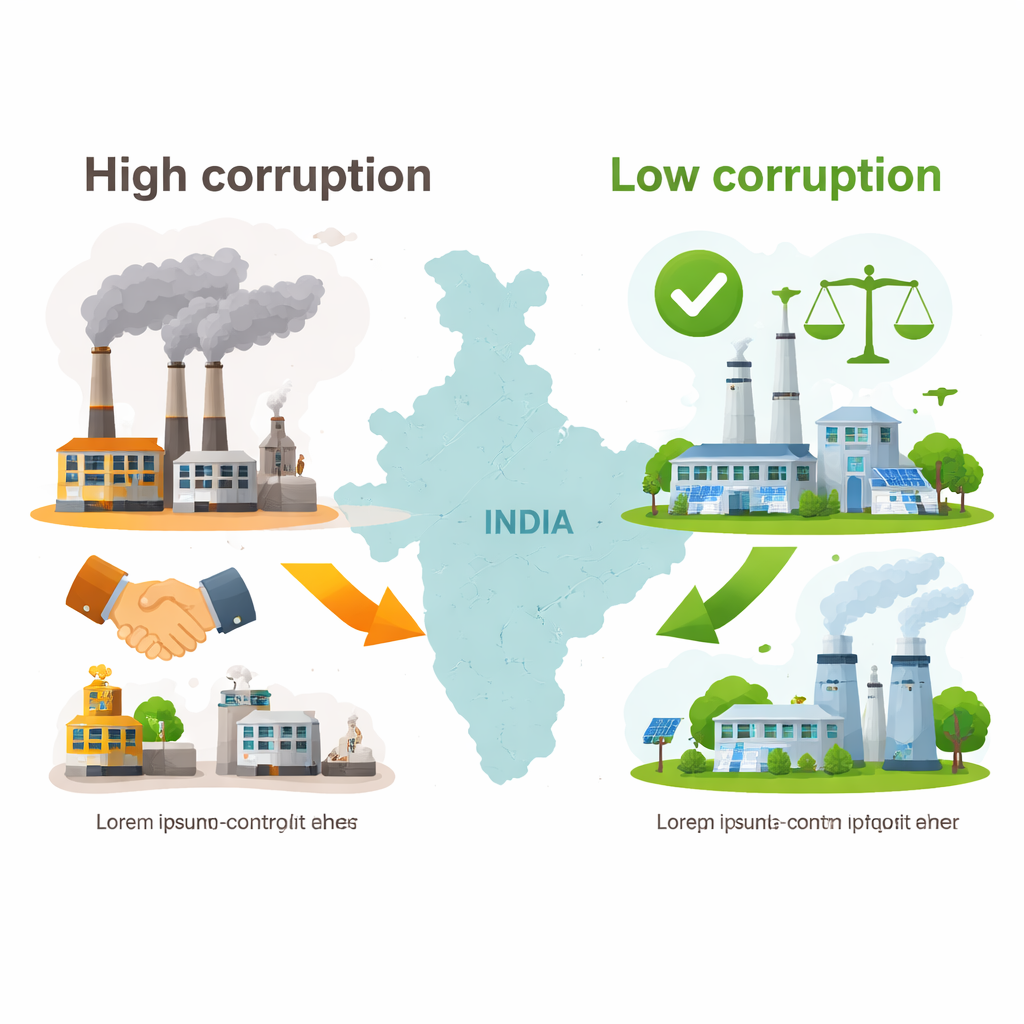
India is one of the world’s manufacturing powerhouses, and what happens inside its factories shapes the air people breathe, the water they drink, and the climate they inherit. This study asks a simple but crucial question: when local officials are corrupt, do factories cut corners on pollution control? By linking large-scale industrial data with businesses’ own reports of bribery and red tape, the authors show how corruption can quietly undermine the shift toward cleaner, greener production.
Factories, pollution, and the power of rules
Modern manufacturing can be run in cleaner ways—using filters on smokestacks, effluent treatment plants, and other pollution-control equipment—but these technologies cost money. In principle, environmental rules and inspections should push factories to make those investments. Institutional theory suggests that this only works if rules are enforced fairly. When officials can be bribed or look the other way, firms have fewer reasons to install or maintain costly equipment, and pollution tends to rise. While earlier research has linked corruption to dirtier environments across countries, there has been little direct evidence on whether corruption changes how much individual factories actually spend on anti-pollution gear, especially in a large, diverse economy like India.
Measuring hidden practices inside a vast economy
To tackle this, the authors combine two major datasets. The first is India’s Annual Survey of Industries, which records detailed information for over 47,000 factories, including how much each spends on pollution-control equipment. The second is the World Bank Enterprise Survey, where firms report their experiences with informal payments—for licenses, utility connections, customs, and tax inspections—and how strongly they see corruption as an obstacle. Using statistical techniques, the researchers turn these responses into a state-level “corruption index” that captures both the frequency of bribes and perceptions of unfair courts and officials. They then match this index to each factory based on its state, along with information on firm size, age, location, exports, environmental certifications, and whether it does research and development.
Who goes green, and who holds back
The analysis treats a factory’s behavior as a two-step choice: first, whether to invest in any pollution-control equipment at all, and second, how much to spend if it does. Across India, only about 4.5% of factories report such spending, and the share varies widely by state. Larger factories, those certified under the ISO 14000 environmental management standards, and those doing R&D are more likely to invest and to spend more when they do. Exporting firms are also more inclined to start investing, likely because they must satisfy foreign buyers and overseas regulations. Subsidies tied to production help increase the size of investments among firms that already choose to spend, especially in heavily polluting industries, suggesting that financial support can nudge plants toward more substantial upgrades.
How corruption quietly shrinks green spending
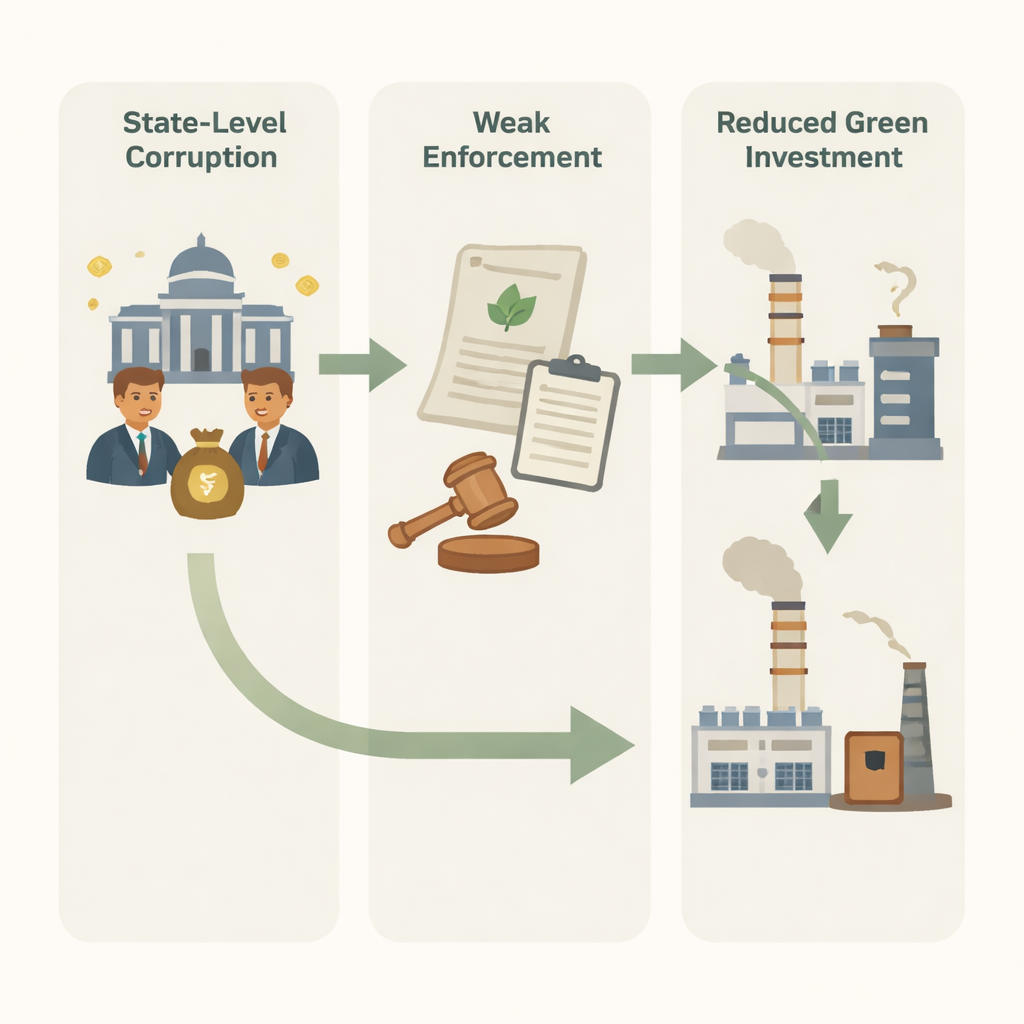
The heart of the study lies in what happens when the corruption index is brought into the picture. The authors find that factories located in more corrupt states do not differ much in whether they decide to invest at all—but once they invest, they spend noticeably less on pollution-control equipment. This pattern holds both for heavily polluting sectors, where regulations are stricter, and for cleaner industries. In high-polluting sectors, factories in highly corrupt states appear to meet formal requirements in a minimal way, likely because informal payments can substitute for real compliance. In less-polluting sectors, higher corruption even raises the chance that firms make some investment, but their actual outlays remain small, suggesting token gestures that satisfy paperwork without delivering large environmental benefits.
What this means for cleaner growth
For a non-specialist, the takeaway is straightforward: rules on paper and green labels on products are not enough. When corruption is widespread, it becomes cheaper for factories to pay bribes than to install effective filters or treatment plants, and the environment suffers. The study shows that strong, honest institutions—courts, inspectors, and regulators that cannot easily be bought—are just as important as technology or finance in making manufacturing greener. Reducing corruption, strengthening enforcement, and tying subsidies to genuine environmental performance could help ensure that India’s industrial growth comes with cleaner air and water, rather than hidden costs borne by citizens.
Citation: Vaishnavi, V., Roy, G.K. Does corruption undermine green manufacturing? Regional evidence from India. Humanit Soc Sci Commun 13, 220 (2026). https://doi.org/10.1057/s41599-026-06534-3
Keywords: corruption, green manufacturing, pollution control, India industry, environmental regulation