Clear Sky Science · en
Green microfinance: Africa’s path to resilience
Why tiny green loans matter
Across much of Africa, millions of people still struggle to get something many others take for granted: a safe glass of drinking water. At the same time, communities are on the front lines of climate change, facing droughts, floods and failing harvests. This article explores an emerging idea—green microfinance—that uses very small, targeted loans to support environmentally friendly projects. The authors ask a simple but powerful question: can these green loans help people gain reliable access to clean water while also tackling poverty, inequality and climate stress?
Small finance, big problems
Traditional microfinance has helped many low-income households start businesses or smooth out their finances, but it has often ignored environmental risks and climate shocks. Green microfinance aims to fix this by backing activities like solar pumps for water, rainwater harvesting, and climate‑resilient farming. Africa is a crucial testing ground: many people lack basic services, wealth is unevenly shared, and climate change is already reshaping lives. The study focuses on one urgent need—safe drinking water—and asks how green microfinance interacts with other forces such as economic growth, poverty, unemployment and pollution across 28 African countries from 2000 to 2023.
Following the money and the water
To trace these links, the researchers assemble data from the World Bank, the African Development Bank and national sources. They measure how many people in each country lack access to safe water, how much funding goes into green microfinance projects, and a set of social and environmental indicators: income per person, household spending, carbon emissions, renewable energy use, the poverty rate, unemployment and income inequality. Using an econometric technique suited to long‑running country data, they examine how changes in green microfinance and these other factors relate to changes in water access over time, while accounting for the fact that past infrastructure decisions strongly shape the present.
What the numbers show
The analysis confirms that access to drinking water is strongly shaped by history: countries that already struggle tend to remain stuck, because water systems are expensive, slow to build and hard to fix once neglected. Within this context, green microfinance stands out as one of the tools that can reduce the share of people without safe water. Where more funding flows into ecological, community‑level projects, fewer people are left unserved. At the same time, some familiar patterns appear. Countries with higher incomes per person generally have better water access, but unemployment and poverty make matters worse by weakening both public budgets and household finances. Where income is highly unequal, investments in shared infrastructure, like village water points and pipes, often lag behind.
Climate, energy and uneven progress
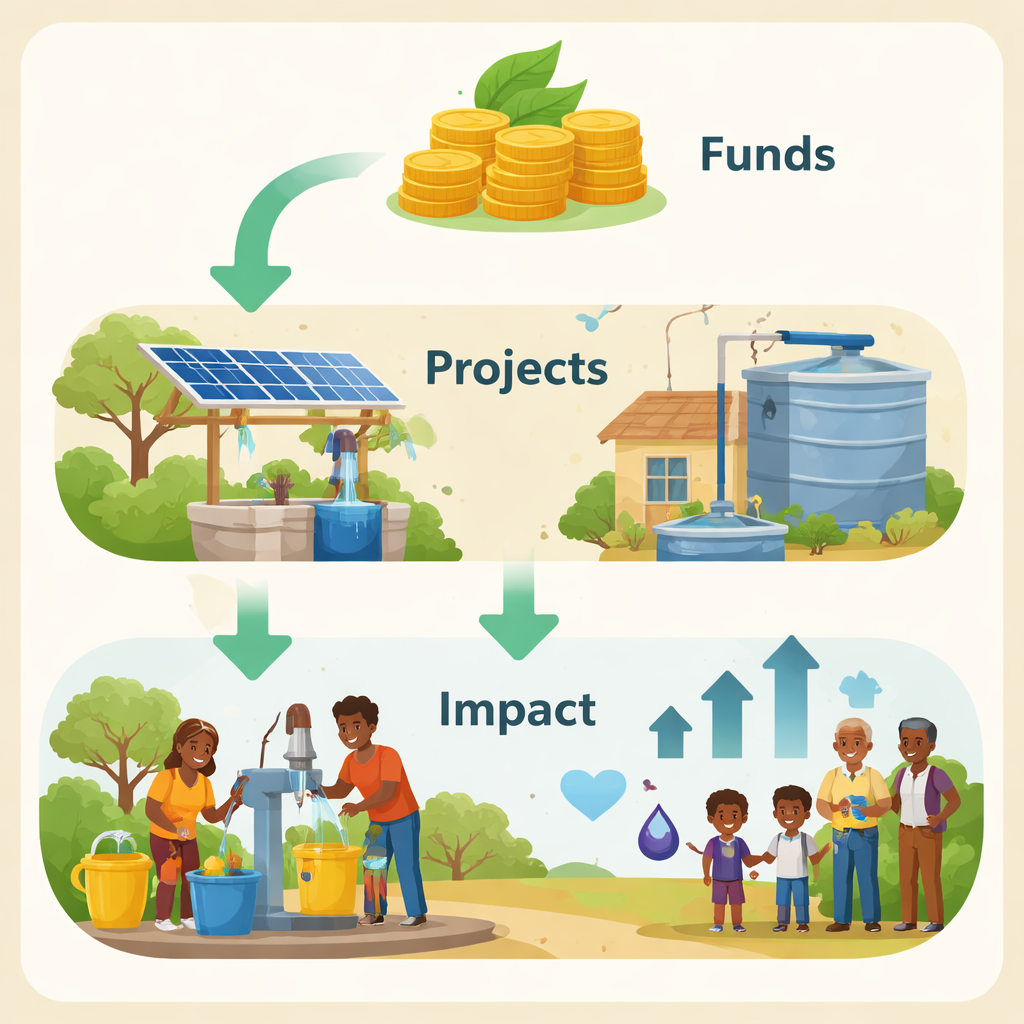
The role of climate‑related factors turns out to be more complicated. Carbon emissions and renewable energy use do not show a simple, direct effect on water access in the statistical models. In some places, the growth of renewable energy has not yet been tied closely enough to basic services, so new solar projects may power cities or industry rather than village wells. Still, case examples—such as solar‑powered pumps and rainwater systems in remote communities—suggest that cleaner energy can support better water access if projects are designed with local needs in mind. The authors argue that green microfinance can be the missing link, channeling funds into small‑scale technologies and community initiatives that combine water, energy and climate resilience.
Pathways to fairer, safer water
Looking ahead, the study proposes several practical steps to unlock this potential. These include pairing small green loans with environmental micro‑insurance to protect water projects from droughts and floods, using digital crowdfunding to attract wider support, and targeting training and finance toward women and young people, who are often central to managing household water. The overall message for non‑specialists is clear: carefully designed green microfinance cannot solve Africa’s water crisis on its own, but it can tip the balance. When combined with inclusive economic policies and smarter energy choices, small loans for green projects can help transform fragile communities into more resilient ones, bringing safe drinking water within reach for millions.
Citation: Abidi, I., Nsaibi, M. & Hussainey, K. Green microfinance: Africa’s path to resilience. Humanit Soc Sci Commun 13, 206 (2026). https://doi.org/10.1057/s41599-026-06530-7
Keywords: green microfinance, clean water access, Africa, climate resilience, inclusive finance