Clear Sky Science · en
Beyond greenery: exploring non-linear dynamics between socio-spatial integration and youth life satisfaction in community renewal
Why Young People’s Happiness in Cities Matters
As more young adults flock to cities, their daily experience of work, travel, and home life increasingly shapes whether urban areas feel welcoming or exhausting. This study looks beyond the usual focus on parks and greenery to ask a deeper question: how do the combined patterns of where services are placed, how people move, and how neighbors relate to one another affect how satisfied young residents feel with their lives? Using Suzhou, China, as a test bed, the authors show that youth happiness depends on a web of social and spatial factors that interact in complex, sometimes surprising ways.
City Life Is More Than Parks and Pretty Streets
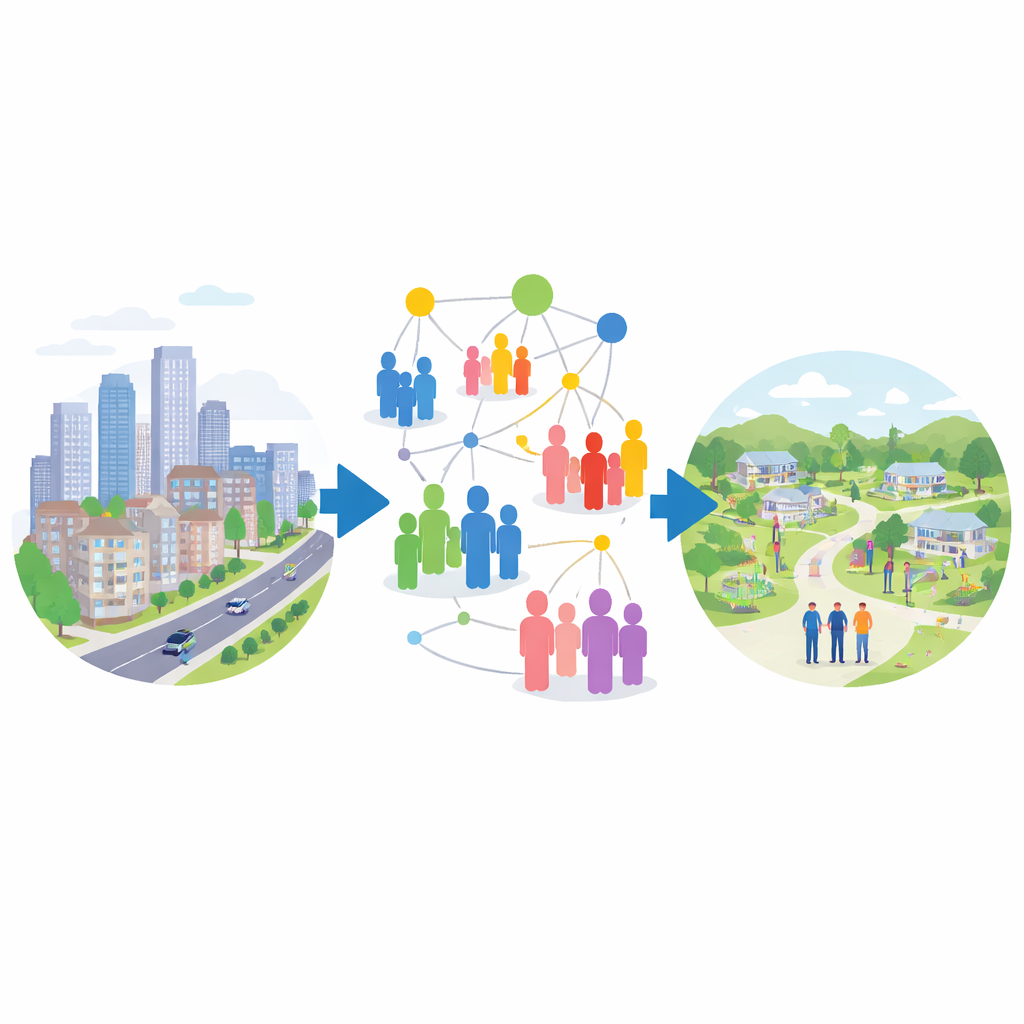
Urban renewal projects often promise better parks, nicer buildings, and upgraded streets. Yet many young people still feel left out or stressed by daily life in these “improved” neighborhoods. The authors argue that this is because renewal has tended to focus on single features, such as adding greenery, while overlooking how social ties, commuting, housing, and public services fit together. In Suzhou’s fast-changing districts, young residents face uneven access to resources, limited say in planning, and patchy community services. These pressures, the study suggests, can quietly erode life satisfaction even in areas that look attractive on the surface.
Measuring Both Feelings and the Built Environment
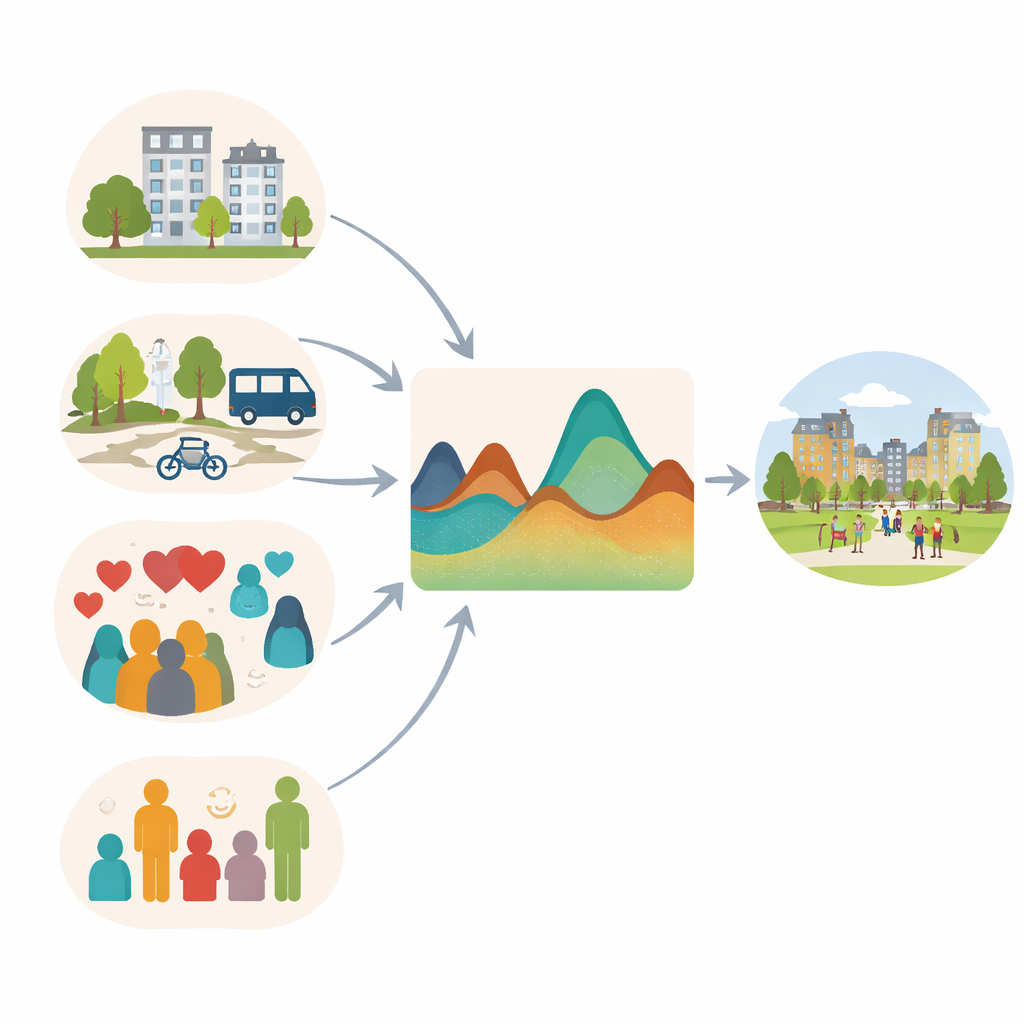
To untangle these influences, the researchers combined a large questionnaire of 1,039 young and mid-career residents (ages 18–50) with detailed maps of local services and infrastructure. They grouped influences into five broad areas: personal background (like income and education), day-to-day social interaction, feelings of safety and emotional well-being, the community environment (such as housing surroundings and nearby facilities), and the commuting environment. Instead of assuming straight-line, “more is always better” relationships, they used machine-learning models to search for tipping points and diminishing returns, and traditional statistical tools to compare self-reported perceptions with on-the-ground conditions.
Hidden Tipping Points in Health, Travel, and Services
The analysis revealed that what matters most to young residents is not simply how many facilities exist, but how these factors combine and where thresholds lie. Good physical health and psychological well-being emerged as the strongest contributors to life satisfaction, followed closely by aspects of commuting, such as travel time, transport quality, and how smooth or stressful daily journeys feel. Many features showed non-linear patterns: for example, access to schools and parks boosts satisfaction up to a point, but after basic needs are met, piling on more of the same brings shrinking benefits. In some cases, very high densities of medical or commercial facilities were linked with lower contributions to happiness, hinting at overcrowding, noise, or congestion. Even greenery did not have a simple “more is better” effect—during certain stages of renewal, disruption to green spaces appeared to temporarily depress satisfaction before improvements later paid off.
Why Feelings Can Differ from the Map
Comparing objective maps with people’s own ratings highlighted a striking gap: how residents feel often explains more of their life satisfaction than what planners can count on a map. For example, simply having many clinics nearby did not guarantee higher happiness, while people who felt physically healthy reported much greater satisfaction regardless of local facility density. Likewise, perceived transport quality and neighborhood safety showed strong benefits, even when the underlying infrastructure statistics were modest. These patterns suggest that young people’s expectations, social norms, and day-to-day experiences can either amplify or blunt the impact of physical improvements, making it risky to rely only on visible upgrades as proof that a neighborhood is thriving.
Designing Youth-Friendly Cities for the Long Run
The authors conclude that creating truly youth-friendly cities requires more than adding parks or building new housing. Effective renewal needs to balance investments in community spaces, transport, and services with policies that support health, social connection, and emotional security. Because many influences show thresholds and saturation points, the goal is to reach “enough” access and quality without oversupplying certain facilities to the point that they create new problems. The study’s approach—mixing residents’ perceptions, mapped indicators, and advanced modeling—offers city leaders a way to spot where small, well-aimed changes in social or spatial conditions could yield the biggest gains in young people’s everyday happiness.
Citation: Chen, J., Ni, H., Song, H. et al. Beyond greenery: exploring non-linear dynamics between socio-spatial integration and youth life satisfaction in community renewal. Humanit Soc Sci Commun 13, 249 (2026). https://doi.org/10.1057/s41599-026-06528-1
Keywords: youth life satisfaction, urban renewal, socio-spatial integration, commuting environment, community wellbeing