Clear Sky Science · en
From kindness to constraints: how spouses’ benevolent sexism impedes academic women in dual-career academic couples
When Help at Home Holds Women Back
Many academics are part of couples where both partners work at universities. On paper these "dual-career" couples look equal, yet women’s careers often advance more slowly than men’s. This article explores a surprisingly subtle reason why: certain kinds of seemingly caring, protective attitudes from husbands can quietly nudge academic women to scale back their ambitions, especially once children are in the picture.
Kind Words, Hidden Costs
The study focuses on what psychologists call benevolent sexism: beliefs that women are delicate, morally superior, and should be cherished and protected. These views sound positive, but they assume that men lead and women care for the home. In academic marriages, a husband who strongly holds these beliefs may insist on "shielding" his wife from stress, expecting her to take on more family duties or to follow his career moves. Over time, this can undermine her sense of independence at work and subtly signal that her research is less important than his. 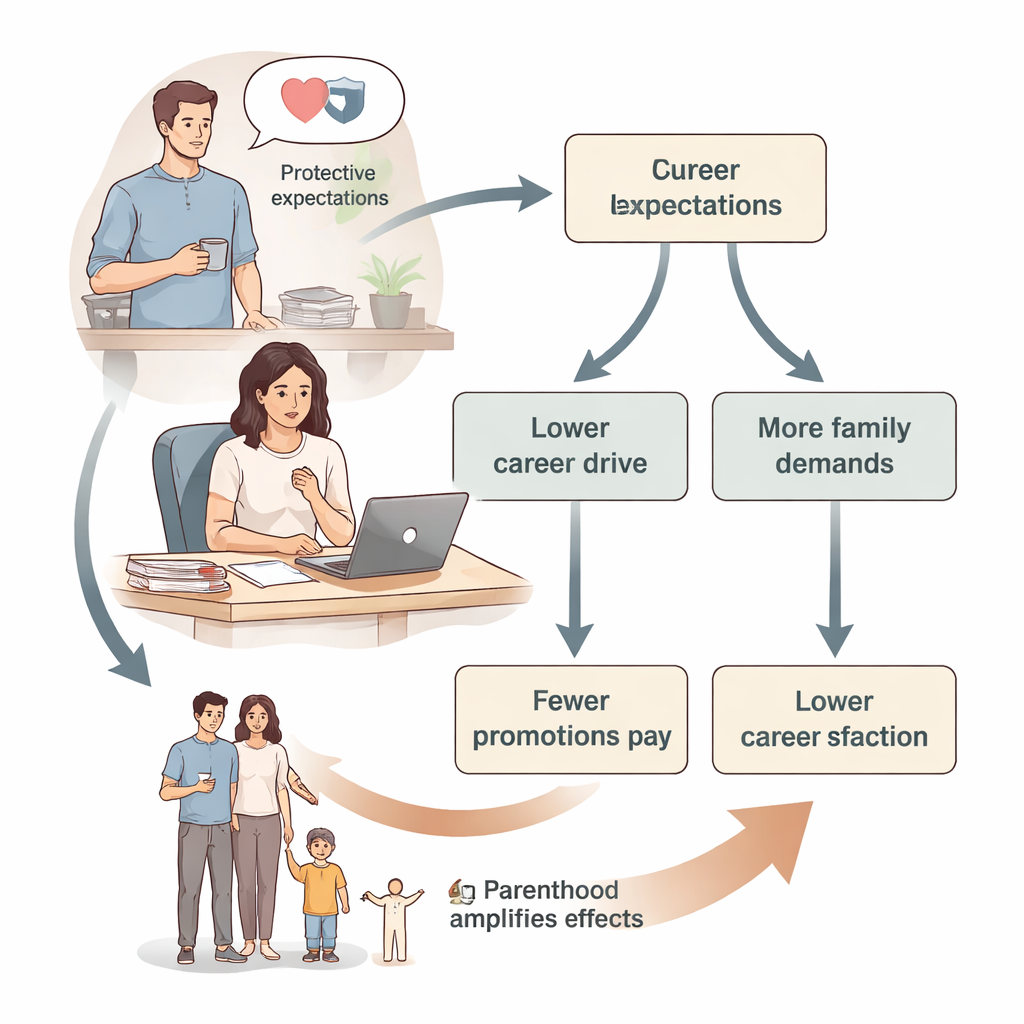
How the Study Was Done
The researcher surveyed 137 women academics in China and their spouses, all in dual-career academic couples. Over three points in time, the women reported how committed they felt to their academic careers, how much family life interfered with their work, and how successful they felt and had been compared with colleagues. Their spouses reported their level of benevolent sexist attitudes. Using a statistical method that links these pieces into one model, the study examined how a husband’s beliefs influenced his wife’s career outcomes, both in hard numbers (promotions and pay) and in her own sense of success.
Two Pathways to Holding Back Women’s Careers
The results show two main pathways through which benevolent sexism harms academic women’s careers. First, when husbands more strongly endorsed these "protective" beliefs, their wives reported lower commitment to their academic careers. Feeling less driven to invest time and energy in research and professional networking was, in turn, linked to fewer promotions and smaller income gains over the previous decade. Second, benevolent sexism was associated with greater family-to-work conflict: women in these marriages were more likely to say that family demands—housework, caregiving, emotional support—disrupted their ability to do their jobs. This constant tug-of-war between home and work reduced how satisfied they felt with their careers, even when their objective achievements looked respectable from the outside.
Why Children Intensify the Pressure
Parenthood made these patterns even stronger. For women with children, a spouse’s benevolent sexism was more strongly tied to drops in career commitment and to higher levels of family-to-work conflict. Once there are children, expectations that the mother should be the main caregiver fit neatly with the husband’s "kind" insistence that she focus on the family. This combination drains the woman’s time, energy, and sense of autonomy right when academic careers often demand long hours, travel, and uninterrupted research time. In couples without children, the negative effects were still present, but much weaker. 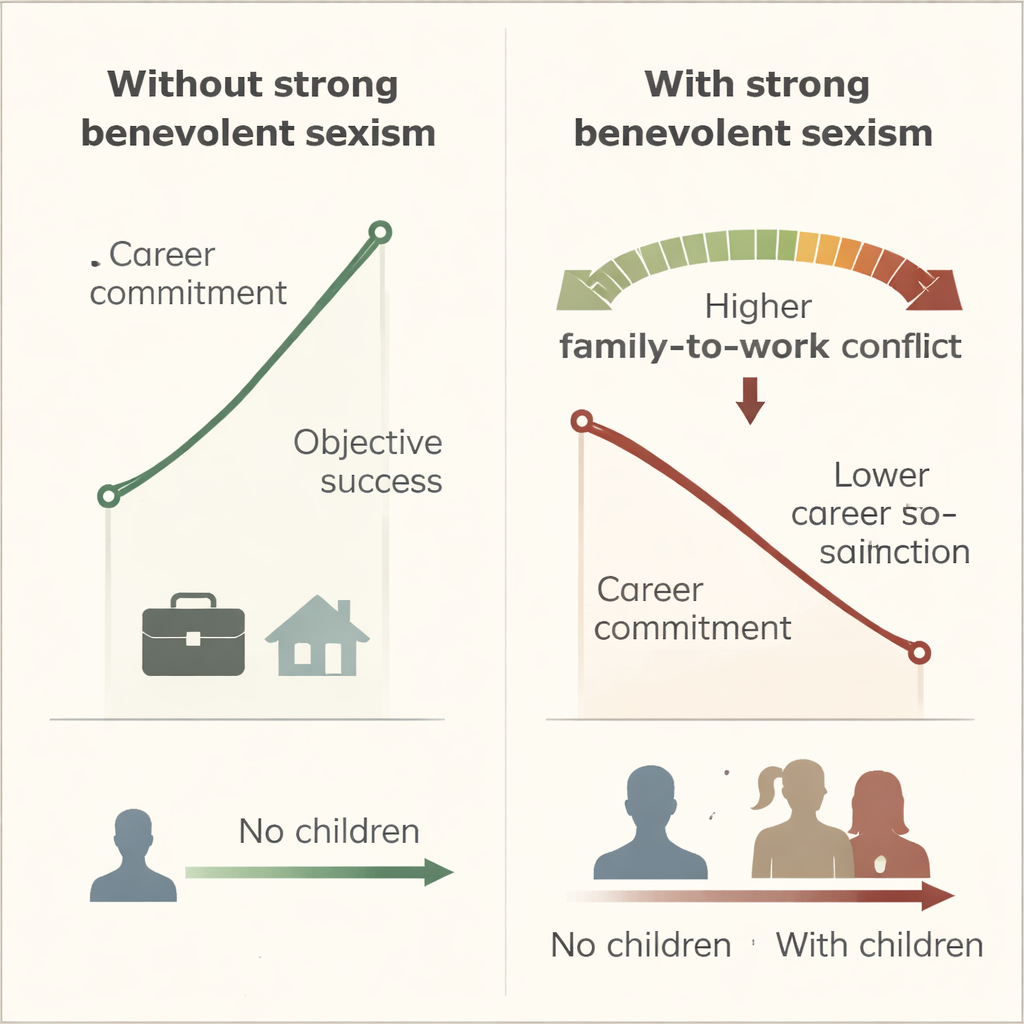
Changing Home and Work, Not Just Attitudes
To a lay reader, the central message is simple: sexism is not only about open hostility or put-downs. It can also appear as caring gestures that assume women should sacrifice their careers for family. This study shows that when those attitudes come from a spouse, they can chip away at an academic woman’s drive, slow promotions and pay growth, and make her feel less successful. These effects are especially sharp for mothers. The findings suggest that promoting gender equality in universities requires more than fair hiring and promotion policies; it also calls for challenging traditional expectations at home and building supports—like shared parental leave, flexible schedules, and childcare—that let both partners pursue their careers on equal footing.
Citation: Dong, J. From kindness to constraints: how spouses’ benevolent sexism impedes academic women in dual-career academic couples. Humanit Soc Sci Commun 13, 210 (2026). https://doi.org/10.1057/s41599-026-06527-2
Keywords: gender inequality, academic careers, benevolent sexism, work–family balance, dual-career couples