Clear Sky Science · en
The pro-environmental implications of job insecurity: the significant role of prosocial motivation
Why Job Worries Matter for the Planet
Most of us know we should recycle, save energy, and cut waste at work—but what happens to these good habits when people fear losing their jobs? This study looks at a simple but powerful question: do worries about job security make employees less likely to act in environmentally friendly ways at work, and why do some people keep helping the planet even in tough times? By following hundreds of workers in South Korea over several months, the researchers show that our sense of safety at work, our emotional bond with our employer, and our desire to help others all shape whether we keep up green actions on the job.
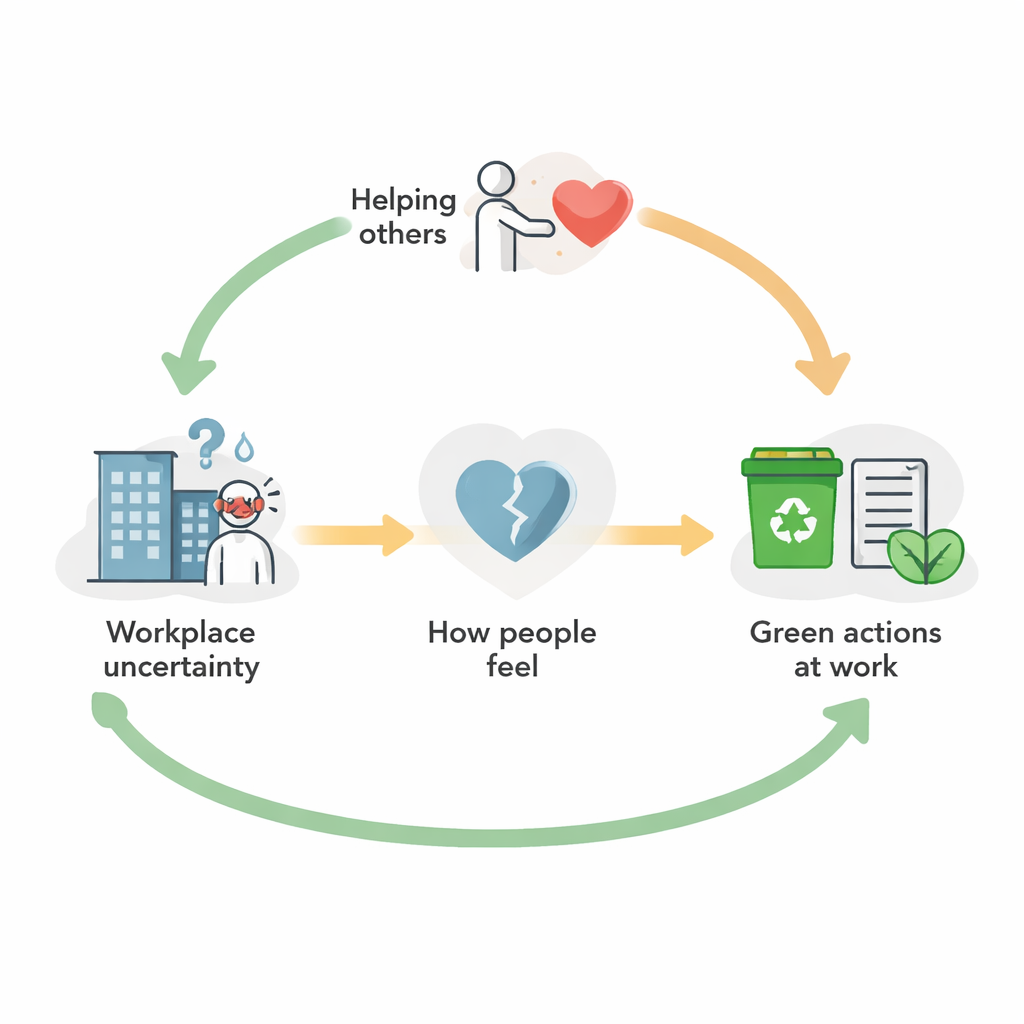
From Job Anxiety to Everyday Green Habits
Modern workplaces are under constant pressure from economic swings, new technologies, and environmental demands. These changes often leave employees feeling unsure about how long their jobs will last. At the same time, organizations ask workers to go beyond their formal duties by turning off unused lights, recycling office supplies, and cutting waste—behaviors known as pro-environmental behavior at work. These eco-friendly actions are usually voluntary; people are not punished for skipping them. That makes them especially sensitive to how secure, supported, and connected employees feel in their jobs.
Emotional Bonds as the Missing Link
The researchers drew on two well-known ideas from psychology. One says people try to protect their limited personal resources, such as energy and emotional strength; the other says work relationships are built on give-and-take. When employees feel their jobs are at risk, they sense that an important resource—steady employment—is under threat. In response, they may pull back their emotional investment in the organization. This weakened attachment is called lower affective commitment. Instead of seeing the company as “my place” and its problems as “my problems,” people become more distant. The study found that job insecurity did not directly make employees greener or less green. Instead, it chipped away at this emotional bond, and that drop in attachment, in turn, made people less willing to put extra effort into green actions.
Why Some People Keep Helping Anyway
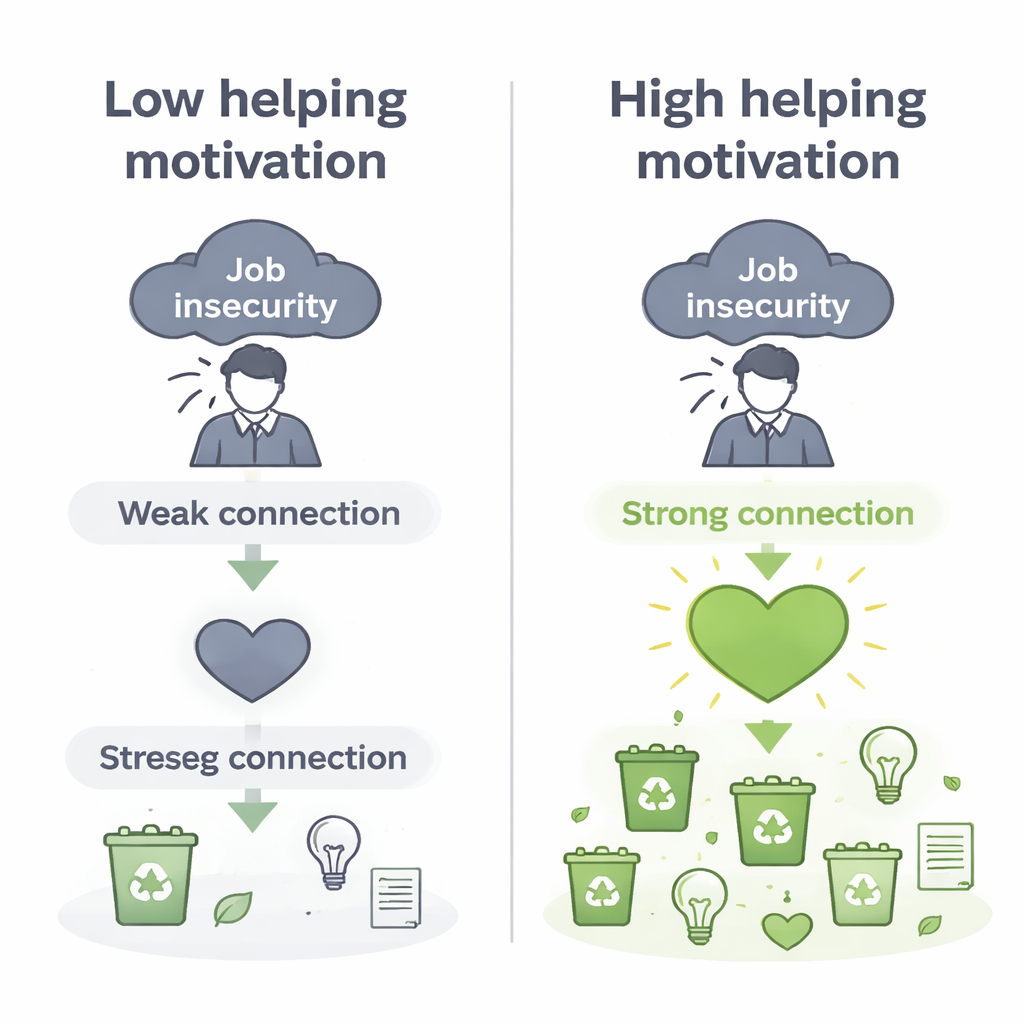
Not everyone reacted to job insecurity in the same way. A key difference was prosocial motivation—the natural desire to help others and contribute to the greater good. Workers high in prosocial motivation are energized by knowing their actions benefit coworkers, customers, or society. In this study, these employees proved more resilient. Even when they felt their jobs might be in danger, their emotional connection to the organization held up much better. For them, the meaning they drew from helping others and supporting a broader cause softened the blow of job worries. As a result, their willingness to carry out green behaviors—recycling, saving resources, and thinking about environmental impacts—remained relatively strong compared with those who were less driven by helping motives.
How the Study Was Carried Out
To untangle these relationships, the researchers surveyed 231 employees from many industries and company sizes in South Korea, using three separate waves of questions over several weeks. First, they measured job insecurity and prosocial motivation. Weeks later, they measured how emotionally attached employees felt to their organizations. After another interval, they asked about everyday green behaviors at work. This time-lagged design helped the team track how earlier feelings and motivations shaped later actions. Using statistical models, they showed that job insecurity consistently predicted lower emotional attachment, that stronger attachment predicted more green behavior, and that the indirect, chain-like effect from job insecurity to green behavior passed through this emotional bond. They also confirmed that high prosocial motivation softened, and sometimes nearly erased, the link between job fears and weakened commitment.
What This Means for Workers and Employers
For a general reader, the message is clear: being worried about your job does not automatically turn you into someone who cares less about the environment. Instead, job fears tend to erode how connected you feel to your workplace, and that loss of connection makes optional green habits easier to drop. People who are strongly motivated to help others are better able to stay committed and keep up their eco-friendly actions, even when the future feels shaky. For organizations, this means that protecting or at least honestly managing employees’ sense of security, strengthening their emotional ties to the company, and fostering a culture of helping and purpose can all help keep green efforts alive during uncertain times—supporting both employee well-being and the health of the planet.
Citation: Kim, BJ., Sohn, H. & Kim, MJ. The pro-environmental implications of job insecurity: the significant role of prosocial motivation. Humanit Soc Sci Commun 13, 202 (2026). https://doi.org/10.1057/s41599-026-06526-3
Keywords: job insecurity, workplace sustainability, pro-environmental behavior, prosocial motivation, employee commitment