Clear Sky Science · en
Enabling Agri Energy Justice: Incorporating agricultural and energy justice into utility-scale onshore wind development on agricultural land
Why Wind Farms and Farms Need Each Other
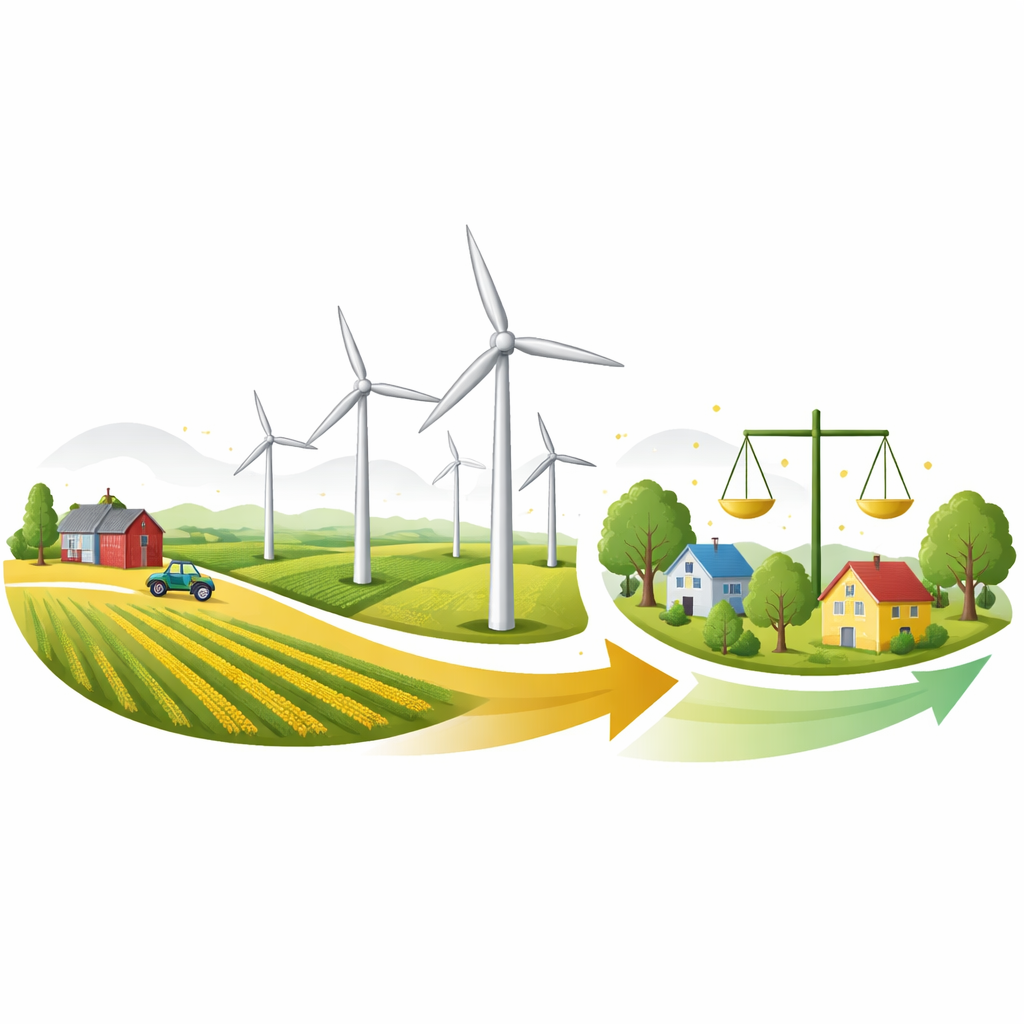
As countries race to cut climate pollution, wide open farmland is increasingly eyed as the perfect place for large wind turbines. But these landscapes are also the backbone of food production and rural livelihoods. This article explores how big wind projects and agriculture can share the same ground fairly, so that farmers, rural communities, and the climate all benefit rather than compete. It introduces a new way of thinking about justice in energy projects that puts farming interests at the center instead of treating them as an afterthought.
Balancing Clean Power and Food Production
The study focuses on the Australian state of Victoria, where powerful winds sweep across rich grain-growing regions. Because these areas already have good access to power lines, they are prime locations for utility-scale wind farms. Yet the same land underpins local economies and food exports. The authors argue that if wind projects ignore farming needs, they risk sparking social conflict, slowing the clean energy transition, and undermining trust in government. They therefore ask: under what conditions can turbines and tractors operate side by side in ways that feel fair to the people who live on and work the land?
A New Lens: Agri Energy Justice
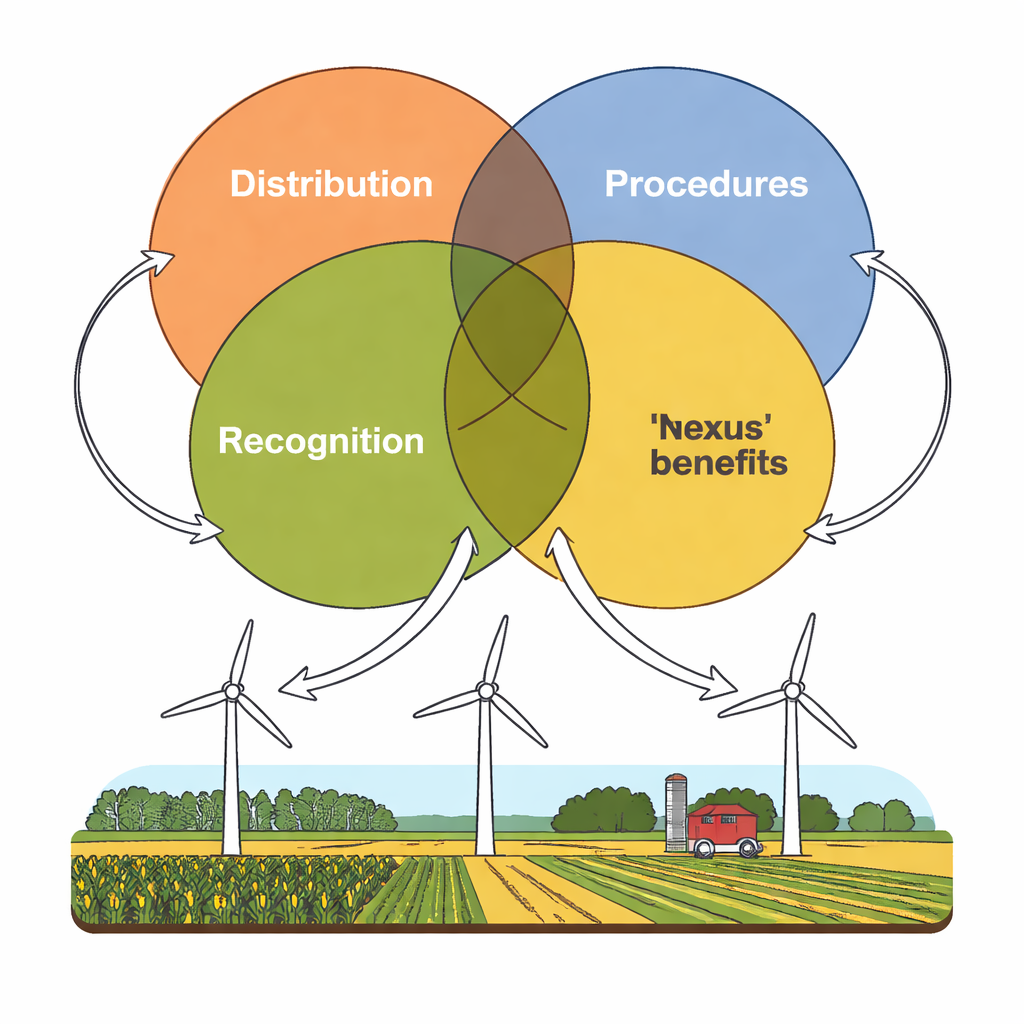
To answer this, the authors propose an Agri Energy Justice (AEJ) framework. It builds on existing ideas of energy justice, which look at who gains and who loses from energy projects, who gets a say, and whose needs are recognized. AEJ keeps these three elements—fair distribution of benefits and burdens, fair procedures, and recognition of different groups—but adds a fourth pillar called “nexus justice.” This new pillar focuses on the tight link between energy and agriculture: how wind projects can directly support or harm farming, soil health, biodiversity, and rural business models. Instead of treating energy and food as separate policy problems, the AEJ approach insists they must be planned together.
Listening to the People on the Ground
The framework is grounded in interviews with 12 experts and stakeholders in the Wimmera Southern Mallee region, one of Victoria’s key grain belts and a hotspot for new wind proposals. Interviewees included farmers, wind developers, and government or regional officials. Many farmers reported feeling in the dark about turbine locations, contract terms, and long‑term impacts on their businesses. They worried about soil damage from heavy machinery, disruption during construction, and who would pay to remove aging turbines decades from now. Others saw major opportunities: new income streams, better resilience to climate and market shocks, and a chance to showcase sustainable production to export buyers—if the rules were fair and information was transparent.
From Tension to Shared Benefits
Using AEJ as a guide, the authors identify several reforms that could turn tension into collaboration. Under the “distributive” pillar, they highlight community ownership models, such as cooperatives or local investment stakes, so rural residents share in long-term profits rather than only hosting infrastructure. Under “procedural” justice, they call for clearer planning rules on decommissioning, recycling, and repowering turbines, backed by financial guarantees so farmers are not left with stranded hardware. For “recognition” justice, they recommend mandatory agricultural impact assessments and farm access codes that respect cropping cycles, biosecurity, and local road networks. Finally, under “nexus” justice, they propose aligning wind auctions and incentive schemes with measurable gains for agriculture—such as biodiversity improvements, sustainability metrics that add value to farm products, and support services that help farmers negotiate and plan.
What This Means for the Future of Rural Energy
In plain terms, the article concludes that wind farms on farmland can be a win–win only if justice for agricultural communities is designed into laws and contracts from the start. The AEJ framework offers policymakers a practical checklist: do projects share benefits fairly, give locals a real voice, respect the realities of farming life, and actively strengthen both food and energy systems together? If the answer is yes across all four pillars, wind development is more likely to proceed smoothly, with fewer disputes and stronger rural economies. If not, the transition to clean power may stall on the very fields it hopes to use. The authors suggest that this farmer‑focused justice approach could guide not only wind farms, but also future climate solutions that reshape how land is used worldwide.
Citation: Taylor, M., Sounness, C. Enabling Agri Energy Justice: Incorporating agricultural and energy justice into utility-scale onshore wind development on agricultural land. Humanit Soc Sci Commun 13, 231 (2026). https://doi.org/10.1057/s41599-026-06522-7
Keywords: onshore wind, agricultural land, energy justice, rural communities, renewable energy policy