Clear Sky Science · en
Contract farming and hog farmers’ income: evidence from a microsurvey in rural China
Why pig contracts matter for kitchen tables
When you buy pork in a supermarket, it’s easy to forget the complex journey from farm to table. In China, where pork is a staple food, a quiet revolution is reshaping how pigs are raised: more and more farmers now work under formal contracts with large companies. This article looks at whether those contracts actually help farm families earn a better living, and what that means for food prices, rural inequality, and the stability of a meat supply that feeds hundreds of millions of people.
From handshake deals to written promises
Traditional small pig farms buy their own piglets and feed, manage disease risks on their own, and then sell finished pigs into a volatile market. Contract farming changes this picture. Under these agreements, companies inspect and approve the farmer’s pig houses, then supply piglets, feed, medicines, and technical guidance. Farmers focus mainly on fattening pigs according to strict rules, while the company promises to buy the animals at a price that blends a guaranteed base with a market-linked premium. In return, the company takes on most of the price risk, and the farmer accepts detailed oversight of daily routines, hygiene, and waste treatment. 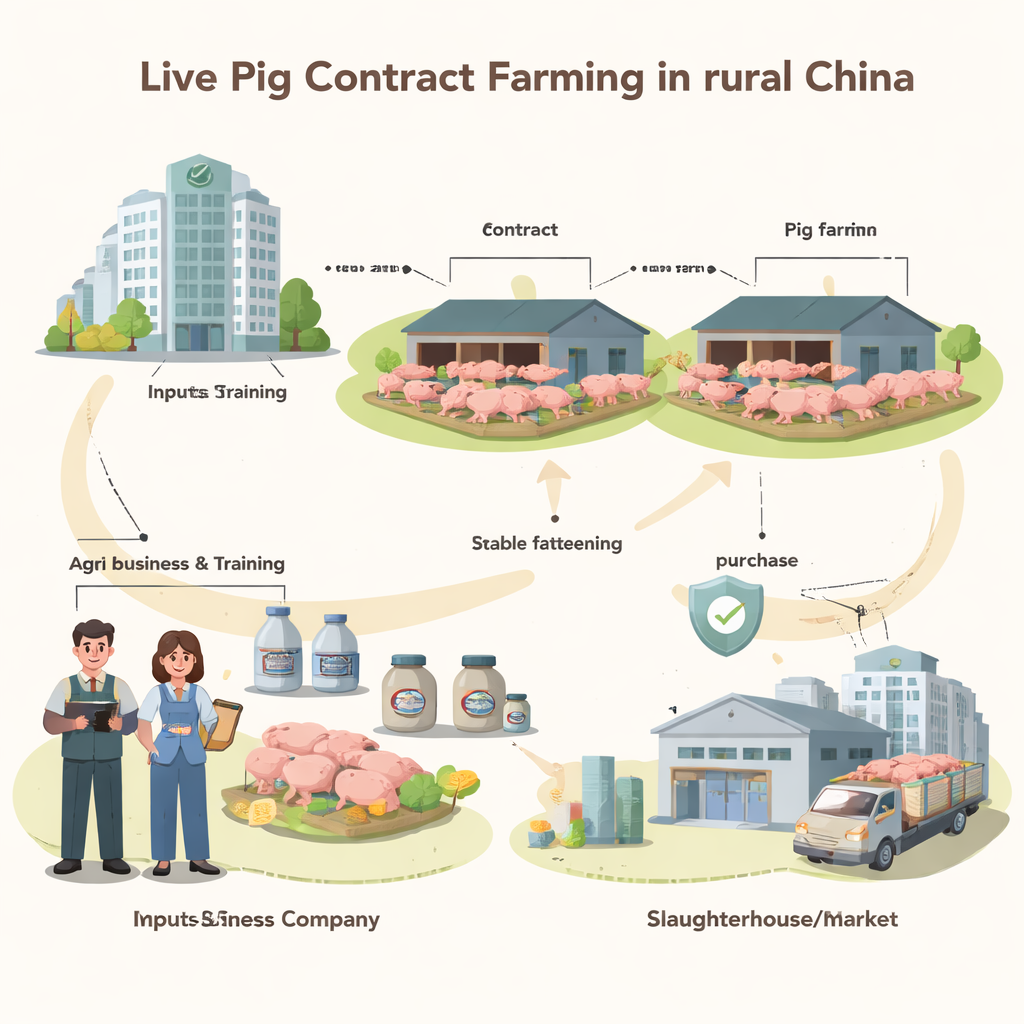
How contracts can raise or lower farm earnings
To understand income effects, the authors surveyed 969 pig farmers in Jiangsu Province between 2020 and 2022, a period marked by disease threats such as African swine fever and big swings in pork prices. About one in five farmers in the sample used contracts. Simply comparing averages showed that contract farmers earned much more than independent farmers, but this could be misleading: farmers decide for themselves whether to sign a contract, and those choices are shaped by age, education, risk attitudes, and past experience. To tease apart cause and effect, the study used an econometric approach that builds a “what if” world, estimating what each farmer would likely have earned had they made the opposite choice about contracts.
The engines behind higher income
The analysis shows that, overall, contracts substantially increase the typical pig farmer’s income. Several mechanisms explain why. First, contracts encourage a clear division of labor. Companies handle breeding, complex disease control, and marketing, while farmers specialize in the fattening stage using an “all in, all out” system—raising pigs in uniform batches, then fully cleaning and disinfecting barns between cycles. This specialization lowers production costs by improving feed use and reducing pig deaths. Second, contracts make it easier for farmers to adopt smart technologies such as automated feeders and climate-control systems, which monitor pig health and barn conditions in real time. These tools cut labor and feed waste, raising output per animal. Third, contracts ease financing bottlenecks. Because companies often extend inputs on credit and set common technical standards, farmers send a positive signal to banks and can more easily obtain loans, allowing them to run larger, more modern operations.
Who gains most – and who may lose out
The benefits of contract farming are not evenly spread. When the authors looked across the income spectrum using a method that focuses on different “slices” of the distribution, they found that low- and middle-income farmers tend to gain significantly from contracts. For these households, the extra support, reduced market risk, and access to technology clearly translate into higher earnings. But at the top end of the income range, contracts can actually reduce profits. Better-off farmers often already have strong management skills, capital, and market connections. For them, the extra transaction costs of negotiating, complying with, and being monitored under a contract can outweigh the advantages of specialization and risk sharing. Interestingly, interviews suggest some wealthier farmers still choose contracts to secure stable buyers and timely payment, prioritizing predictability over maximum profit. 
What this means for farmers and consumers
For a general reader, the bottom line is that contract farming can be a powerful tool for lifting many smaller pig farmers’ incomes while supporting a more reliable pork supply, especially in the face of disease outbreaks and price shocks. By helping ordinary farmers work more efficiently, adopt modern tools, and tap new sources of credit, contracts can reduce income gaps at the lower end of the rural economy. At the same time, the study warns that a one-size-fits-all model may not suit larger, more advanced farms, and that designing fair, transparent contracts remains crucial. Done well, these arrangements can support both the farmers who raise pigs and the urban families who depend on pork as an everyday source of protein.
Citation: Bai, X., Xu, R., Hu, H. et al. Contract farming and hog farmers’ income: evidence from a microsurvey in rural China. Humanit Soc Sci Commun 13, 208 (2026). https://doi.org/10.1057/s41599-026-06515-6
Keywords: contract farming, pig production, rural income, China agriculture, livestock economics