Clear Sky Science · en
Granting permits to carbon emissions: does the new production factor place a greater burden on capital or labor?
Why carbon permits matter for people’s paychecks
As countries race to cut greenhouse gas emissions, governments are turning pollution into something you must buy the right to produce. These tradable carbon emission permits are usually discussed as a climate tool, but they also change how the economic pie is divided between workers and owners of capital. This paper asks a deceptively simple question with big social implications: when carbon becomes a priced and limited resource, who ultimately bears the economic burden—labor or capital—and how does that shape household welfare?

A new ingredient in the production recipe
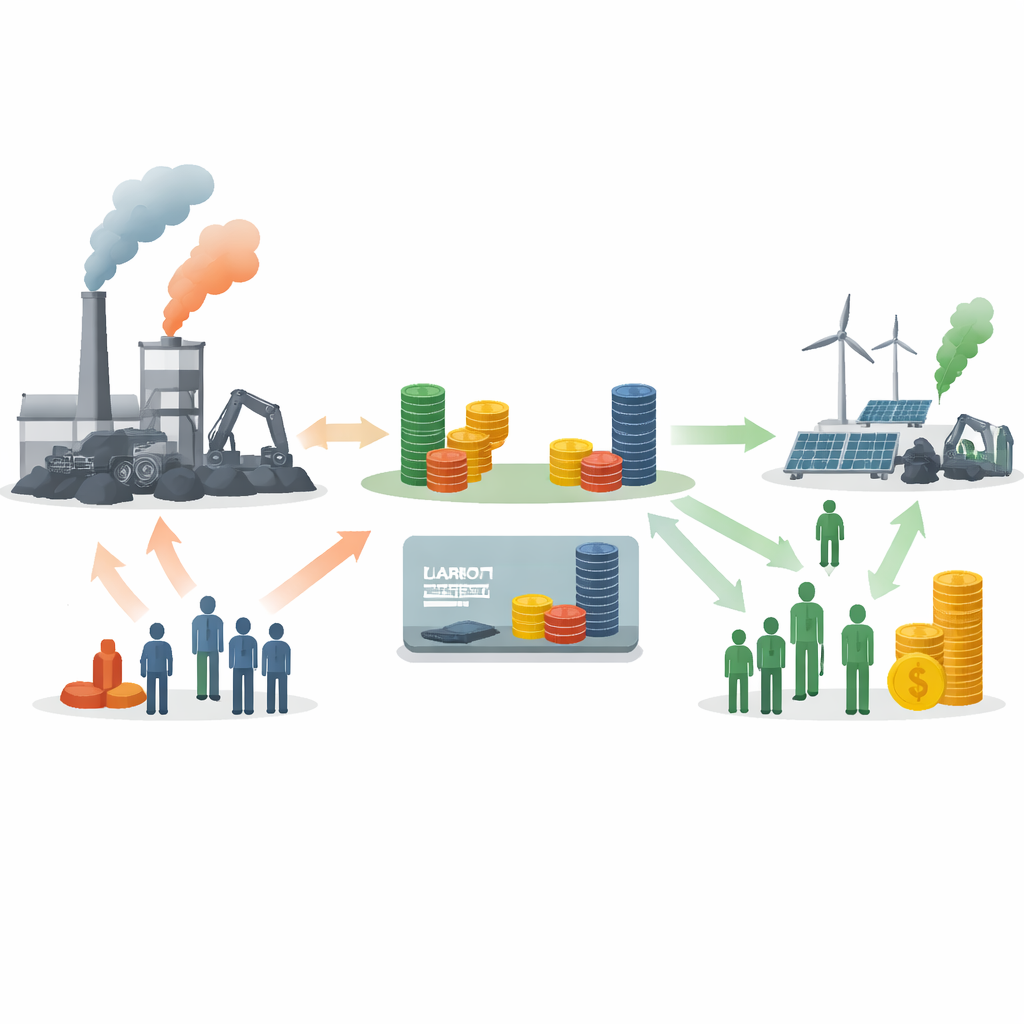
The authors treat carbon emission permits as a new factor of production, alongside the familiar duo of capital and labor. Any factory in a high‑emission industry—such as power generation, steel, or cement—must now combine machines, workers, and carbon permits to produce output. Because the total number of permits is capped to meet climate targets, they become a scarce resource that firms must either hold or buy. In a two‑sector economic model, one sector produces high‑carbon goods using all three inputs, while the other produces low‑carbon goods using only capital and labor. This setup allows the researchers to trace how limits on permits ripple through firms’ choices of technology, hiring, and investment.
Two ways carbon markets reshape the burden
Within this framework, the impact of carbon constraints on income distribution between labor and capital breaks into two channels. The first is a substitution effect: when permits become more expensive or scarce, firms try to replace them with other inputs that can play a similar role in cutting emissions—such as cleaner equipment or more labor‑intensive processes. If labor is easier to substitute for carbon‑heavy energy than capital is, then workers become relatively more valuable and their share of income rises. The second is an output effect: tighter caps shrink high‑carbon industries and expand cleaner ones. Because heavy emitters are typically more capital‑intensive, their contraction tends to hurt capital incomes more than wages, while the growth of relatively labor‑intensive low‑carbon sectors pulls in workers.
Different policy designs, different twists
Not all carbon markets operate the same way, and these design choices matter for who gains and who loses. Under a mass‑based scheme, regulators fix the total number of permits in advance, directly capping emissions. Under a rate‑based scheme, firms receive permits in proportion to their output, based on an emissions‑per‑unit‑of‑production benchmark. The model shows that with mass‑based caps, the output effect usually burdens the factor used more heavily in high‑carbon sectors—most often capital. With rate‑based rules, however, the link between permits and output can work like an implicit subsidy for expanding cleaner production, sometimes softening or even reversing that burden. In both systems, the balance between substitution and output effects depends on technical details such as how easily capital and labor can replace carbon‑intensive inputs, and how strongly consumers shift demand from dirty to clean goods when relative prices change.
What the numbers say for China
To move beyond theory, the authors calibrate their model to detailed data from China, the world’s largest carbon emitter and a country with a vast labor force. They classify electricity, heavy manufacturing, and transport as the high‑carbon sector and all other industries as low‑carbon. Using official statistics on factor income shares and estimates of how easily different inputs can be substituted, they simulate China’s emissions trading schemes under several policy scenarios extending from 2030 to 2060. Across both mass‑based and rate‑based designs, the model consistently finds that carbon trading raises labor’s share of income while lowering capital’s share, with the rate‑based system amplifying this shift. In the most ambitious low‑carbon scenario for 2060, labor income is equivalent to about a 30% increase compared with 2030, while capital income falls by roughly one‑third.
Implications for households and inequality
Because wages dominate the income of poorer and middle‑income households, while capital income looms larger for the rich, these shifts play out unevenly across the population. Linking their model’s factor‑income results to data from the China Family Panel Studies, the authors estimate how household welfare changes relative to consumption. They find that emissions trading raises welfare for all income groups but benefits lower‑ and middle‑income households the most, especially under rate‑based allocation. In other words, a well‑designed carbon market can simultaneously cut emissions, support workers’ share of national income, and modestly narrow inequality.
What this means for climate policy and the future of work
For a lay observer, the key takeaway is that carbon permits are not just an abstract climate instrument; they reshape the basic bargain between labor and capital. When carbon rights are scarce and tradable, firms adjust by favoring cleaner technologies and, under realistic conditions, relying relatively more on workers than on machines in carbon‑intensive sectors. In China’s case, this makes the “slice of the pie” going to labor larger and boosts the welfare of ordinary households, particularly in the middle of the income distribution. While the study uses a simplified model and a closed‑economy setting, its central message is clear: with careful design, carbon markets can help tackle climate change without sacrificing—and may even enhance—economic fairness.
Citation: Yu, F., Ye, B., Xiao, D. et al. Granting permits to carbon emissions: does the new production factor place a greater burden on capital or labor?. Humanit Soc Sci Commun 13, 260 (2026). https://doi.org/10.1057/s41599-026-06512-9
Keywords: carbon emissions trading, labor income share, capital and labor, climate policy, China carbon market