Clear Sky Science · en
The effect of injury risk on players value: evidence from the main European Leagues
Why injuries matter beyond the pitch
For most fans, a football injury is frustrating because it keeps a favorite player off the field. But for professional clubs, injuries are also a major financial risk. This study looks at how likely players are to suffer serious injuries and how that risk changes what they are worth on the transfer market. Using data from the main European leagues over 15 seasons, the authors show that injury risk is not just a medical problem—it is a core driver of the economic value of modern football squads.
The hidden cost of time on the sidelines
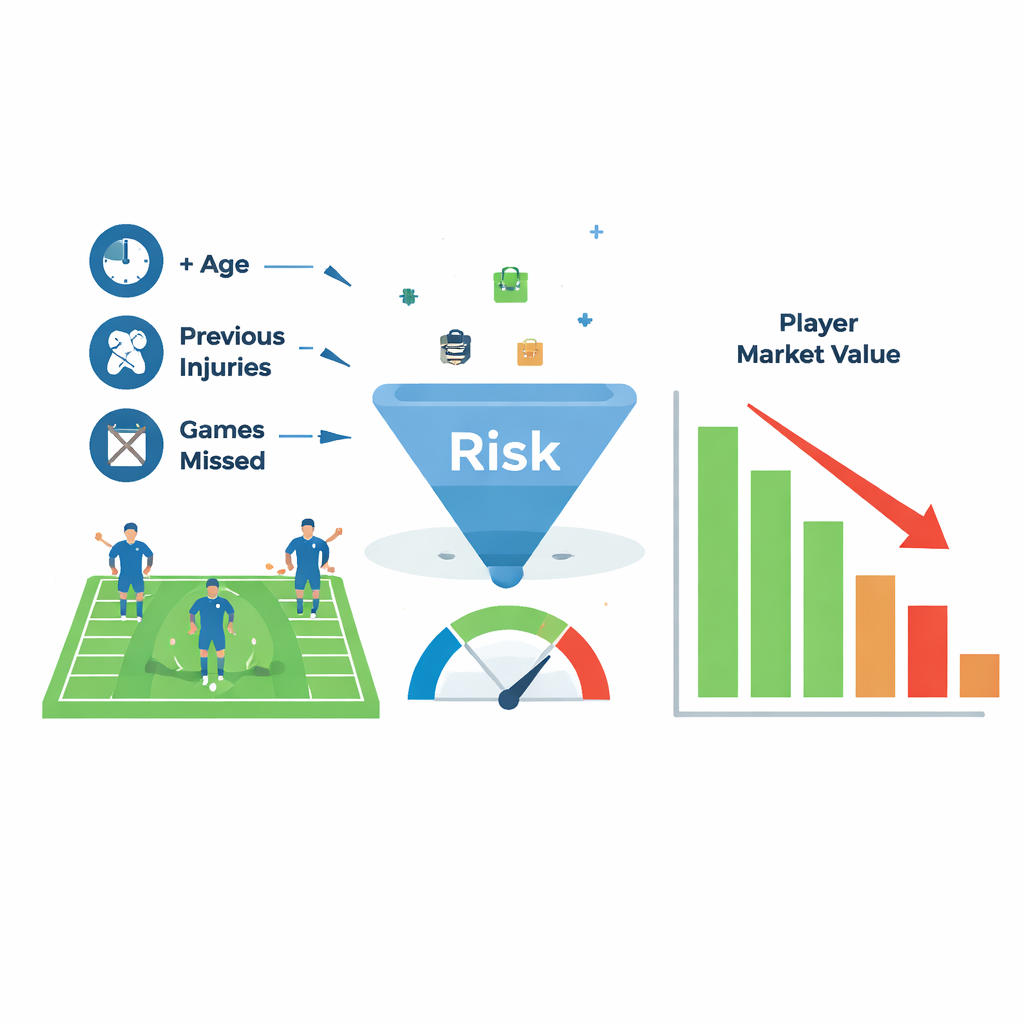
European clubs pour huge sums into transfer fees and salaries, and a player’s abilities form the main “capital” of a team. When a player is injured, there are medical bills, but the biggest losses arise from missed games, weaker performances, and reduced chances to qualify for lucrative competitions. Previous research had counted injuries and their direct costs, but no comprehensive model had tied an individual player’s risk of getting hurt to his estimated market value. This gap matters because long absences—more than a month out, or missing several matches—can shorten careers and shrink the resale value of even star players.
Measuring who is most likely to get hurt
To tackle this, the authors first built a statistical model to estimate how likely each player was to suffer a serious injury in a given year. They used detailed records from seven top European leagues between 2006 and 2020, combining over 50,000 season-by-player entries with more than 14,000 recorded injuries. Instead of just counting injuries, they focused on games missed: no games missed, a handful of games, a moderate spell out, or more than ten games out. Age, playing position, preferred foot, height, league, and year were all taken into account. The results confirmed what many team doctors suspect: players who have already missed many games through injury are far more likely to do so again, and this is especially true when previous absences were long and involved recurrent problems.
Age, position, and recurring trouble
The study also shows that injury risk changes over a player’s career in a non-linear way. From late teens into the mid‑20s, the chance of a serious injury rises, then levels off around the peak-performance years, and eventually falls again as older players are used more carefully or play fewer minutes. Forwards face a higher risk of repeated serious injuries than defenders, reflecting their heavy involvement in sprints, tackles, and scoring chances. Interestingly, two-footed players in this sample appeared more exposed to severe recurrent problems than those who strongly favor one foot, hinting that greater versatility on the ball may come with different movement demands and stresses on the body.
How risk translates into price tags
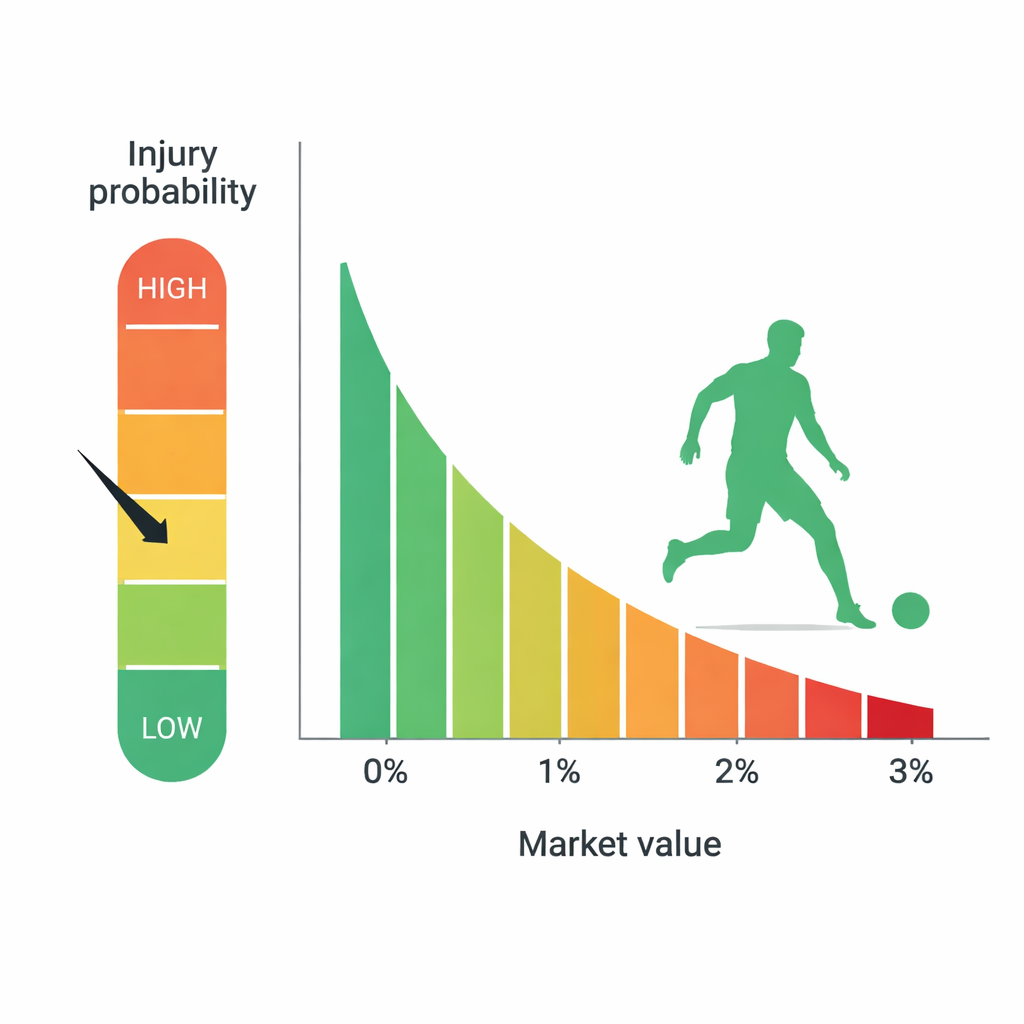
In the second step, the authors linked each player’s predicted injury risk to his market value as estimated by Transfermarkt, a widely used crowd-based valuation site. They used an advanced panel-data method that follows players over time, comparing each footballer mainly with his own past to filter out fixed traits like underlying talent or reputation. After controlling for goals, assists, cards, substitutions, and basic personal characteristics, injury risk still stood out: a 1% increase in the probability of suffering a serious injury was associated with about a 2.29% drop in market value. When the risk captured not only severity but also recurrence, the penalty grew to roughly 2.92%. Mid-range players, valued in the several-million-euro band, were particularly sensitive to increases in injury risk, while the very top stars showed slightly more resilience but were still penalized.
What this means for clubs and fans
For non-specialists, the key message is clear: the chance that a player will be badly hurt in the future already shows up in his market price today. Clubs that ignore injury history and age patterns risk overpaying for fragile assets and underinvesting in prevention. By turning medical and performance data into a simple injury probability, this study offers a practical tool to adjust player valuations, design fair contracts and insurance, and plan squad rotation and workloads. In an era of crowded calendars and rising transfer fees, managing injury risk is not just about keeping players fit—it is central to protecting the financial value of the team.
Citation: Rubio-Martin, G., González Sánchez, F., Manuel-Garcia, C.M. et al. The effect of injury risk on players value: evidence from the main European Leagues. Humanit Soc Sci Commun 13, 223 (2026). https://doi.org/10.1057/s41599-026-06511-w
Keywords: football injuries, player market value, sports economics, injury risk, European football leagues