Clear Sky Science · en
ICT investment and carbon emission efficiency in regional port groups: evidence from Chinese coastal provinces
Why digital ports matter for climate and trade
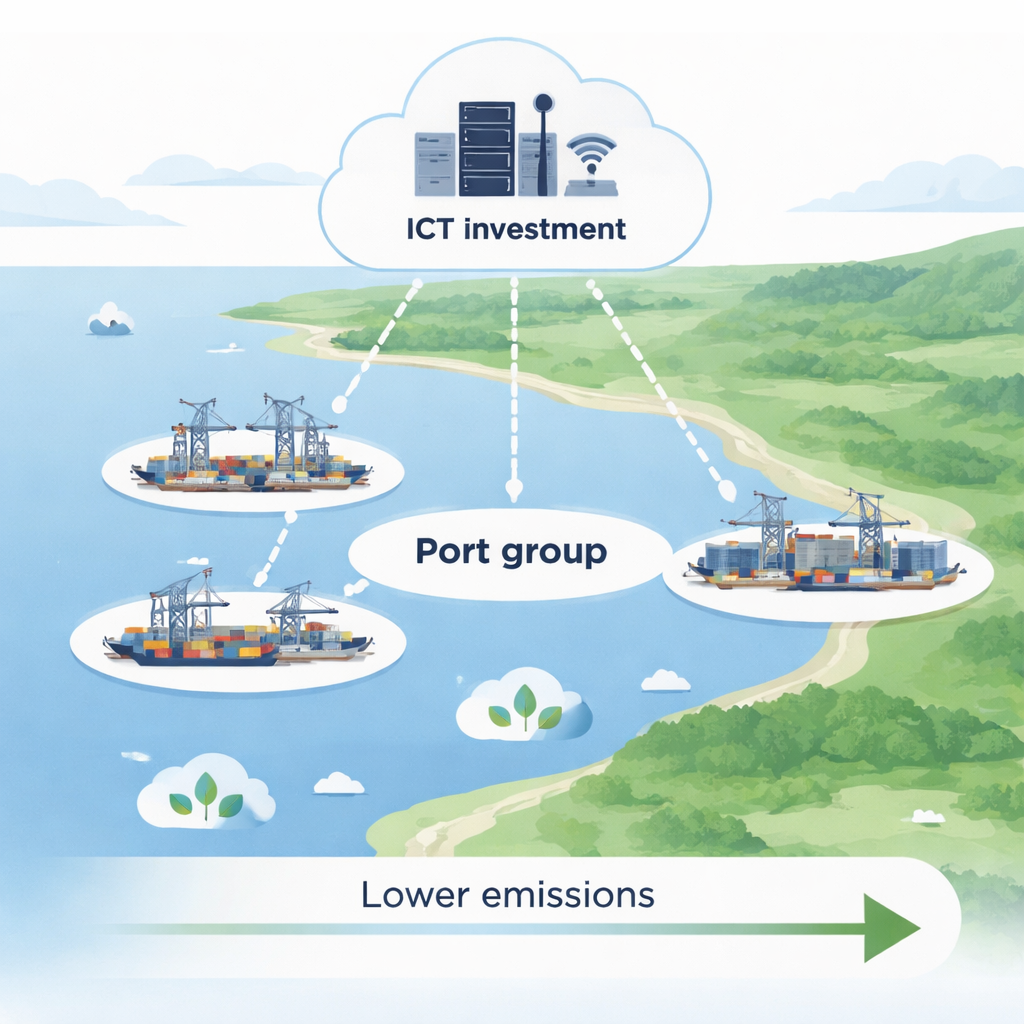
Ports sit at the crossroads of global trade and climate change. They keep goods moving worldwide, but the ships, trucks and cranes that serve them also emit large amounts of greenhouse gases. This article asks a pressing question: can investments in digital technologies – from smart sensors to better software – help ports cut their carbon footprint without slowing trade? Focusing on clusters of ports along China’s coast, the authors show how digital upgrades can make ports cleaner and more efficient at the same time.
Busy gateways under climate pressure
Modern ports are no longer just piers and warehouses; they are vast logistics hubs that knit together sea, land and industry. Because of this, they contribute a noticeable share of global greenhouse gas emissions. As trade has boomed, especially in fast‑growing economies like China, these hubs have come under pressure to move more cargo while meeting tougher environmental rules. At the same time, digital tools – often grouped under the label "information and communication technology" (ICT) – are spreading rapidly. These range from automated cranes and smart meters to real‑time tracking systems and shared data platforms. Policymakers and port managers hope such tools can help them run smoother operations and use less energy, but until now there has been little hard evidence on whether this really improves how efficiently ports handle carbon emissions.
Tracking digital spending and carbon results
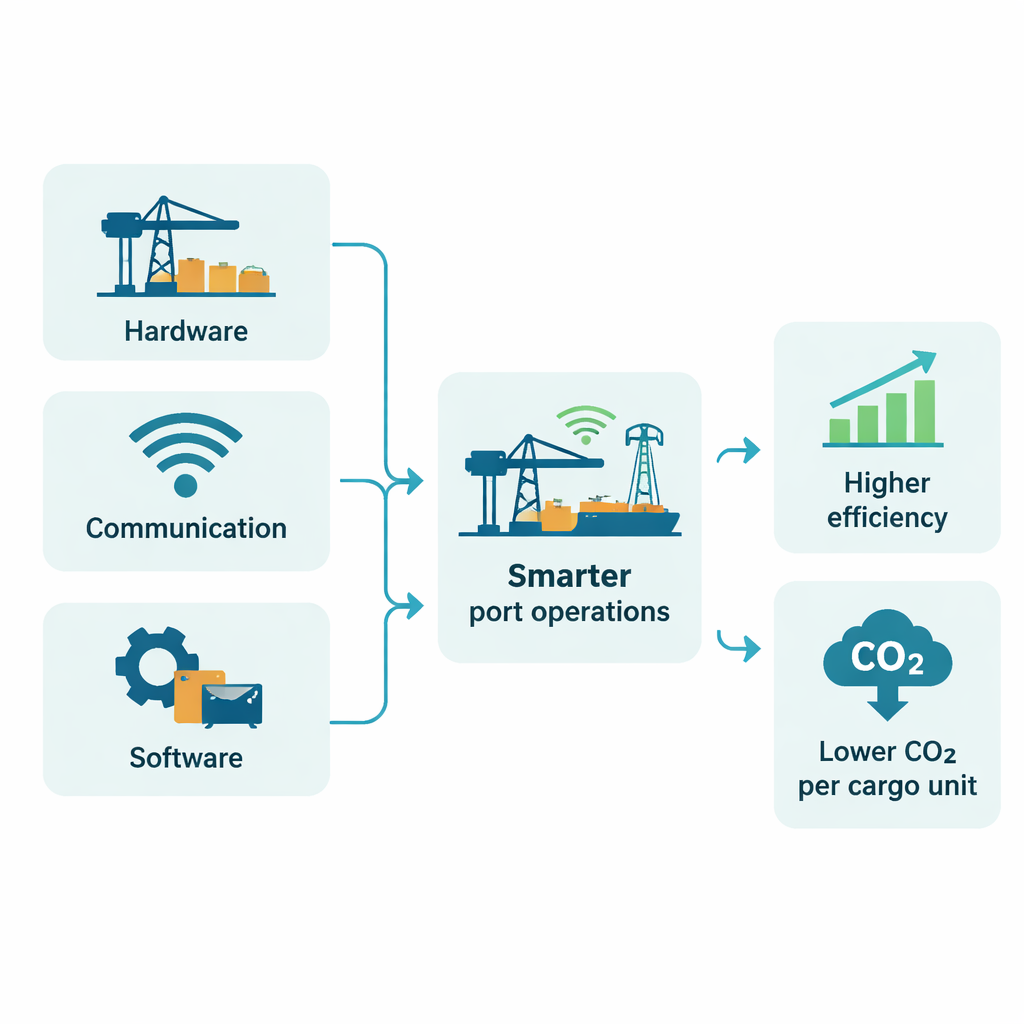
The study looks at nine coastal provinces in China between 2008 and 2019, treating all the ports within each province as a single regional system. Rather than simply counting how much money is spent in a given year, the authors build up a picture of the stock of ICT assets over time, separating it into three parts: hardware (such as servers, control systems and automated equipment), communication gear (networks and transmission devices) and software. They then compare this digital capital to a measure of "carbon emission efficiency" – how much economic and cargo activity the port region generates for each unit of carbon dioxide emitted. To capture the real complexity of ports, they use a two‑stage model: one stage covers the physical handling of ships and cargo, and the other covers links to the surrounding region, such as roads, railways and local economic output.
How smart tools change port behaviour
The results are clear: regions that invest more in ICT tend to move closer to the ideal of moving more goods with less carbon. Hardware investments have the strongest effect, followed by communication equipment and then software. New machines and control systems can automate loading and unloading, cut ship waiting times and fine‑tune electricity use, all of which lower fuel consumption. Digital links between ports and their hinterlands help avoid empty trips and bottlenecks. The study also uncovers an important indirect effect. As information flows improve, ports within a region tend to specialise – some focus on certain types of cargo or functions, others on support services. This clearer division of labour lets them reach larger scales and gain expertise, which reduces emissions per unit of cargo handled. In other words, digital tools do not just make individual machines smarter; they reshape how the whole port system is organised.
Finding the sweet spot for cooperation
Many governments have tried to merge or tightly coordinate neighbouring ports to avoid wasteful competition. The authors find that such integration does change how well digital investments pay off – but not in a simple straight line. At low levels of integration, poor coordination blunts the benefits of new technology. As integration deepens, shared planning and common systems allow digital tools to have a bigger impact on carbon efficiency. But beyond a certain point, further consolidation can actually weaken the gains, because large, centralised organisations may become slower to innovate and less responsive to local conditions. This "inverted U‑shape" appears for overall ICT spending, and most clearly for hardware and communication equipment. Software behaves differently: its impact relies more on whether it is used to support meaningful changes in how ports specialise and cooperate.
What this means for cleaner trade
For a lay reader, the takeaway is that going digital can indeed help ports become greener, but not all digital investments are equal and governance matters. Investing in physical digital infrastructure – smarter cranes, meters and networks – brings the biggest direct carbon savings, especially when ports within a region are integrated enough to share information and coordinate, but not so centralised that they become rigid. Software delivers benefits mainly when it enables ports to take on distinct roles and work together as a system. The study suggests that climate‑conscious trade does not require choosing between efficiency and the environment: with the right mix of technology and cooperation, ports can reduce emissions while keeping goods – and economies – moving.
Citation: Jin, X., Liu, S. & Lei, X. ICT investment and carbon emission efficiency in regional port groups: evidence from Chinese coastal provinces. Humanit Soc Sci Commun 13, 207 (2026). https://doi.org/10.1057/s41599-026-06509-4
Keywords: smart ports, digital infrastructure, carbon efficiency, maritime emissions, port governance