Clear Sky Science · en
Fiscal centralization versus decentralization of transport infrastructure operation and maintenance
Why Government Money Shapes Your Daily Commute
Anyone who has sat in traffic on a crumbling overpass has felt the consequences of how governments choose to spend money on roads and rails. This paper looks at a deceptively simple question with big everyday impacts: should a nation’s central government or local governments be in charge of paying for, operating, and maintaining transport infrastructure once it is built? Using China as a detailed case, the study explores which funding arrangements are more likely to keep highways, bridges, and railways safe, efficient, and well maintained over time.
From Building More to Taking Care of What Exists
China has spent decades rapidly expanding its transport network, building highways, high-speed rail lines, and ports at remarkable speed. That building boom has helped fuel economic growth, but it has also created a new challenge: keeping so much infrastructure in good working order. Politicians tend to favor visible new projects that boost short-term growth and career prospects, while routine operation and maintenance often receive less attention and funding. Many local governments carry heavy debts from past construction and face widening gaps between toll revenues and loan repayments, making it tempting to delay maintenance and focus on new projects that look better on performance scorecards.
Who Decides, and Why It Matters
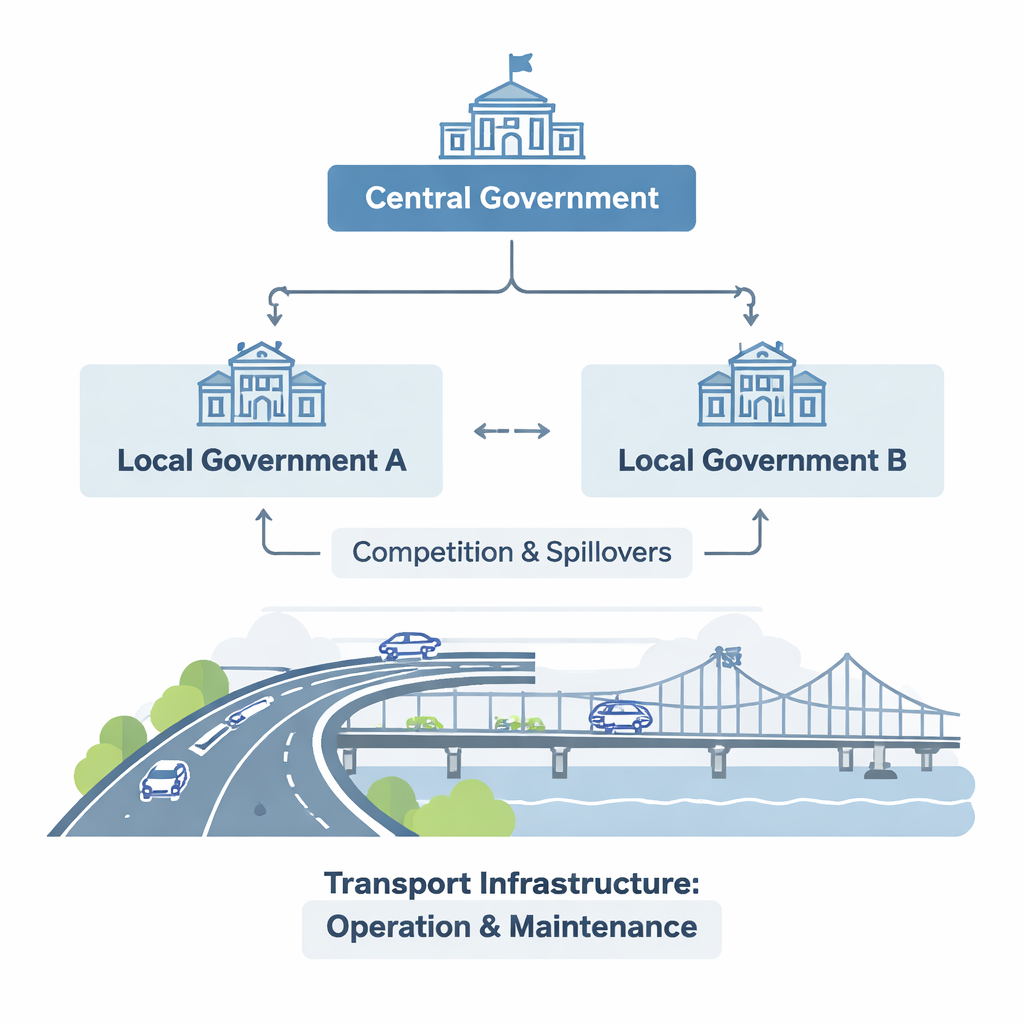
In China’s system, political power is centralized but many spending responsibilities are pushed down to provinces and cities. Local leaders are judged heavily on economic performance, so they compete to attract businesses and workers through better transport links. At the same time, transport infrastructure has strong “spillover” effects: a new or better-maintained road in one region can benefit neighbors by improving logistics and labor mobility, or hurt them through congestion and pollution. This mix of top-down control, local competition, and cross-region effects makes it hard to design a funding system that encourages everyone to invest enough in upkeep rather than just more concrete.
Using Game Theory to Mimic Real-World Politics
The author builds a mathematical model inspired by evolutionary game theory to imitate how a central government and two neighboring local governments might behave over time. Instead of assuming perfectly logical decision-makers, the model treats officials as learning actors who adjust their strategies based on past results, partial information, and random shocks such as policy changes or economic downturns. The central government can choose between a more centralized approach—tight control, heavy monitoring, and stronger penalties—or a more decentralized one, giving local governments more freedom but also less direct oversight. Local governments, in turn, can either run their transport systems proactively, investing in regular, forward-looking maintenance, or reactively, fixing problems only after they become serious.
What the Simulations Reveal
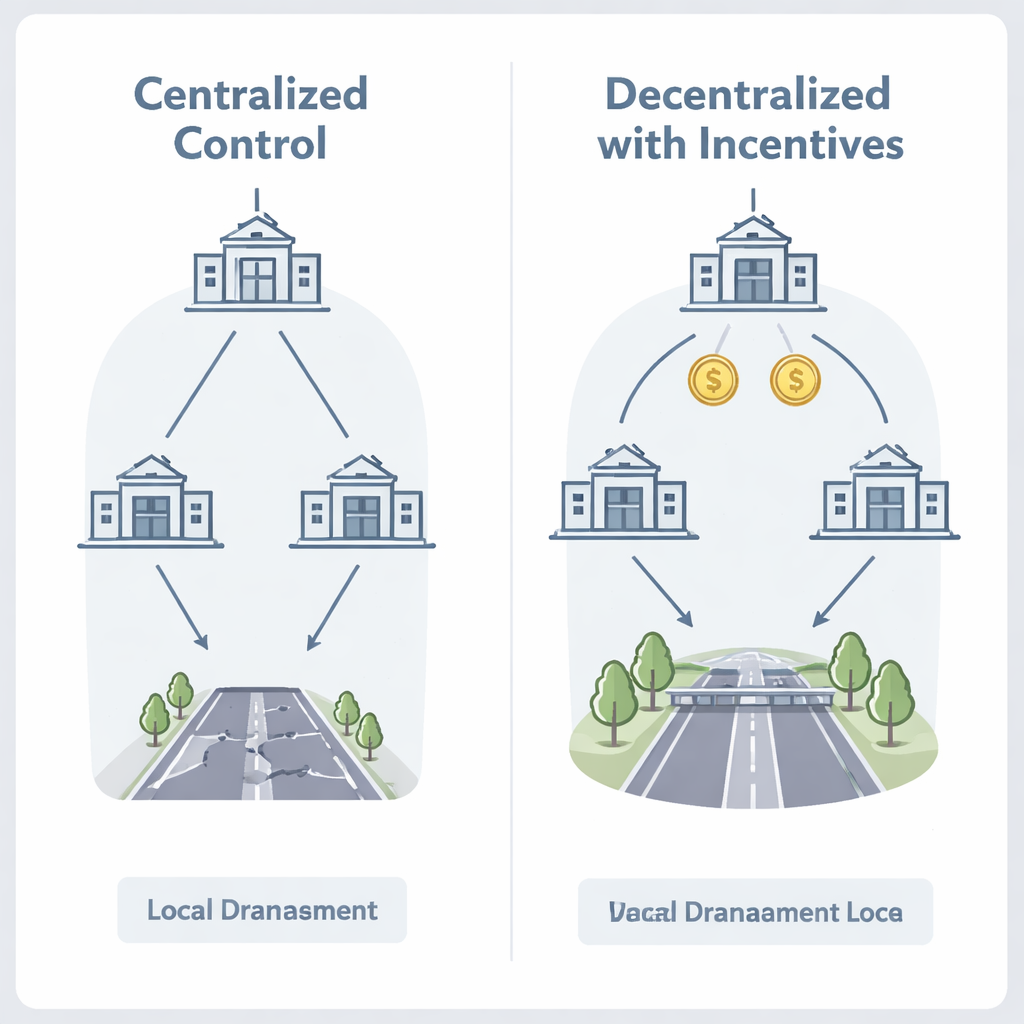
When the central government keeps tight centralized control, the model suggests it is very hard to motivate both local governments to consistently invest in good operation and maintenance at the same time. High monitoring and information costs for the center, combined with local incentives to chase short-term growth, lead to uneven and often insufficient upkeep. By contrast, under a well-designed decentralized system—where local governments bear more responsibility but also receive targeted transfers and face meaningful penalties—both local authorities can converge toward more proactive maintenance. The simulations, calibrated using data from the prosperous province of Guangdong and the less-developed Guangxi region, show that better outcomes arise when local benefits from good maintenance are clear, maintenance costs are manageable, financial support and fines are well calibrated, and competition for businesses and workers is strong enough to punish neglect.
What This Means for Travelers and Taxpayers
For ordinary people, the study’s message is that simply centralizing control is not a magic fix for potholes and unsafe bridges, nor is decentralization automatically better. The most reliable path to well-maintained roads and railways combines decentralized responsibility with smart national rules: transfers that help poorer regions afford upkeep, penalties that make neglect costly, and evaluation systems that reward long-term service quality rather than just new construction. When these pieces are in place, local governments have stronger reasons to care about the everyday performance of transport infrastructure—which ultimately means safer, smoother, and more reliable journeys for everyone.
Citation: Jia, F. Fiscal centralization versus decentralization of transport infrastructure operation and maintenance. Humanit Soc Sci Commun 13, 199 (2026). https://doi.org/10.1057/s41599-026-06500-z
Keywords: transport infrastructure maintenance, fiscal decentralization, China local government, evolutionary game theory, public investment policy