Clear Sky Science · en
The impact of renewable energy on CO2 emissions in Middle Eastern and BRICS economies
Why This Matters for Everyday Life
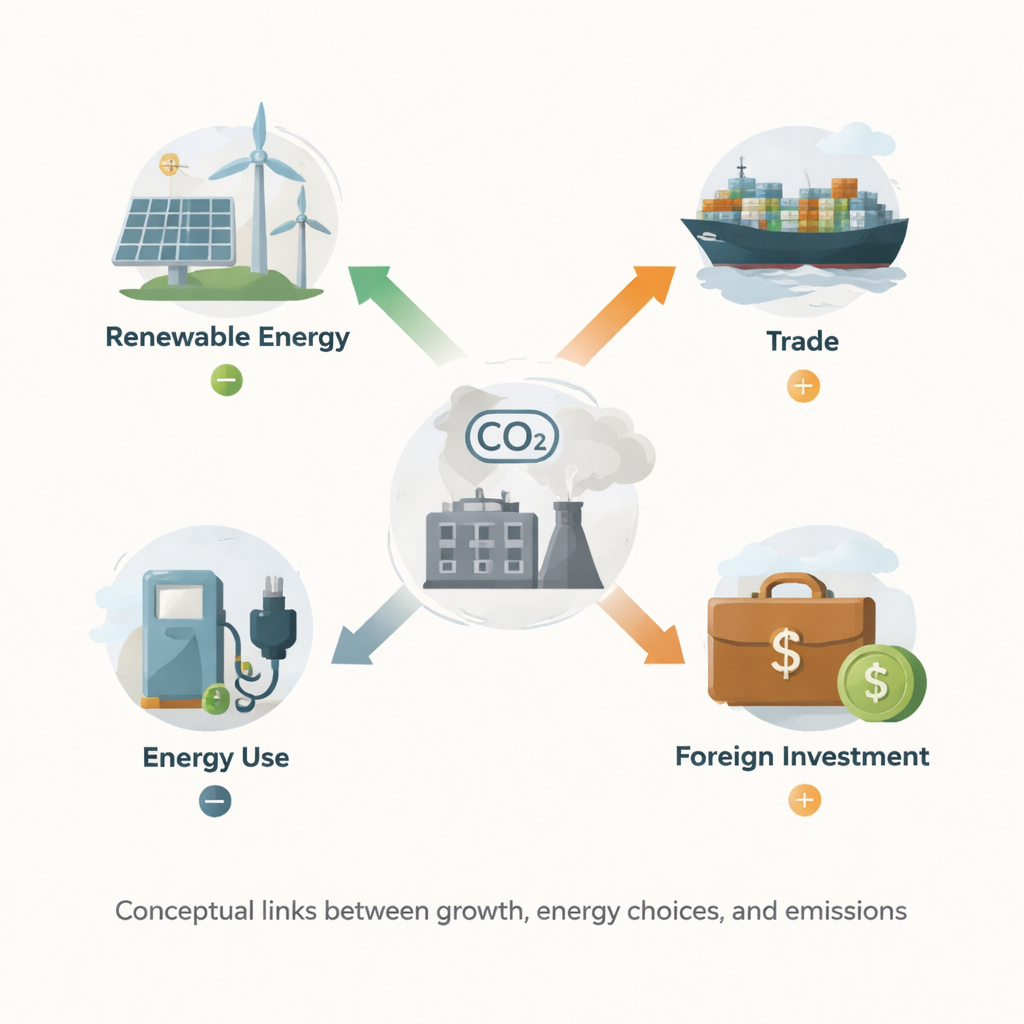
How fast the world shifts from fossil fuels to clean energy will shape the air we breathe, the stability of our climate, and even the jobs in our communities. This study looks at two heavyweight groups in the global economy—the oil-rich Middle East and the fast-growing BRICS countries (Brazil, Russia, India, China and South Africa)—to ask a simple but crucial question: when these countries use more renewable energy, do their carbon dioxide (CO2) emissions actually go down, and how do trade and foreign investment fit into the picture?
Two Regions, One Climate Challenge
The Middle East and BRICS nations play outsized roles in global energy and pollution. Middle Eastern economies lean heavily on oil and gas, while BRICS countries combine rapidly expanding industries with a growing mix of renewables like solar, wind and hydropower. Both regions struggle with smog, heat waves and stressed ecosystems—but they face different economic realities and energy traditions. By comparing them side by side from 1995 to 2020, the study uncovers how growth, energy choices, trade and foreign investment together push emissions up or down, offering lessons that extend well beyond these 17 countries.
What the Researchers Examined
The author pulled together 25 years of data on CO2 emissions per person, energy use, renewable energy’s share of the mix, trade with the rest of the world, and foreign direct investment (FDI). Rather than just tracking simple trends, the study used advanced statistical tools to ask: when one factor changes—say, renewable energy usage—does it tend to be followed by a change in emissions, and is that link long-lasting? Special tests checked whether countries moved together because of shared shocks, like oil price swings or global recessions, and whether the relationships held up under different ways of crunching the numbers. The result is a picture not only of correlation but of likely cause-and-effect over time.
Renewables vs. Emissions: Who Does Better?
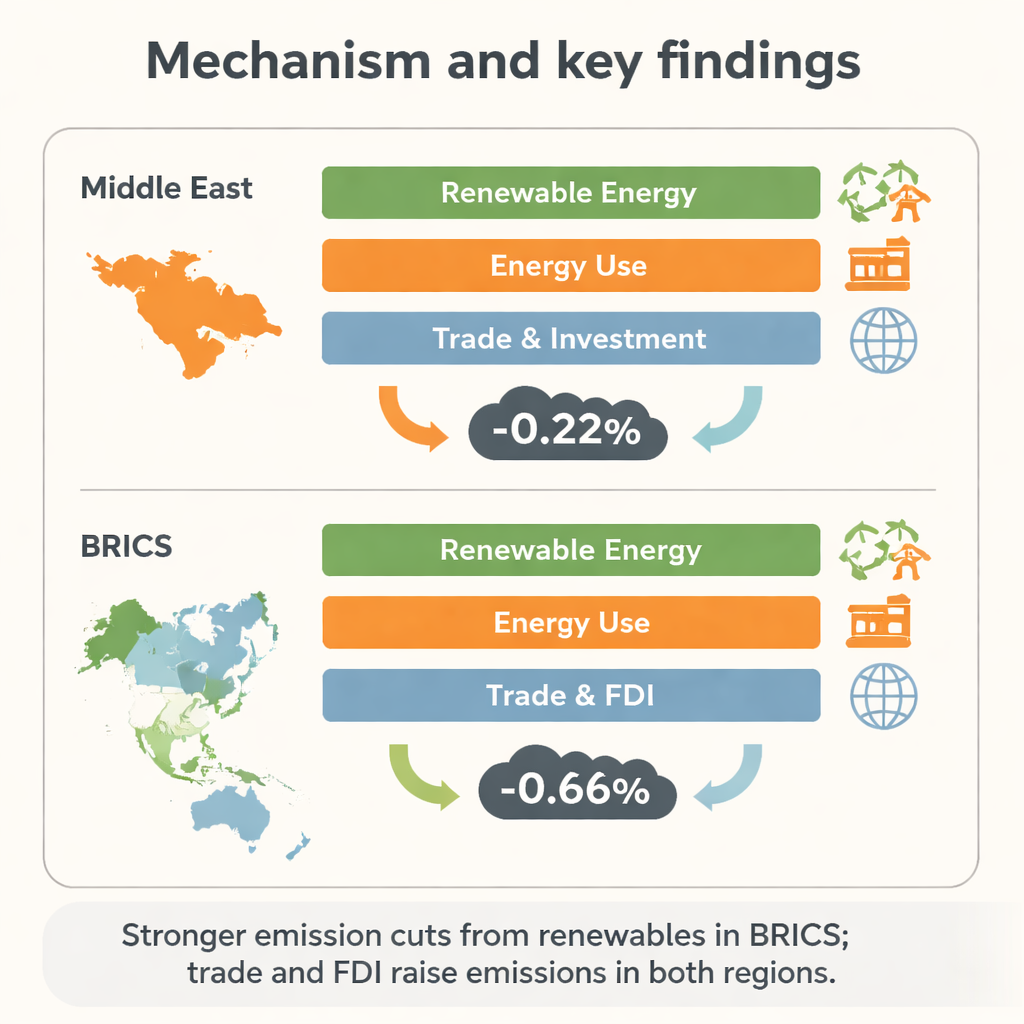
The clearest message is that renewables work. In both regions, higher use of renewable energy is tied to lower CO2 emissions, and this link appears to be causal rather than coincidental. On average, a 1% rise in renewable energy use is associated with a 0.22% drop in emissions in Middle Eastern countries and a much stronger 0.66% drop in BRICS nations. That difference likely reflects how far each region has gone in building clean infrastructure, modernizing its power grid and backing renewables with strong policies. In BRICS, where China and India are rapidly rolling out solar and wind, clean energy seems to bite much deeper into pollution than in Middle Eastern economies that still rely overwhelmingly on oil and gas.
When Trade and Investment Add Pressure
Economic openness turns out to be a double-edged sword. Trade with the rest of the world tends to push emissions higher in both regions, especially where exports and imports are dominated by energy-hungry or carbon-heavy goods and long-distance shipping. In the Middle East, more trade clearly goes hand in hand with greater CO2 output, while in BRICS, trade and emissions also move together over the long run. Foreign investment, meanwhile, does not consistently drive emissions up or down—but where it flows into fossil-fuel projects or heavy industry, it tends to raise pollution. In the Middle East, the study even finds signs that dirtier environments can scare investors away, hinting that cleaner air may increasingly be seen as a business asset rather than a luxury.
Policy Lessons Hidden in the Numbers
Beneath the technical language lie plain policy choices. Because renewable energy reliably cuts emissions—especially in BRICS—governments can make real progress by speeding up solar, wind and other clean power, improving efficiency and phasing out the dirtiest fuels. At the same time, trade and investment rules can be rewritten to favor low-carbon technologies and cleaner production instead of locking countries into polluting pathways. For the Middle East, that means using its oil wealth to fund a genuine shift away from fossil fuels; for BRICS, it means ensuring that rapid growth goes hand in hand with stronger environmental standards. For readers everywhere, the takeaway is straightforward: when nations back renewables with serious policy and steer trade and finance toward cleaner options, they can grow their economies while sending less CO2 into the air we all share.
Citation: Addis, A.K. The impact of renewable energy on CO2 emissions in Middle Eastern and BRICS economies. Humanit Soc Sci Commun 13, 194 (2026). https://doi.org/10.1057/s41599-026-06492-w
Keywords: renewable energy, CO2 emissions, Middle East, BRICS, trade and investment