Clear Sky Science · en
Green well-being: a study on the impact of ESG perception on subjective well-being
Why our surroundings shape our happiness
Why do some people feel happier than others, even when they live in the same city or earn similar incomes? This study argues that a big part of the answer lies in how ordinary people judge the quality of the world around them—whether the air feels clean, neighbors seem fair, and local officials are doing a decent job. Focusing on adults across China, the researchers show that these everyday impressions of environmental, social, and political life quietly but powerfully shape how satisfied people feel with their lives.
How people turn big systems into personal feelings
The authors introduce the idea of “ESG perception,” meaning how residents personally rate three broad areas: the environment they live in, the way people treat each other, and the performance of local government. Rather than tracking only hard numbers like pollution levels or income, the study looks at how people interpret their own experience—whether their neighborhood feels safe, their community seems supportive, and public services appear fair and effective. This perception is treated as a bridge: huge, complex systems on one side, and an individual’s mood and life satisfaction on the other.
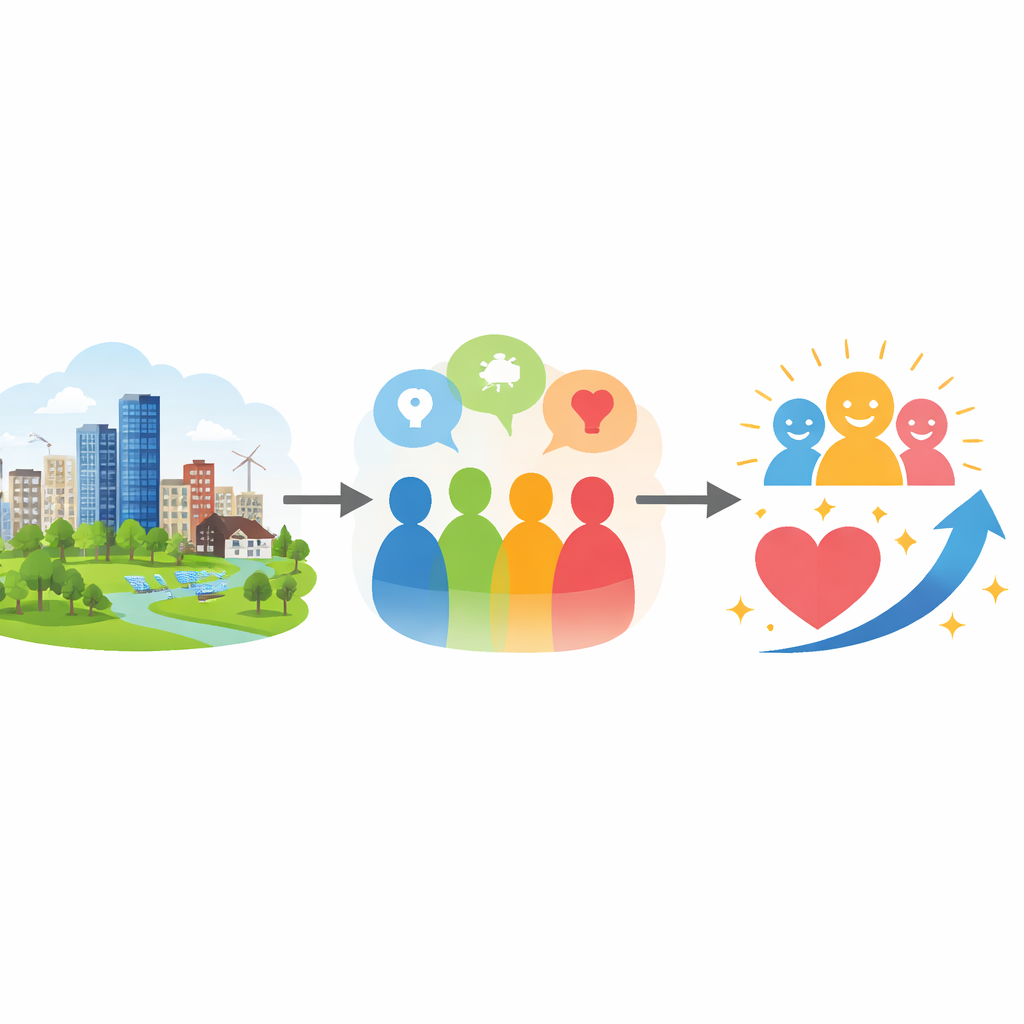
Following thousands of households over time
To explore this bridge, the researchers draw on four waves of data from the China Family Panel Studies, a large national survey that has tracked tens of thousands of people and households since 2010. They focus on the years 2016 to 2022, when the survey consistently asked about happiness, life satisfaction, depressive feelings, and hopes for the future, alongside questions about local facilities, neighborhood trust, social security, and government performance. By comparing changes in perceptions in one year with changes in well-being in later years, and by accounting for factors such as age, income, health, and regional economies, they can tease out how much ESG perception matters on its own.
What the data say about green well-being
The results are strikingly consistent. People who view their environmental, social, and governance surroundings more positively report higher overall well-being, even when the analysis corrects for wealth, health, and where they live. This holds under many different checks, including alternative ways of measuring perceptions and happiness, adding family-level comparisons, and using matching techniques to balance out differences between more and less satisfied respondents. The positive link appears in each survey year studied and even strengthens by 2022, after the most intense period of pandemic restrictions had passed and daily life again made the quality of local conditions more visible.
The hidden pathways of fairness and trust
Beyond this direct link, the study zooms in on how perceptions work. It tests three possible channels: time spent exercising outdoors, feelings about how fair society is, and satisfaction with local government. Outdoor activity is indeed associated with better well-being, but people’s ESG perceptions do not reliably push them to exercise more, so this pathway is weak. In contrast, the social and political channels are strong. When residents believe that effort is rewarded, opportunities are real, and competition is fair, they feel happier—and positive ESG perceptions tend to foster this sense of fairness. Likewise, when people judge their local government as performing well on jobs, education, health care, and pollution control, they feel more secure and content, and these favorable views are tightly connected to ESG perception.
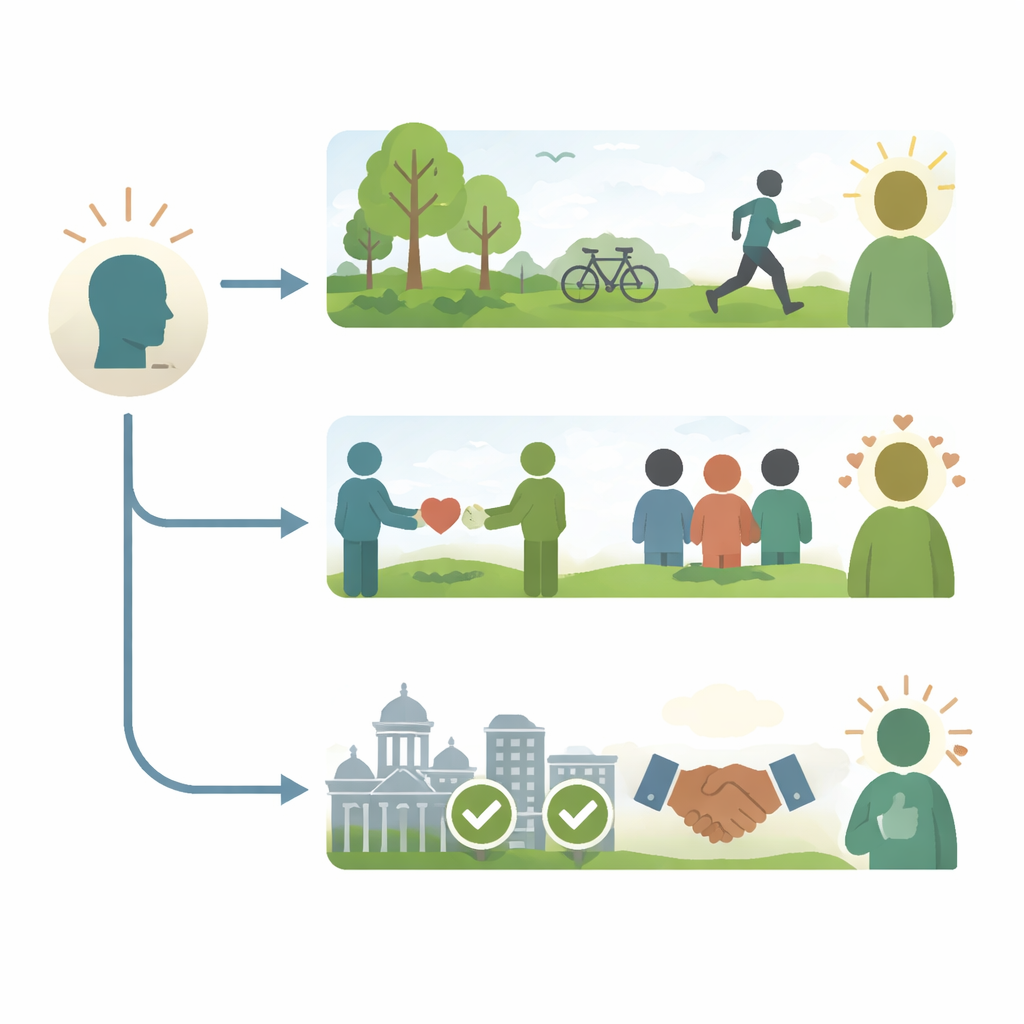
Different places, similar story
The strength of these links is not the same everywhere. Urban residents seem more sensitive to ESG conditions than rural residents, perhaps because they encounter dense infrastructure, public services, and environmental problems more directly. Regions with higher incomes and stronger institutions—especially eastern and central China—show the greatest boost in happiness from positive ESG perceptions, while western and northeastern areas benefit too, but somewhat less. Age, however, does not change the pattern much: younger and older adults alike appear to translate their reading of environmental quality, social climate, and governance into similar gains or losses in well-being.
What this means for everyday life and policy
For a layperson, the takeaway is simple but powerful: happiness is not only about private circumstances like income or health, but also about feeling that one’s surroundings are clean, fair, and competently managed. Improving air quality, public spaces, social protection, and honest government can lift moods and life satisfaction—but only if people can see and believe in those improvements. For policymakers, this means that communication, transparency, and fairness are as important as concrete projects. When residents feel that their environment is cared for, society is just, and public institutions are on their side, their sense of well-being measurably rises.
Citation: Bi, D., Huang, W. & Hu, Y. Green well-being: a study on the impact of ESG perception on subjective well-being. Humanit Soc Sci Commun 13, 338 (2026). https://doi.org/10.1057/s41599-025-06364-9
Keywords: subjective well-being, ESG perception, social fairness, government trust, China panel survey