Clear Sky Science · en
Topological modelling of urban air pollution and cognition
Why city air and clear thinking are connected
Most people know that dirty air can harm the lungs and heart, but fewer realise it may also cloud the mind. This study looks at how everyday air pollution in large UK cities relates to how quickly middle-aged adults think and react. By mapping both pollution and mental performance across neighbourhoods, the researchers show that where you live in a city may quietly shape how sharply you can focus and respond.
Looking for patterns in real city life
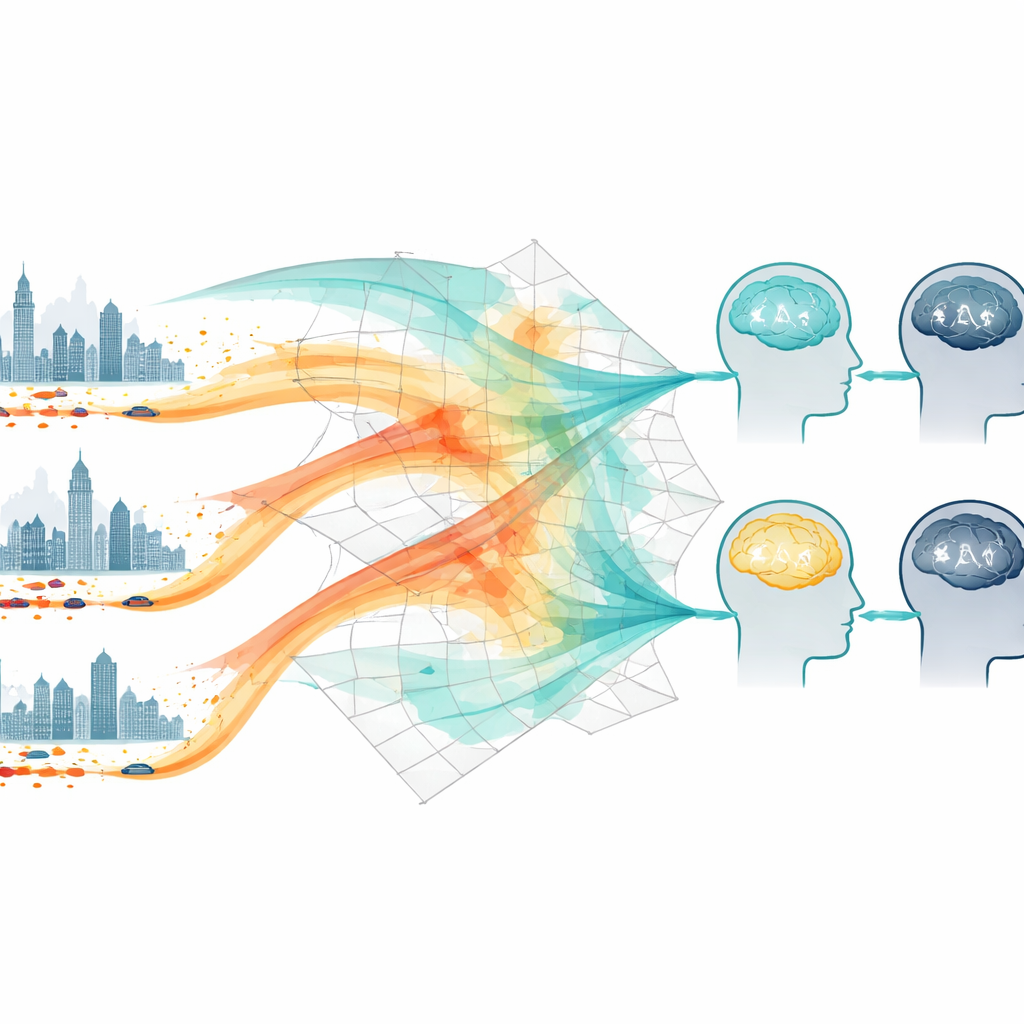
The researchers drew on the UK Biobank, a large health study that follows more than half a million volunteers. They focused on four major English cities—Birmingham, Leeds, Liverpool and Manchester—because each has many participants and a history of traffic and industrial pollution. For every person, they knew roughly where they lived, how they performed on simple computer-based thinking tests, and how much air pollution was estimated at their home. The team looked at three common pollutants largely linked to traffic and fine particles, and two tests that capture how quickly people react and how fast they can complete a card-matching task.
Measuring quick thinking in a noisy world
Reaction time—the split-second delay between seeing something and pressing a button—is a widely used gauge of mental speed, especially in ageing research. Completion time in a memory-based matching game is another indicator of how swiftly the brain works. Because the volunteers were mostly in midlife, before widespread dementia, these measures reflect ordinary differences in thinking speed rather than severe illness. The study also took into account other factors that could blur the picture, such as age, sex, education, physical health, walking pace, alcohol use and how people rated their own health, so that any link between air and thinking would be less likely to be explained away by these influences.
Adding geography to the picture
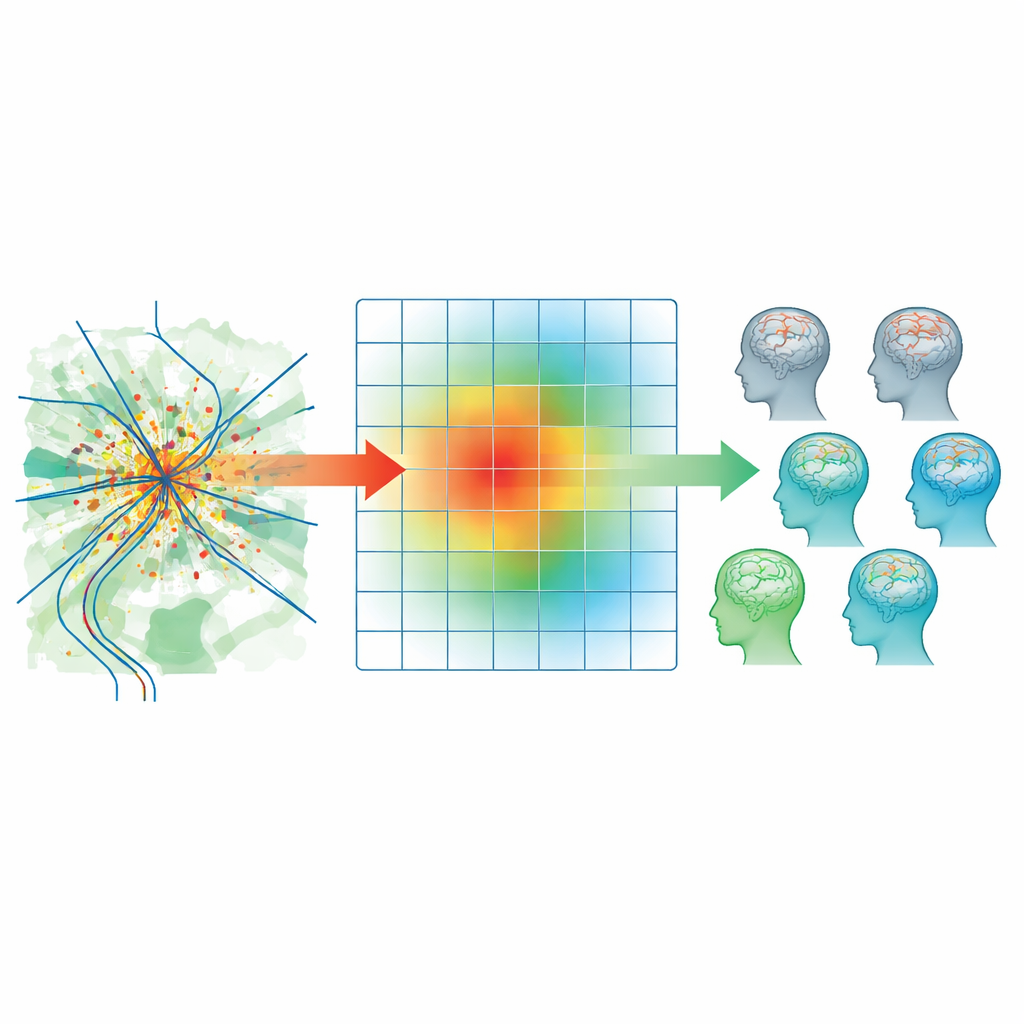
Many earlier studies simply compared pollution levels and thinking scores across whole groups of people, ignoring where they lived beyond a broad urban or rural label. This study instead treated geography as central. Using a tool called GeoSPM, originally developed for brain scans, the team laid a fine grid over each city and asked: in which small areas do higher pollution and slower thinking consistently show up together, even after adjusting for other influences? By smoothing the data over a few kilometres and correcting carefully for chance findings, they could pinpoint neighbourhood-scale patches where pollution and cognition moved in step.
Central streets, dirty air and slower minds
The maps revealed 51 city patches where air quality and thinking performance were significantly linked. In 29 of these areas, the pattern was straightforward and worrying: above-average pollution coincided with slower reaction times and longer completion times. These hotspots tended to cluster around city centres and major roads, echoing known problem routes where nitrogen dioxide regularly exceeds official limits. In a smaller number of mainly outer areas, the opposite pattern appeared—cleaner air went hand-in-hand with better thinking speed. Some regions showed odd or mixed patterns, hinting that other, unmeasured aspects of neighbourhood life—perhaps noise, stress, or social factors—may also be at work.
What this means for people and policy
Put simply, the study suggests that living near busy, polluted roads in big cities is linked to slightly slower thinking, even in otherwise healthy, middle-aged adults. While the changes in speed are modest for any one person, they matter when multiplied across millions of city dwellers and over decades of life. Slower thinking in later years can increase the risk of memory problems and dementia, adding pressure to families and health services. The findings also highlight an inequality: central, traffic-heavy neighbourhoods bear more of the mental burden of dirty air than cleaner outskirts. For decision-makers, the message is clear: tackling urban air pollution is not just about easing breathing problems—it is also about protecting the brain power that modern, knowledge-based societies depend on.
Citation: Engleitner, H., Suárez Pinilla, M., Rossor, M. et al. Topological modelling of urban air pollution and cognition. npj Digit. Public Health 1, 7 (2026). https://doi.org/10.1038/s44482-025-00009-z
Keywords: air pollution, cognitive performance, urban health, spatial analysis, public health policy