Clear Sky Science · en
Tunable and highly sensitive functionalized carbon-nanotube-based integrated systems for chemical gas sensing
Smelling Danger and Disease with Tiny Wires
Catching the faint whiff of a gas leak, a polluted street, or an infection in a hospital usually requires bulky instruments or slow lab tests. This research describes a new kind of microchip "electronic nose" that can pick up extremely small amounts of many different gases at room temperature, using technology that could be mass-produced like today’s computer chips. Such a device could one day help doctors spot infections from a patient’s breath or hospitals check for harmful bacteria without ever opening a petri dish.
Why Better Gas Sensors Matter
Detecting chemicals in the air is crucial for monitoring air quality, keeping workers safe from leaks, and finding early signs of disease. Existing sensors often struggle with three things: they are not sensitive enough to trace amounts of chemicals, they cannot easily tell similar gases apart, and they are hard to manufacture in large numbers at low cost. The team behind this work set out to solve all three problems at once by combining advanced nanomaterials with standard chip-making techniques.

Building a Smart Sensing Chip
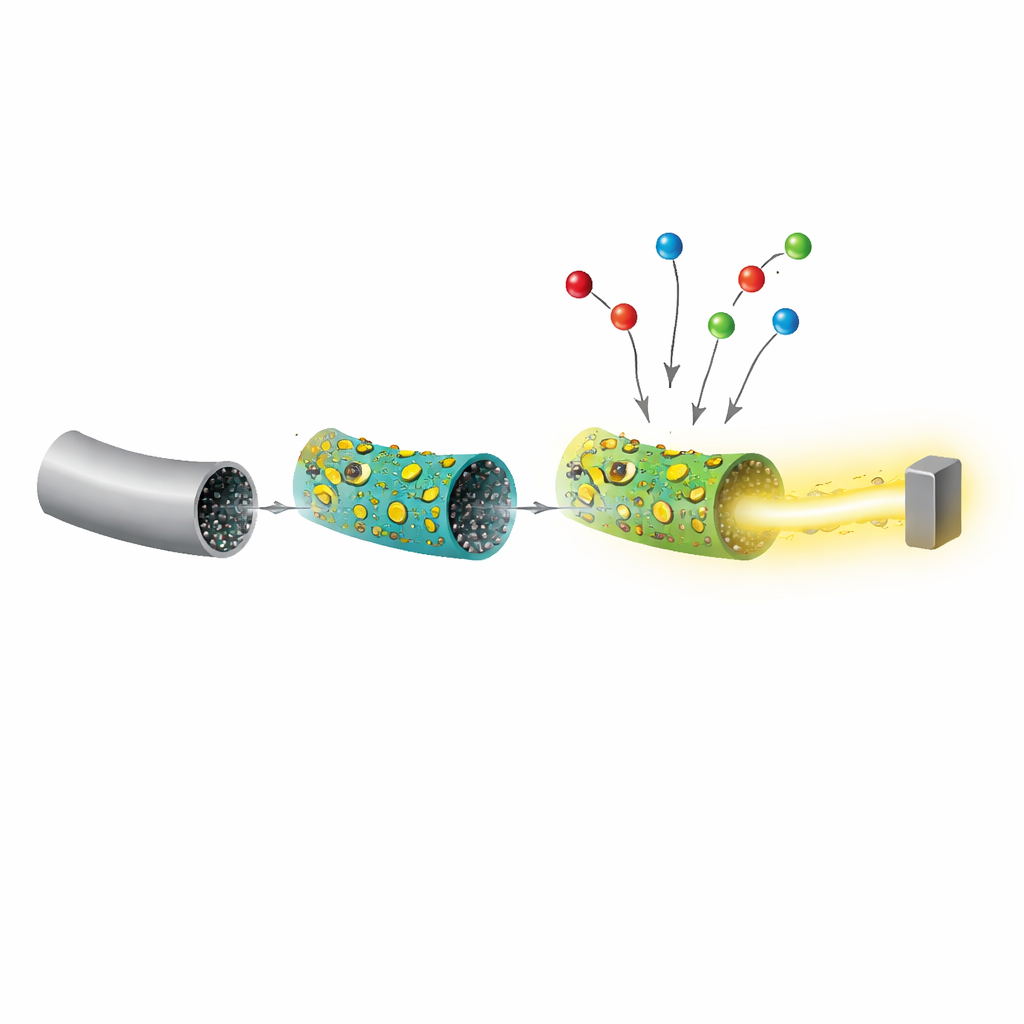
At the heart of the new platform are carbon nanotube field-effect transistors, tiny wire-like switches made from rolled-up sheets of carbon. Because every atom in a nanotube sits on the surface, it is extremely responsive to nearby molecules. However, bare nanotubes respond in similar ways to many gases, limiting their usefulness as a precise nose. The researchers tackled this by coating the nanotubes with a porous, electrically conductive layer called a metal–organic framework, and then adding specks of different metals on top. This two-step treatment is done directly on large, factory-made chips containing 2,048 individual sensors arranged in 32 repeating blocks, allowing the process to scale like ordinary electronics.
Turning Weak Whiffs into Strong Signals
The porous coating acts like a sponge that soaks up gas molecules and funnels electric charge into the nanotubes, greatly amplifying the signal. The team showed that for several common gases—including nitrogen dioxide, ammonia, hydrogen sulfide, ethanol, acetone and hydrogen—the treated sensors responded up to about a hundred times more strongly than untreated ones. Imaging and spectroscopic measurements revealed how this happens: when gas molecules interact with the porous layer and the metal specks, they shift the way charge flows into and between the nanotubes. This changes both the height of the barriers where the nanotubes contact metal wires and the ease with which charge moves along and between tubes, producing a much larger and more tunable electrical response.
Creating a Digital Smell Fingerprint
Because different metals and coating recipes change how each sensor reacts, the researchers could deliberately make groups of sensors with distinct personalities. Some might respond strongly to alcohol vapors, others more to ammonia, and so on. By arranging 16 types of metal decoration, each at several loadings, across the chip, they generated a patchwork of patterns when the chip was exposed to different gases. Statistical tools then treated each gas as a unique "smell fingerprint," separating six test gases into clearly different clusters based solely on how the sensor array responded over time. This pattern-based approach mirrors how our own noses work, using many broadly tuned sensors whose combined activity encodes specific odors.
Sniffing Out Bacteria and Yeast
To show that the chip could tackle real biological problems, the team tested gases released by three common microbes grown on agar plates: a typical gut bacterium, a harmful lung bacterium, and a pathogenic yeast. Without disturbing the cultures, they simply placed the sensor chip above the plate and let the natural vapors drift to the array at room temperature. Even when the microbes were diluted, the chip produced distinct electrical patterns for each species, achieving around 95% accuracy in telling them apart. Importantly, the system worked with a compact, portable readout circuit and without any heated elements or large gas-handling equipment, pointing toward practical point-of-care devices.
What This Means for Everyday Life
In essence, this work shows that it is possible to mass-produce a small, low-power chip that can "smell" complex chemical mixtures and distinguish their sources with high reliability. By carefully layering porous coatings and metal particles onto carbon nanotube electronics, the researchers turn faint, nonspecific gas signals into strong, distinctive patterns that computers can readily classify. For non-specialists, the take-home message is simple: this technology could eventually shrink sophisticated lab gas analyzers into pocket-sized detectors that help monitor air pollution, safeguard factories, and rapidly flag infections in clinics—all using the same kind of scalable manufacturing that made modern microelectronics ubiquitous.
Citation: Song, J., Kim, DH., Tiepelt, J. et al. Tunable and highly sensitive functionalized carbon-nanotube-based integrated systems for chemical gas sensing. Nat. Sens. 1, 252–260 (2026). https://doi.org/10.1038/s44460-026-00037-z
Keywords: electronic nose, gas sensing, carbon nanotubes, medical diagnostics, metal–organic frameworks