Clear Sky Science · en
A trust model for networked systems
Why trust matters in our connected world
From smart speakers at home to sensors in factories and hospitals, our lives increasingly depend on devices that talk to each other without us noticing. But how can these devices quickly decide which other machines to trust, especially when hackers try to fool them or knock them offline? This paper introduces a new way to measure and update trust inside such digital communities so that unreliable or compromised devices are quietly sidelined while dependable ones keep the system running smoothly.
Trust as a living scoreboard
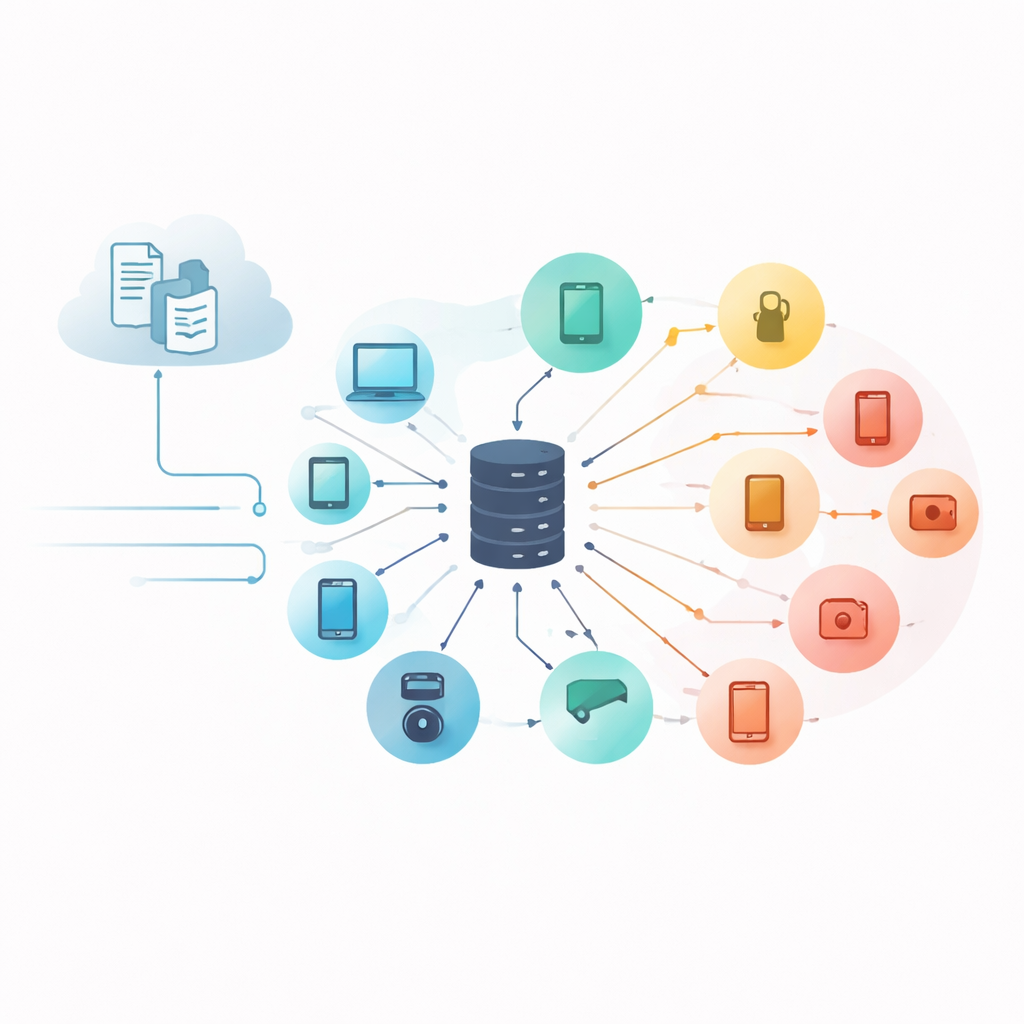
Instead of treating trust as a fixed label, the authors view it as a score that changes over time for every device in a network. Each device holds a number that represents how trustworthy it currently is. When other devices see it behaving well—sending correct messages on time—its score can rise. When it misbehaves, becomes silent, or seems under attack, that score falls. Crucially, a device’s trust score is also its “voting power”: only devices with a positive score can cast opinions about others, and giving an opinion slightly drains their own score. This simple rule both records reputation and limits how often any one device can influence the crowd.
Sharing opinions without letting loud voices dominate
In this model, every device can send signals that mean either “I trust this peer” or “I distrust this peer.” The chances of sending either type of signal are encoded as probabilities, and the strength of these connections can change over time. A regulator outside the network—such as a system manager—feeds each device a steady trickle of new “voting rights,” while also being able to reduce them if desired. Because each opinion costs a voting right, devices that speak too often gradually lose their influence. At the same time, devices that are widely trusted gain more opportunities to vote. The end result is a kind of “trust plutocracy” in which reliable devices naturally shape the overall picture, and untrustworthy ones are prevented from steering the group.
Fast math instead of slow trial and error
One challenge in designing such a trust system is predicting how it will behave without running long, detailed simulations. The authors build on a mathematical framework known as the Random Neural Network to derive compact equations that describe the long-term trust level of every device. Solving these equations, which can be done with standard software, gives the probability that each device is in a “trusted” state. System designers can then define thresholds, for example marking devices below one cutoff as unsafe, those above another as clearly reliable, and the rest as uncertain. This analytical shortcut makes it practical to tune large networks and understand which components are most at risk.
Watching trust rise and fall during cyberattacks
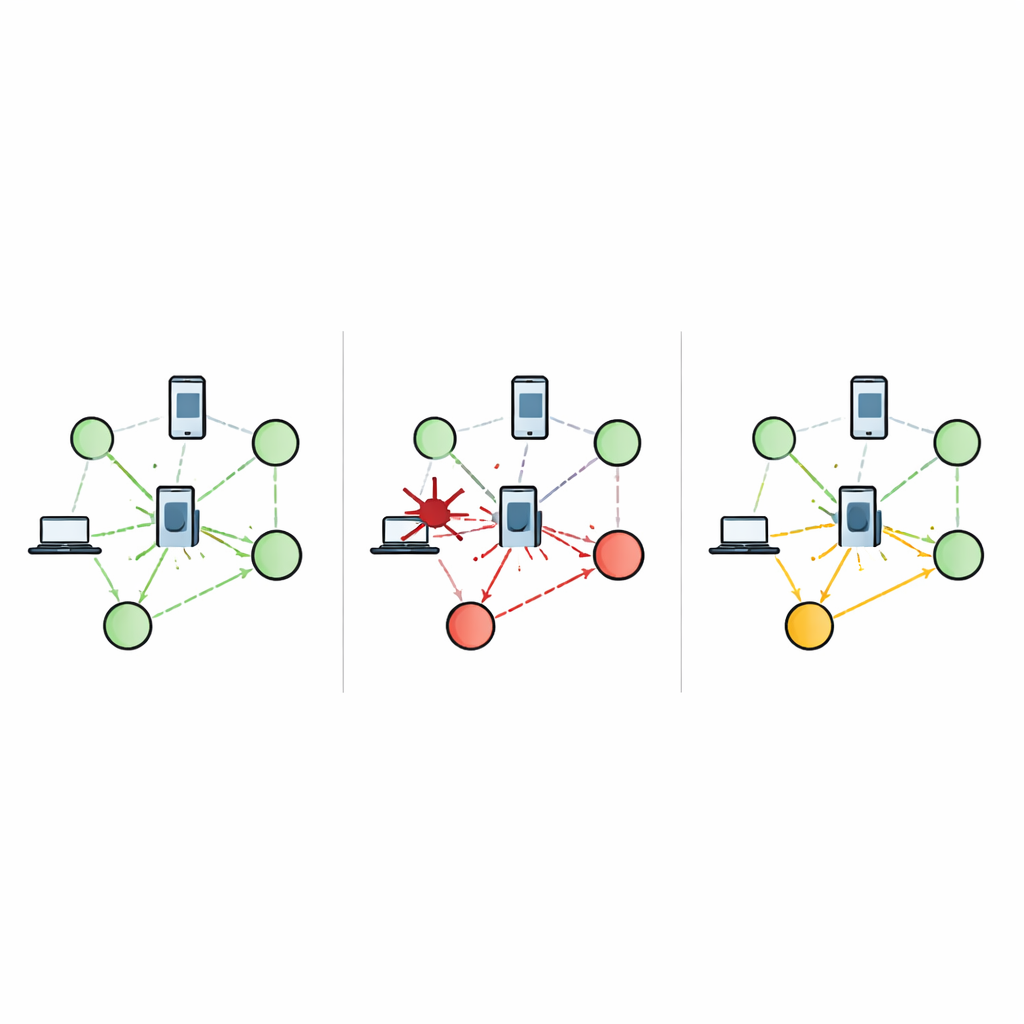
To test their model, the authors simulate networks of Internet of Things (IoT) devices and gateways that exchange messages every few seconds. They introduce message losses and various cyberattacks—such as denial-of-service, distributed denial-of-service, and botnet attacks—based on a widely used real-world dataset of intrusion traffic. When attacks strike a device, other nodes gradually stop hearing from it or see suspicious behavior and begin to lower their trust in it. The model translates this into reduced trust scores and weakened influence for that device, while honest peers keep or regain high scores. Visualizations show trust values plunging for attacked nodes during the assault and then slowly recovering when normal behavior resumes, while neighboring devices may see smaller ripples in their own trust levels.
Practical use in everyday networks
The trust model can be run on a dedicated server that listens to reports from all devices, updates their trust scores, and broadcasts the current trust map back to the network. This central approach makes it harder for a rogue device to secretly boost its own reputation or that of its allies. In an IoT deployment, such a server could automatically decide which gateways should handle data, whether to demand extra checks from doubtful devices, or when to discard messages entirely to block malware. Because the mathematical core is efficient, the system can react quickly as conditions change.
What this means for safer digital ecosystems
Overall, the paper shows that trust in a network does not need to be a vague or static idea: it can be turned into a dynamic, measurable quantity that responds to both everyday communication and rare but damaging cyberattacks. By linking a device’s right to speak with its proven reliability, the proposed model ensures that honest behavior is rewarded and harmful or faulty components lose their sway. For non-specialists, the message is straightforward: this approach offers a principled way to let connected devices “earn” our confidence over time, helping future wireless and IoT systems stay resilient even when the network itself comes under attack.
Citation: Gelenbe, E., Ren, Q. & Yan, Z. A trust model for networked systems. npj Wirel. Technol. 2, 10 (2026). https://doi.org/10.1038/s44459-026-00030-5
Keywords: network trust, Internet of Things, cybersecurity, random neural network, intrusion attacks