Clear Sky Science · en
Low-complexity equalization of Zak-OTFS in the frequency domain
Why faster wireless needs new tricks
As our world moves toward 6G, wireless networks must keep up with high-speed trains, cars, drones, and ever-higher carrier frequencies. Under these conditions, today’s standard signaling method, OFDM, begins to struggle: signals blur in time and frequency, and receivers must work much harder to keep up. This paper introduces a way to keep an emerging alternative, called Zak-OTFS, both robust and computationally light by shifting most of the heavy lifting into the frequency domain.

From avoiding interference to using it wisely
Current 4G and 5G systems rely on OFDM, which lays data onto many narrow frequency tones. When users are not moving too fast, each tone experiences a relatively stable channel, and the receiver can correct distortions with an extremely simple “one-tap” operation per tone. But as mobility and carrier frequency increase, motion causes rapid frequency shifts (Doppler), tones leak into each other, and the clean diagonal structure OFDM relies on disappears. To avoid this, OFDM must increase the spacing between tones, sacrificing spectral efficiency and excluding some extreme mobility scenarios, such as communication with bullet trains or at very high carrier frequencies.
A different grid for space and motion
Zak-OTFS takes a different view. Instead of organizing information on a time–frequency grid, it places data directly on a delay–Doppler grid, which describes how signals are delayed and shifted in frequency by the environment. In this picture, the wireless channel becomes a relatively stable “map” of paths whose structure changes slowly compared with the data rate. Zak-OTFS does not try to avoid interference; it expects each transmitted symbol to arrive as several delayed and Doppler-shifted copies that overlap. This design lets the system maintain nearly constant spectral efficiency over a wide range of delays and Doppler spreads, even where OFDM effectively fails. The challenge is that the resulting mathematical description at the receiver is dense and hard to invert with straightforward methods.
Turning a tangle into a narrow band
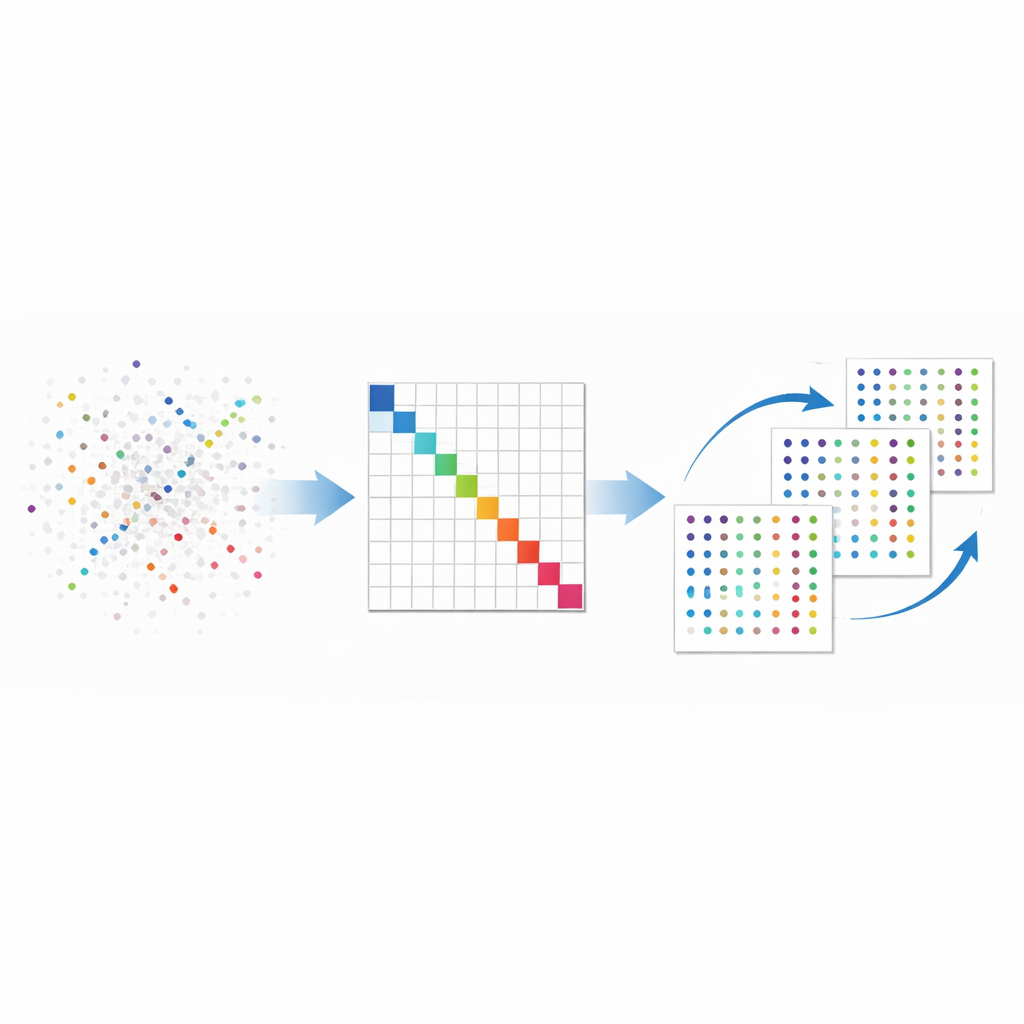
The authors show that Zak-OTFS can be re-expressed in the frequency domain in a way that keeps all its advantages while making equalization far simpler. They start by applying a specific transform, the inverse discrete frequency Zak transform, to convert symbols from the delay–Doppler grid into a frequency-domain representation. In this new view, the channel matrix—essentially, the rule mapping transmitted symbols to received ones—turns out to be “modulo banded,” with most of its energy clustered around a shifted diagonal. By carefully choosing how information is placed in frequency, using the mathematical null space of the transform, they force the effective matrix to become truly banded: only a narrow strip around the main diagonal matters. This structural simplification is the key to a drastic reduction in computational cost.
Lightweight algorithms that still perform
Once the matrix is banded, the authors use a classical iterative method, the conjugate gradient algorithm, to perform minimum mean-square-error equalization. Because each iteration touches only the small band instead of a full dense matrix, the complexity grows only linearly with the frame size, rather than cubically as in naive approaches. Simulations show that this low-complexity frequency-domain equalization performs almost identically to traditional Zak-OTFS equalization done directly in the delay–Doppler domain, both when the channel is perfectly known and when it must be estimated from pilot signals. The study covers various pulse-shaping filters and compares results against OFDM and another candidate 6G waveform (AFDM), finding that Zak-OTFS with the proposed equalization retains its robustness across harsh mobility conditions.
Stable signals for a moving world
In plain terms, this work shows how to make a promising next-generation wireless waveform both sturdy and practical. Zak-OTFS already provides a way to see the channel as a stable delay–Doppler landscape, well-suited to high-speed and high-frequency scenarios where OFDM falters. By revealing a frequency-domain viewpoint in which the underlying mathematics simplifies to a narrow band and by exploiting that structure with efficient iterative methods, the authors demonstrate that reliable equalization need not be computationally heavy. This makes Zak-OTFS a more realistic option for future 6G systems that must deliver robust connectivity to users in fast motion without overwhelming the hardware in their devices and base stations.
Citation: Mattu, S.R., Mehrotra, N., Khan Mohammed, S. et al. Low-complexity equalization of Zak-OTFS in the frequency domain. npj Wirel. Technol. 2, 9 (2026). https://doi.org/10.1038/s44459-025-00011-0
Keywords: Zak-OTFS, frequency-domain equalization, high-mobility wireless, 6G waveforms, delay-Doppler communication