Clear Sky Science · en
Efficient electrification in a warming climate could contribute to keeping energy burdens in check
Keeping the Lights On and the House Warm
For many families, especially those with low incomes, paying the energy bill every month means making painful trade-offs—sometimes between heating the home and buying food or medicine. This study asks a timely question: as the climate warms and more homes switch from gas furnaces to electric heat pumps, will energy bills become easier or harder to afford? By looking closely at different cities, seasons, and household types across the United States, the authors show that the answer is not simple—but it is crucial for shaping fair climate and energy policies.

Why Energy Bills Hit Some Households Harder
The authors focus on “energy burden,” the share of a household’s income spent on electricity and gas. High burdens are common among low-income, Black, and Hispanic households, who are more likely to live in inefficient, leaky homes with older heating and cooling systems. Past studies often looked only at total energy use or yearly averages. This research instead examines monthly energy burdens for 10,000 representative single-family homes in 28 U.S. cities, using real utility rate structures and detailed data on housing and income. That approach captures the spikes that matter most to families—for example, a single brutal January where the heating bill can rival a month’s income.
Warming Winters and New Heat Pumps
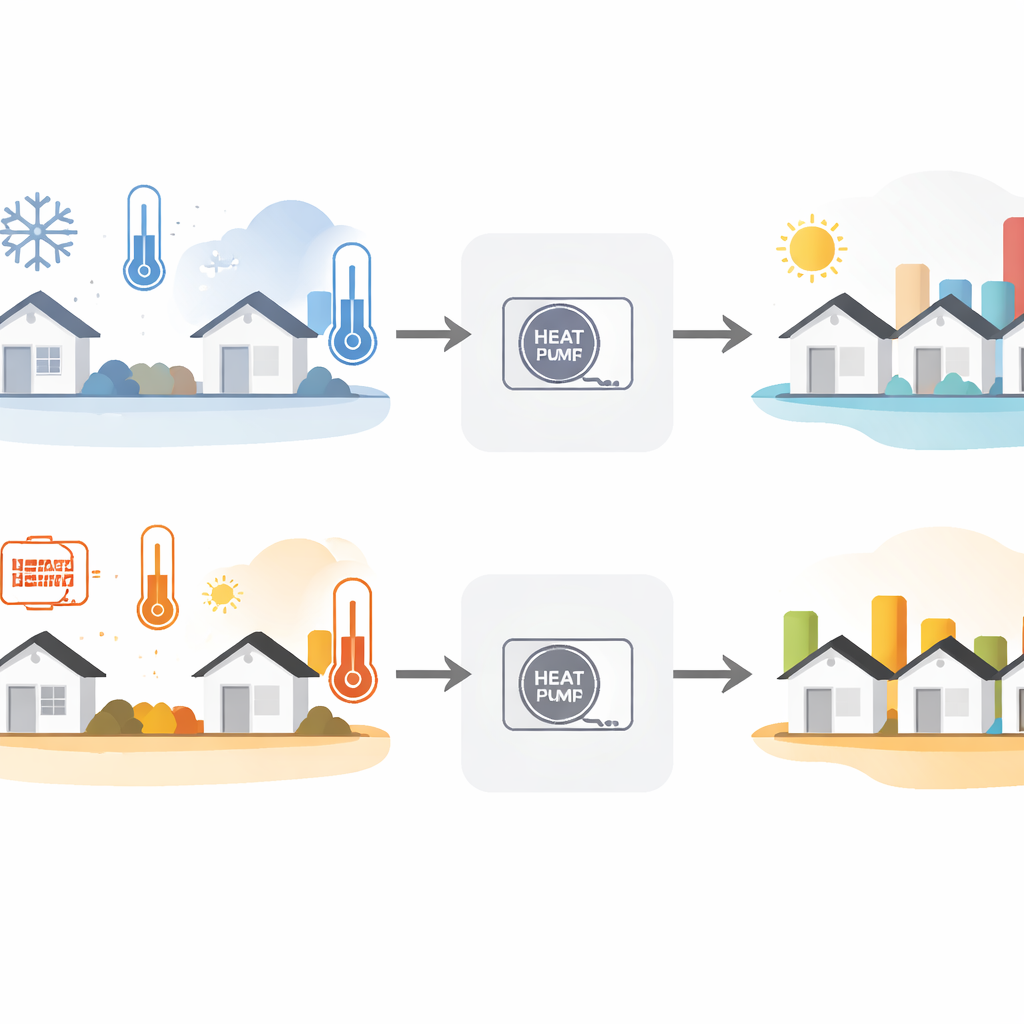
Two powerful trends are reshaping home energy use: climate change and the push to electrify heating with air-source heat pumps. Heat pumps can efficiently provide both heating in winter and cooling in summer, and are viewed as essential for cutting greenhouse gas emissions. But electricity often costs more per unit of energy than fuels like natural gas, and heat pumps work less efficiently in very cold weather. At the same time, warming winters can reduce heating needs while hotter summers increase cooling demand. Using a simplified but physics-based building model combined with future climate scenarios, the authors simulate how different combinations of current systems, future heat pumps, and historical versus mid-century climates change bills for each sampled home.
Cold Cities, Hot Cities, and Unequal Outcomes
The results show that location matters enormously. In cold and very cold cities such as Detroit, Buffalo, Boston, and Minneapolis, switching from gas furnaces to electric heat pumps alone tends to raise winter energy burdens, because higher electricity prices outweigh efficiency gains at low temperatures. Warming winters partly offset this, and in many mixed or milder climates—like Baltimore, Dallas, and Seattle—heat pumps plus a warmer climate actually lower typical burdens. In hot and hot-humid cities such as Phoenix, Houston, and Orlando, heat pumps cut summer cooling costs, but climate change pushes cooling demand up, leading to modest net improvements rather than dramatic savings. Marine climates like San Francisco and Seattle see relatively small changes overall due to their already mild conditions.
The Households Who Feel Every Spike
Looking beyond city averages reveals stark inequalities. In Detroit, the median annual energy burden is under 5%, but for the 10% of households with the highest burdens it reaches about 58%, meaning more than half of their income goes to energy. In very cold Buffalo, the median January burden across all households is nearly one quarter of income, and for the most vulnerable it can approach or even exceed 100% in the coldest month—essentially making it impossible to pay the bill without severe sacrifice. Electrification helps some groups dramatically, especially those currently using resistance electric heating, propane, or fuel oil, whose bills can drop when they adopt heat pumps. But it can hurt others who now rely on relatively cheap natural gas. Aggregating everyone together can be misleading: citywide averages may show savings even while some gas-heated households see higher and more stressful winter bills.
What This Means for Fair Climate Policy
The study concludes that electrification combined with a warming climate can keep or even lower energy burdens in many places, but will not, by itself, solve the problem of energy poverty—and in some cold cities it can worsen winter stress for certain groups. To protect vulnerable households, the authors argue that policies must be tailored to local conditions. In cold regions, weatherizing homes and reforming electricity rates can cushion higher winter costs. In mixed and warm regions, lowering the upfront cost of heat pumps and educating residents about cooling savings can speed adoption. Everywhere, targeted bill assistance and income-based rate designs will still be needed, because even the most efficient technology cannot erase the reality that some families simply do not earn enough to comfortably cover essential energy use.
Citation: Yi, M., Nawawi, S. & Vaishnav, P. Efficient electrification in a warming climate could contribute to keeping energy burdens in check. Commun. Sustain. 1, 51 (2026). https://doi.org/10.1038/s44458-026-00053-7
Keywords: energy burden, heat pumps, climate change, energy poverty, building electrification