Clear Sky Science · en
Air pollution and greenspace exposure disparities revealed by hyperlocal exposure metrics across European cities
Why City Air and Green Spaces Matter
Across Europe, city living is on the rise, and with it comes a basic question: who gets clean air and who gets access to trees, parks, and other greenery? This study looks closely at three European capitals—Dublin, Amsterdam, and Copenhagen—to see how exposure to traffic-related air pollution and street-level greenery differs for people of different incomes, backgrounds, and origins. Using detailed mapping tools, the researchers show that the environmental advantages and disadvantages of city life are not shared equally, and that the patterns vary from city to city in surprising ways.
Looking Street by Street
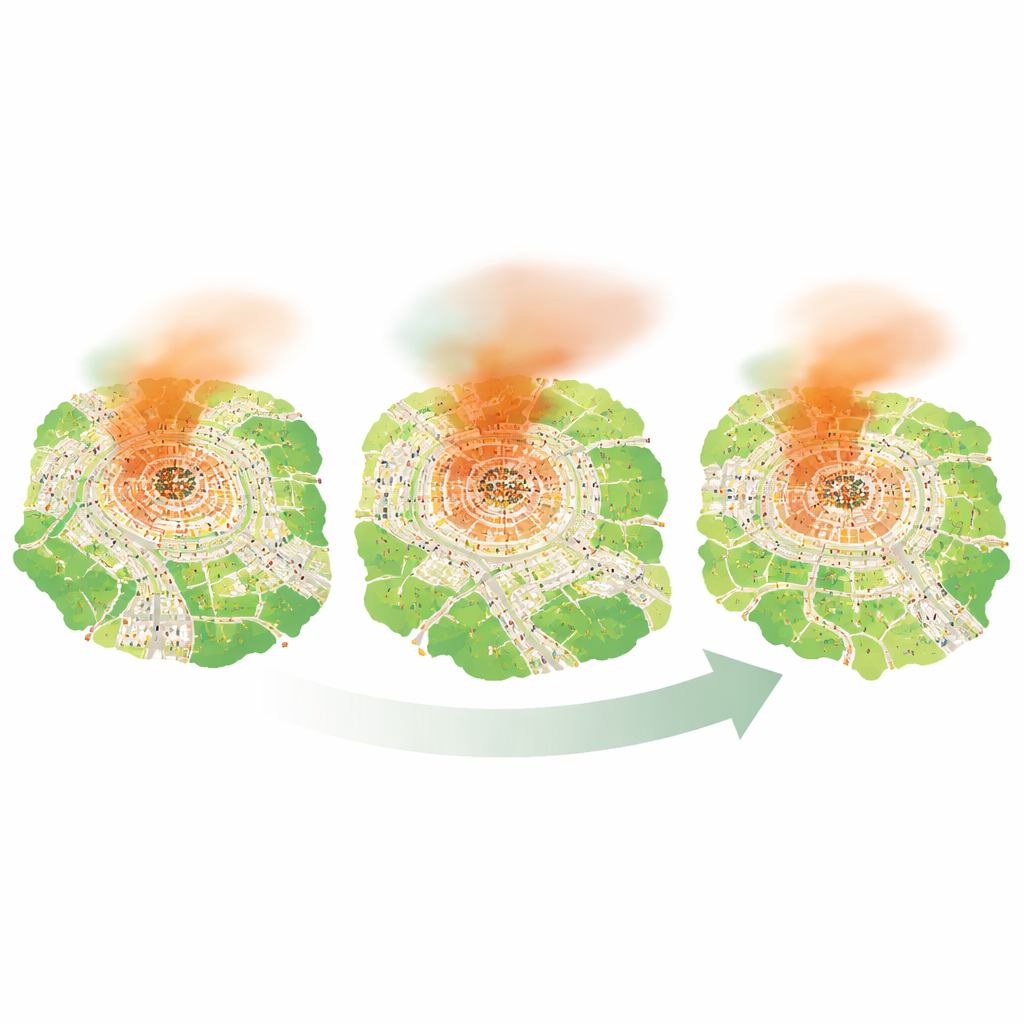
Instead of relying on a few monitoring stations or coarse maps, the team used “hyperlocal” data: air pollution measured second-by-second by sensor-equipped cars driving along city streets, and greenery measured from Google Street View images using computer vision. From these data they calculated how much nitrogen dioxide—a traffic-related pollutant linked to heart and lung disease—and how much visible street greenery were present on roughly 50-meter segments of road. They then combined these fine-scale environmental measurements with detailed census data to estimate how much pollution and greenery different population groups actually experience in the places where they live.
Different Cities, Different Environmental Divides
The three cities shared some broad patterns. In all of them, central districts and areas along major roads tended to have more nitrogen dioxide, while greener streets were more common toward the edges of the urban area and around large parks. But when the researchers overlaid these maps with information about people’s backgrounds, the picture became more complex. In Dublin, racial and ethnic minority residents were more likely to live in areas with higher traffic pollution and less greenery than White residents. Immigrants there, and also in Copenhagen, were more often found in dirtier and less green neighborhoods than natives. Amsterdam, however, showed the opposite trend for immigrants, who tended to live in somewhat cleaner and greener areas than people classified as natives under Dutch definitions.
Surprising Patterns of Wealth and Environment
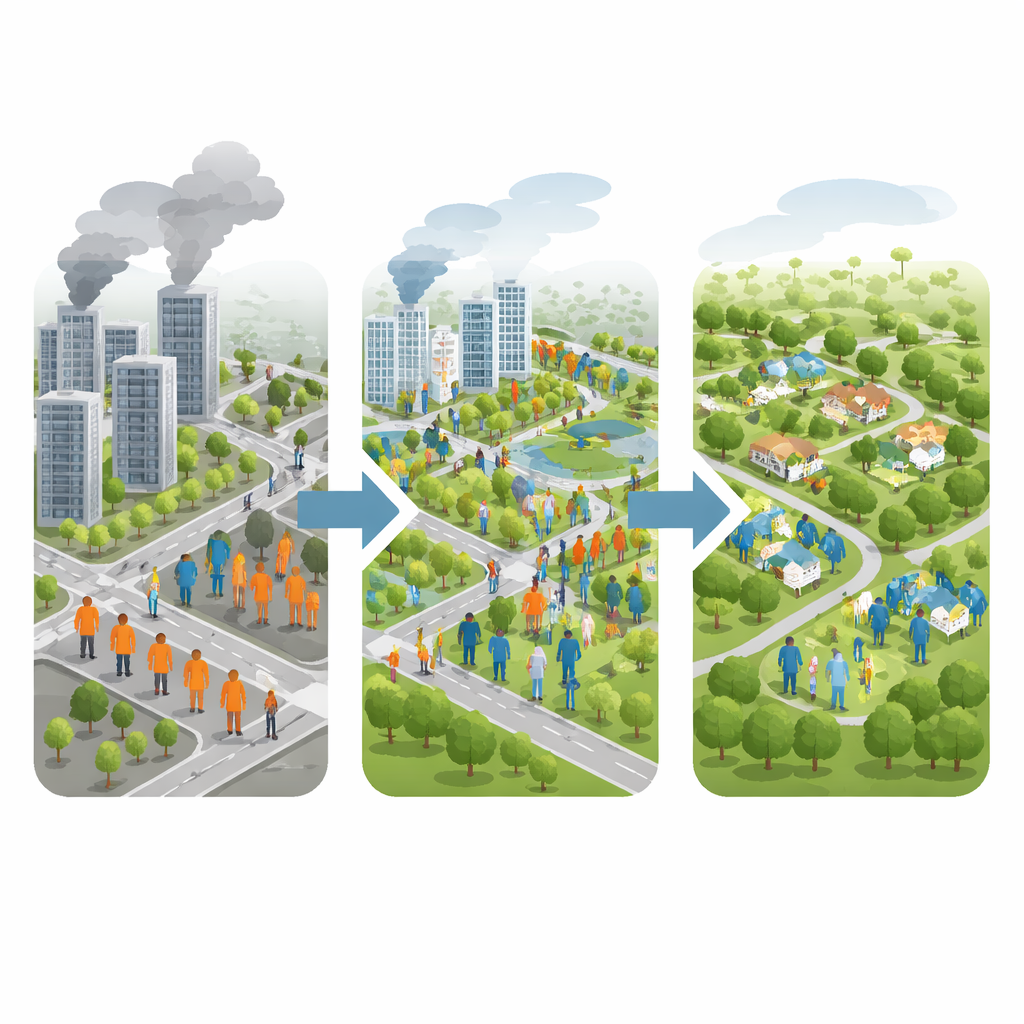
One of the most striking findings concerned income. In all three cities, people living in low-income areas were exposed to lower average levels of nitrogen dioxide and higher levels of greenery than those in high-income areas. This runs counter to many studies from the United States, where poorer neighborhoods often suffer the worst pollution and the least access to green space. In Western Europe, the authors suggest, wealthier residents are frequently drawn to historic, amenity-rich city centers, where traffic and dense buildings push up pollution and limit space for trees. Poorer residents may be pushed outward to less central neighborhoods that, while less prestigious, can actually offer cleaner air and more street-level vegetation.
Who Is Affected and Why It Matters
To understand whether these patterns were just accidents of city layout, the team created thousands of random “what if” versions of Dublin’s population map, shuffling where people lived while keeping the overall city structure the same. The real-world disparities—especially higher pollution and lower greenery for racial and ethnic minorities—were consistently larger than what would be expected by chance, implying that social and historical forces, not randomness, shape these exposures. The study also shows that, within similar income bands, White Dubliners still tend to live in cleaner and greener areas than minority residents, and that the details of who is considered “native” or “immigrant” can strongly affect the picture in each country.
What This Means for Fairer Cities
Overall, the study concludes that there is no single European pattern of environmental advantage and disadvantage. Instead, each city shows its own mix of who breathes more polluted air and who sees more greenery outside their door. By revealing these differences street by street, the work gives urban planners and policymakers sharper tools to design fairer and healthier cities—whether that means targeting pollution hot spots where minority or immigrant communities live, or ensuring that central, wealthier districts do not monopolize civic investments while quietly bearing higher pollution burdens. The authors argue that such city-specific, fine-grained evidence is essential if Europe is to build urban environments that are both sustainable and socially just.
Citation: Sabedotti, M.E.S., Duarte, F., Koutrakis, P. et al. Air pollution and greenspace exposure disparities revealed by hyperlocal exposure metrics across European cities. Commun. Sustain. 1, 48 (2026). https://doi.org/10.1038/s44458-026-00046-6
Keywords: air pollution, urban greenspace, environmental justice, European cities, health disparities