Clear Sky Science · en
Optimizing electric vehicle charging patterns and infrastructure for grid decarbonization
Why Your Car’s Plug Matters for the Planet
Electric cars are often promoted as climate saviors, but what happens when millions of them plug in at once? This study looks at Shanghai, one of the world’s largest electric vehicle (EV) cities, to ask a deceptively simple question: if we are smart about when and where EVs charge, can we keep the lights on, avoid building expensive new power plants, and still cut carbon pollution? The answer, the authors find, is yes—if cities coordinate drivers’ charging habits with well-planned charging stations and a cleaner power grid.
The Hidden Problem Behind Clean Cars
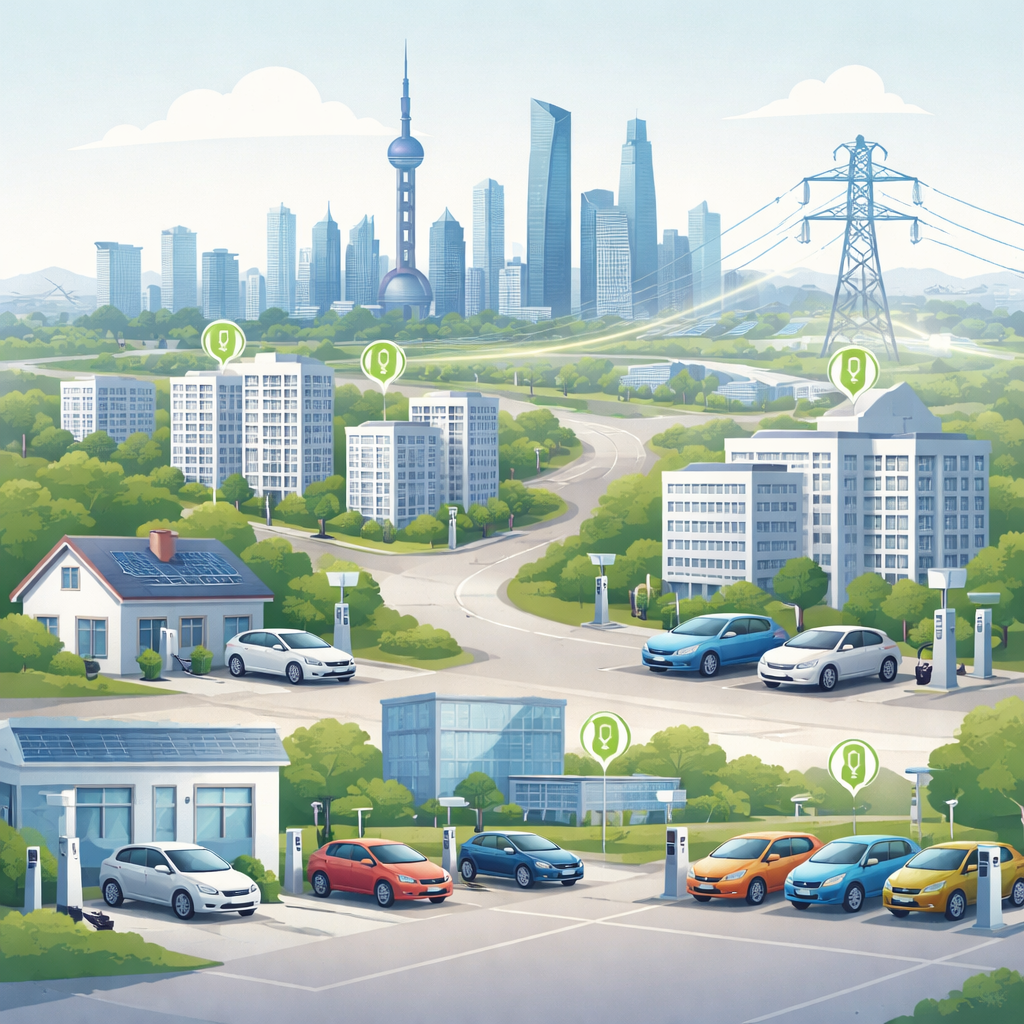
Today, most EV owners in Shanghai plug in at home after work, piling their charging load on top of the city’s normal evening electricity peak. That means power companies must fire up extra plants, often fueled by fossil fuels, just when pollution is already at its worst. The study shows that home charging dominates demand and spikes from early evening to midnight, overlapping almost perfectly with the city’s highest grid loads. Public charging—at workplaces or shopping areas—plays a much smaller role and is unevenly spread across the city, leaving some neighborhoods short of options that would make off-peak charging practical. Without better coordination, rising EV adoption could increase strain on the grid and push emissions from city streets back to distant power plants.
A Smarter Way to Plug In
Using second-by-second driving and charging data from thousands of EVs between 2018 and 2024, the researchers tested a “flexible scheduling” strategy. Instead of changing people’s trips, they only shifted charging sessions within the places and times drivers already visit. For example, a car that arrives home late at night and is driven to a public area the next afternoon could delay part of its charging to that later stop, when the grid is under less pressure. The model limits these changes so they don’t seriously inconvenience drivers: it moves only a fraction of charging events between stops and delays charging by a modest amount within each parking period. Even under these cautious rules, the citywide effect is large—the peak charging power over a week can drop by more than 40%, as energy use is spread from the busiest evening hours into quieter nighttime or mid-day periods.
Building the Right Stations in the Right Places
Scheduling alone is not enough; it must be backed by well-placed charging stations. The team projected how Shanghai’s economy, population, EV fleet, and public charging network might grow through 2035. They then designed a deployment plan that ties the number of new charging stations in each area to local population and expected charging demand. Crucially, only about one-tenth of new public chargers are reserved specifically to support flexible scheduling, with the rest serving everyday needs. Even with this small dedicated share, the city can support much more off-peak charging, reduce local overloads, and make it practical for drivers to shift away from the evening rush to public stations in other districts or at different times of day.
Cutting Carbon While Easing Grid Stress
Because China’s eastern power grid is still heavily dependent on fossil fuels, especially at peak times, shaving those peaks has clear climate benefits. The study combines its charging simulations with forecasts of how the region’s electricity mix will change, including growth in wind, solar, and hydropower. Between 2018 and 2035, the researchers estimate that smarter charging and targeted station deployment could avoid more than 10,000 gigawatt-hours of peak-time electricity use and cut around 46,000 tons of carbon dioxide emissions linked specifically to extra power dispatch for EV charging. On a per-vehicle basis, the additional emissions from transmitting power to meet EV demand first rise as the fleet expands, then fall again as the grid gets cleaner and scheduling takes hold. Even when not every driver follows the schedule, the benefits remain: higher participation leads to disproportionate gains, because the biggest improvements come from the drivers who are willing to shift the most charging away from the tightest peaks.

What This Means for Future Cities
For a non-specialist, the core message is straightforward: electric cars deliver their full climate promise only when their charging is aligned with a cleaner, well-managed grid. In Shanghai, carefully timing and locating charging—without changing where people live or work—can avoid costly new power plants, cut pollution, and make better use of renewable energy. The authors argue that other fast-growing EV cities can follow a similar path by combining real-world driving data, modest incentives for off-peak charging, and thoughtful placement of public chargers. Done right, plugging in an EV becomes not just a cleaner choice than filling a gas tank, but also a tool to help stabilize the grid and speed up the shift to low-carbon power.
Citation: Liao, C., Deng, J., Chen, X.M. et al. Optimizing electric vehicle charging patterns and infrastructure for grid decarbonization. Commun. Sustain. 1, 43 (2026). https://doi.org/10.1038/s44458-026-00037-7
Keywords: electric vehicle charging, smart grid, urban mobility, charging infrastructure, decarbonization