Clear Sky Science · en
High-capture-rate carbon capture and storage enables cost-effective decarbonization of Europe’s power sector
Keeping the Lights On While Cutting Carbon
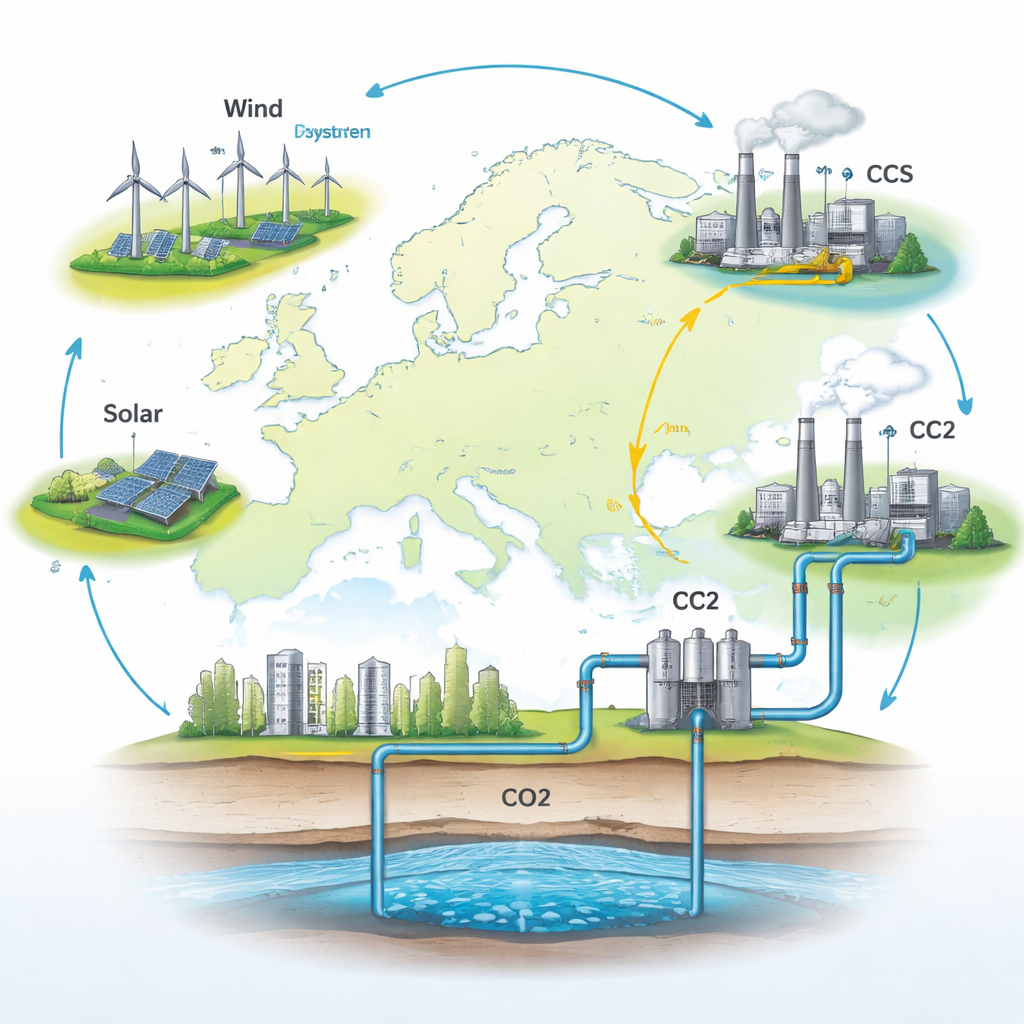
Europe has promised to slash climate-warming emissions, yet much of its electricity still comes from fossil fuels. Shutting down coal and gas plants overnight would risk blackouts and soaring bills. This study asks whether a different path is possible: keeping some fossil power plants running, but fitting them with advanced carbon capture and storage (CCS) systems that trap almost all of their pollution. The authors show how this approach, combined with a massive build-out of wind and solar power, could help Europe reach its climate goals at lower cost and with a more reliable power grid.
Building a Cleaner Power Mix
The researchers use a detailed computer model of Europe’s power system to explore different futures through 2050. The model simulates how electricity demand grows, how quickly new power plants and transmission lines can be built, and how weather affects wind, solar, and hydropower. It then finds the least-cost combination of technologies that can meet electricity needs while following strict limits on carbon dioxide emissions. In every scenario, wind and solar become the backbone of Europe’s electricity supply, rising from about 60% of today’s generation to roughly 80% by mid-century, while nuclear power gradually fades as old plants retire.
What Happens to Fossil Fuels?
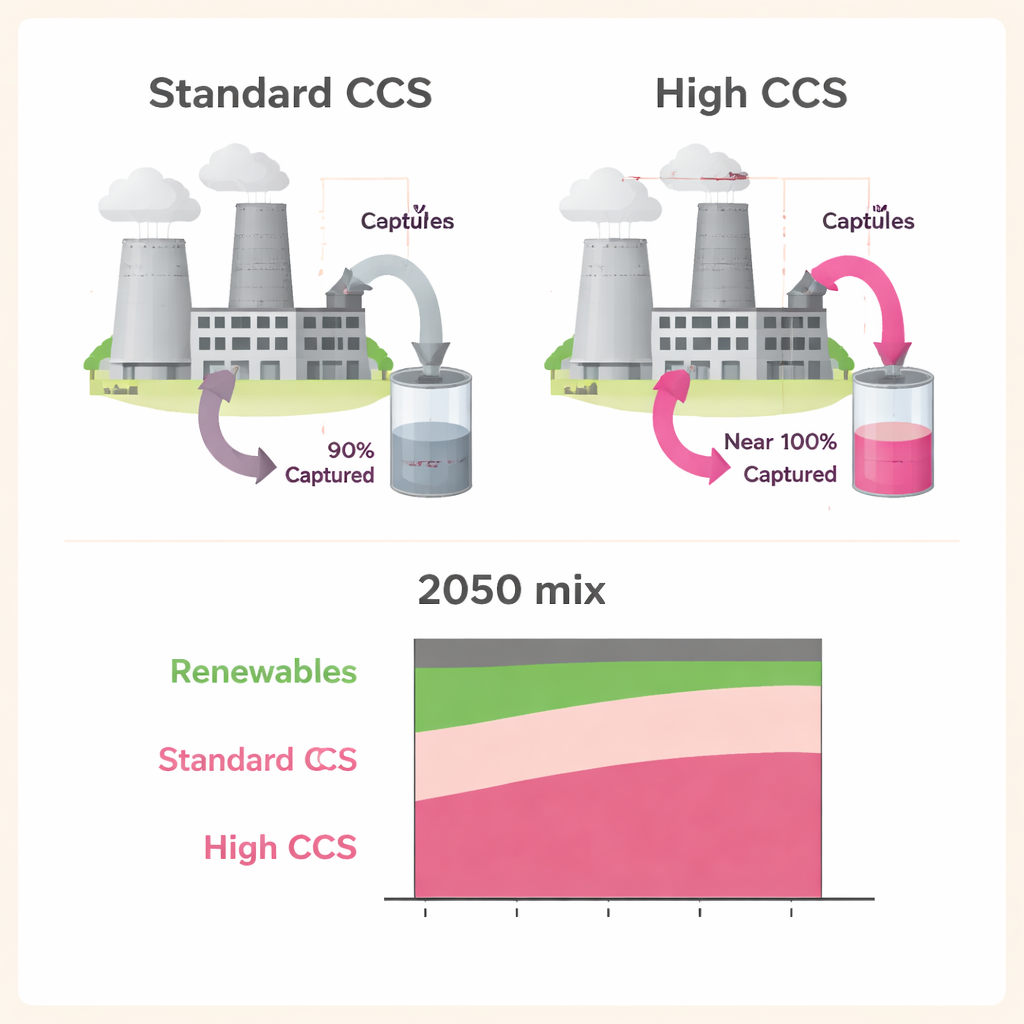
Instead of vanishing, fossil-based power shifts into a new role. Coal and gas plants without carbon capture are used less and less, but many remain installed as rarely used backup for extreme demand peaks. The main change is that new fossil plants are built with CCS equipment. Standard CCS can remove about 90% of a plant’s carbon emissions, while a newer “high-capture” version can remove virtually all of them, making the plants effectively carbon neutral at the smokestack. By 2050 in the central scenario, fossil plants with CCS supply around one-fifth of Europe’s electricity—more in absolute terms than today’s unabated fossil generation—while total power sector emissions fall by more than 95%.
Different Rules, Different Outcomes
The team tests four policy-style scenarios. In the “base” case, both standard and high-capture CCS can be built anywhere they are technically available. A “conventional” case bans the new ultra-high-capture option, forcing the system to rely more on standard CCS, wind, solar, and biomass. A “no-fossil-2040” scenario stops all new fossil plant construction after 2040, even if equipped with CCS, while a “limited-CCS” scenario allows CCS only in four North Sea countries with large offshore storage potential. Across these futures, the system still leans heavily on renewables, but restricting where or how CCS can be used makes the power system noticeably more expensive. The limited-CCS case, for example, raises total power costs by about 6%, because many more wind farms, solar arrays, and storage units must be built to compensate.
Why Carbon Prices and Carbon Removal Matter
The model also calculates how high carbon prices would need to be to push the power sector toward deeper cuts. It finds that going from roughly 93–97% emission reductions to a full 100% is extremely costly: carbon prices would have to soar to hundreds or even over a thousand euros per tonne in the 2050s. At that point, it becomes cheaper to clean up the last few percent of emissions using carbon dioxide removal (CDR) methods such as direct air capture or bioenergy with CCS, which pull CO2 out of the atmosphere. The authors conclude that the most cost-effective path is to decarbonize the power sector to about 92–97% and rely on CDR to neutralize the remaining emissions, rather than forcing the grid itself to become permanently “carbon negative.”
What This Means for Europe’s Energy Future
For non-specialists, the message is that Europe’s cheapest and most reliable route to a near-zero-emission power system combines three pillars: very large amounts of wind and solar, a continued but transformed role for fossil power plants fitted with advanced CCS, and a supporting layer of carbon removal to mop up the last emissions. High-capture-rate CCS allows some coal and gas plants to keep operating without blowing the carbon budget, reducing the cost and difficulty of the transition. But this strategy still demands vast new CO2 transport and storage infrastructure, careful limits on biomass use, strict rules to avoid locking in unnecessary fossil fuel use, and strong public oversight. If these conditions are met, CCS can be a bridge that helps Europe keep the lights on while phasing out the climate impact of fossil power.
Citation: Homaei, S., Anantharaman, R., Backe, S. et al. High-capture-rate carbon capture and storage enables cost-effective decarbonization of Europe’s power sector. Commun. Sustain. 1, 34 (2026). https://doi.org/10.1038/s44458-026-00036-8
Keywords: carbon capture and storage, European power grid, renewable energy transition, climate policy, carbon removal