Clear Sky Science · en
Comparative assessment of United States coastal hubs for large scale electrochemical marine carbon dioxide removal
Why the Ocean Matters for Climate Fixes
As the planet warms, simply slowing new emissions will not be enough; we also need to pull carbon dioxide that is already in the air back out. The ocean is already our biggest natural helper, quietly absorbing a large share of human-made carbon. This study asks a practical question with big implications: if we use new electrochemical devices to boost the ocean’s ability to store carbon, where along the U.S. coastline should we build them first so they are effective, affordable, and fair to nearby communities? 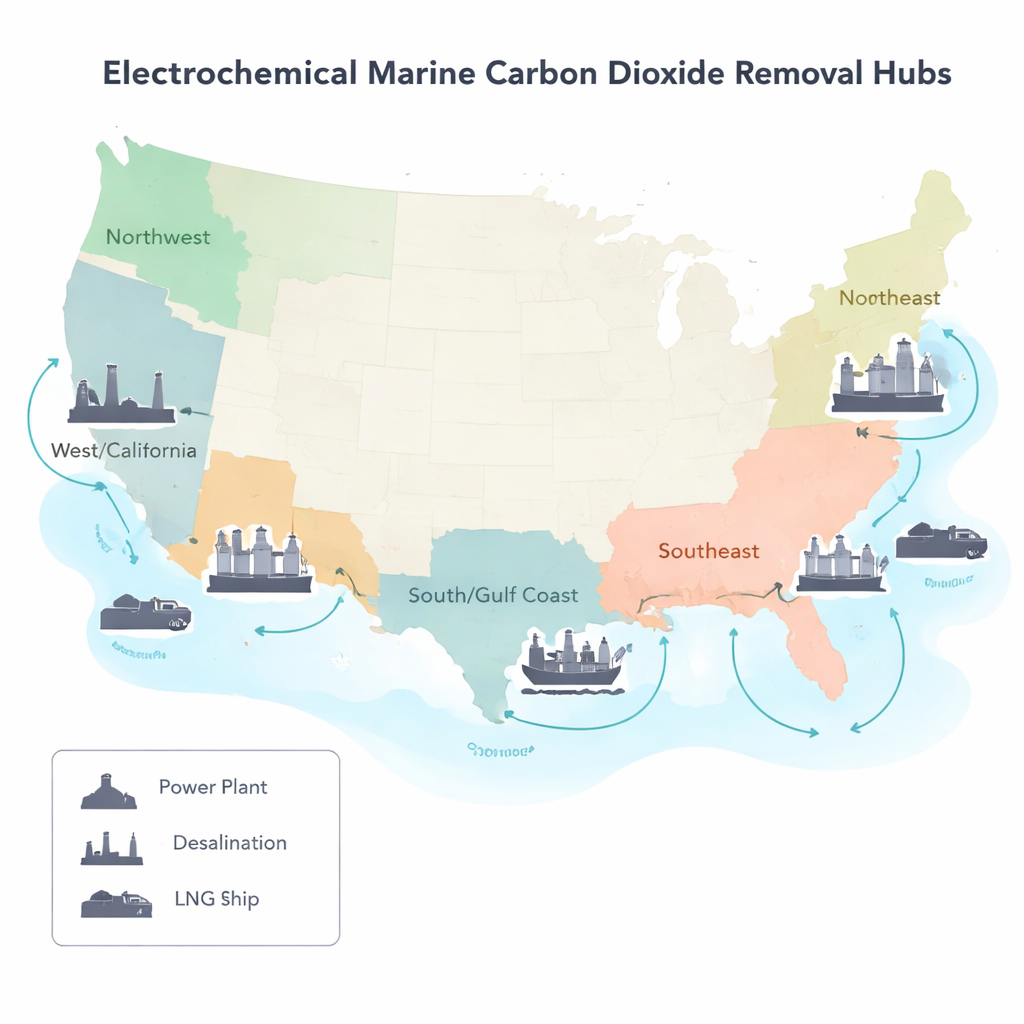
Turning Seawater into a Climate Tool
The paper focuses on an emerging idea called electrochemical marine carbon dioxide removal. Instead of grabbing carbon directly from smokestacks or the open air, these systems treat seawater itself. By running an electric current through seawater, they gently change its chemistry so it can hold more carbon in stable dissolved forms and solid minerals. In the “hybrid” version studied here, the process also produces hydrogen gas, a clean fuel that can be sold, making the overall system more attractive economically. A key advantage of this approach is that it does not depend on long pipelines or underground storage sites for pure CO₂ gas, which are expensive and controversial in many regions.
Looking for the Best Coastal Neighborhoods
Building such facilities from scratch along the entire shoreline would be slow and costly. Instead, the authors look for places that already pump large amounts of seawater for other reasons: coastal power plants, desalination plants, and liquefied natural gas (LNG) terminals. Using public data, they assemble a list of 38 such sites around the continental United States, recording how much water each one moves, what local electricity costs, how clean the regional power grid is, how much carbon nearby industries emit, and how socially vulnerable surrounding communities are. They then use a clustering method to group neighboring facilities into five broad “hubs”: Northeast, Southeast, South (Gulf Coast), West (mainly California), and Northwest. Each hub bundles multiple facilities and their shared regional conditions.
Weighing Capacity, Cost, Clean Power, and People
To compare hubs, the study boils complex data down to seven key yardsticks. These include how much carbon the hub could remove based on seawater flow; how affordable removal might be, based on electricity prices and energy needs; how clean the regional electricity mix is; the local carbon footprint from existing industry; the social vulnerability of nearby communities; how diverse the facility types are within the hub; and how strong the local hydrogen infrastructure is, such as pipelines and storage. Using a formal scoring method, experts assign higher weight to criteria like carbon-removal capacity, cost, and grid cleanliness, while still factoring in social and infrastructure concerns. A ranking algorithm then scores each hub on how close it comes to an ideal combination of all these traits.
Where Big Impact Is Most Likely
The results show that three hubs rise to the top. The South hub, anchored along the Gulf Coast of Texas and Louisiana, scores highest overall because it combines relatively cheap electricity, strong hydrogen pipelines and storage, high industrial emissions that could be offset, and a mix of facility types. The West hub, largely in California, stands out for its huge seawater-handling capacity, abundant clean power, and decent hydrogen infrastructure, even though electricity is more expensive. The Northeast hub also looks promising thanks to strong removal capacity and a relatively clean grid, though it depends heavily on power plants and has less facility diversity. The Southeast performs moderately well, while the Northwest appears more fragile: its ranking drops sharply if a single large facility or certain LNG terminals are taken out of the picture. 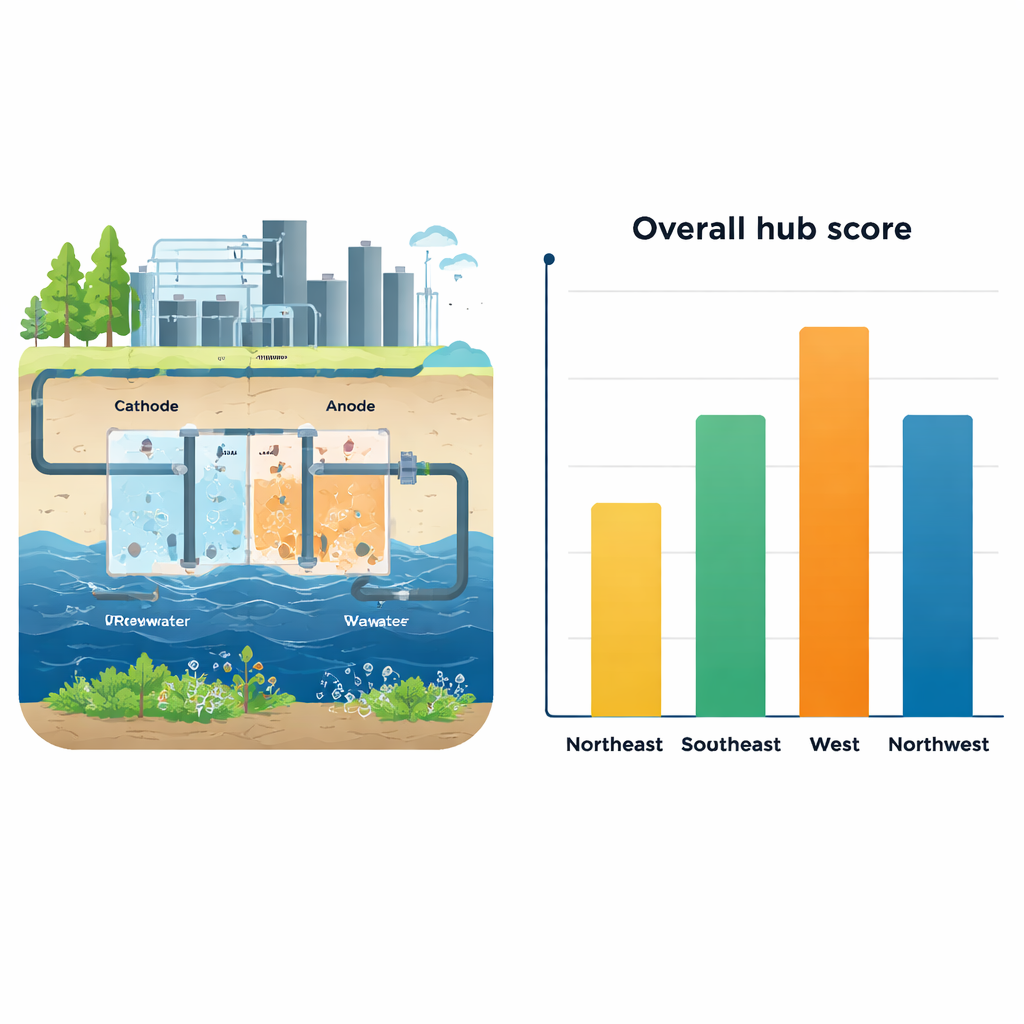
Resilient Choices and Future Directions
Importantly, the overall picture remains stable even when the authors stress-test their assumptions by changing how different criteria are weighted or by virtually removing key facilities. While the exact order of the top three hubs can shift, the same regions—South, West, and Northeast—consistently emerge as leading candidates. This suggests that investors and policymakers can start planning with some confidence while technology keeps improving. For a layperson, the takeaway is straightforward: by carefully choosing where to place these seawater-based systems, the U.S. can pull more carbon from the atmosphere for each dollar spent, use cleaner electricity to do it, and direct benefits such as jobs and cleaner air toward communities that need them most. The framework developed here can also be reused in other countries, helping to guide a global rollout of ocean-based carbon removal in a strategic, evidence-based way.
Citation: Refaie, A., Afshari, M., Tapia, V. et al. Comparative assessment of United States coastal hubs for large scale electrochemical marine carbon dioxide removal. Commun. Sustain. 1, 33 (2026). https://doi.org/10.1038/s44458-026-00035-9
Keywords: ocean carbon removal, electrochemical seawater treatment, carbon capture hubs, hydrogen co-production, climate mitigation