Clear Sky Science · en
Scaling up enhanced rock weathering for equitable climate change mitigation
Turning Rocks into a Climate Ally
As the world scrambles for ways to pull planet-warming carbon dioxide out of the air, a deceptively simple idea is gaining attention: spreading finely crushed rock on farm fields. This study explores how that tactic—known as enhanced rock weathering—could scale up worldwide over the rest of the century, how much carbon it might lock away, and who stands to benefit most. The answers matter not just for the climate, but also for global fairness: will this new tool mainly serve rich countries, or can it become a shared resource that helps farmers and communities everywhere?
How Rock Dust Helps Farms and the Climate
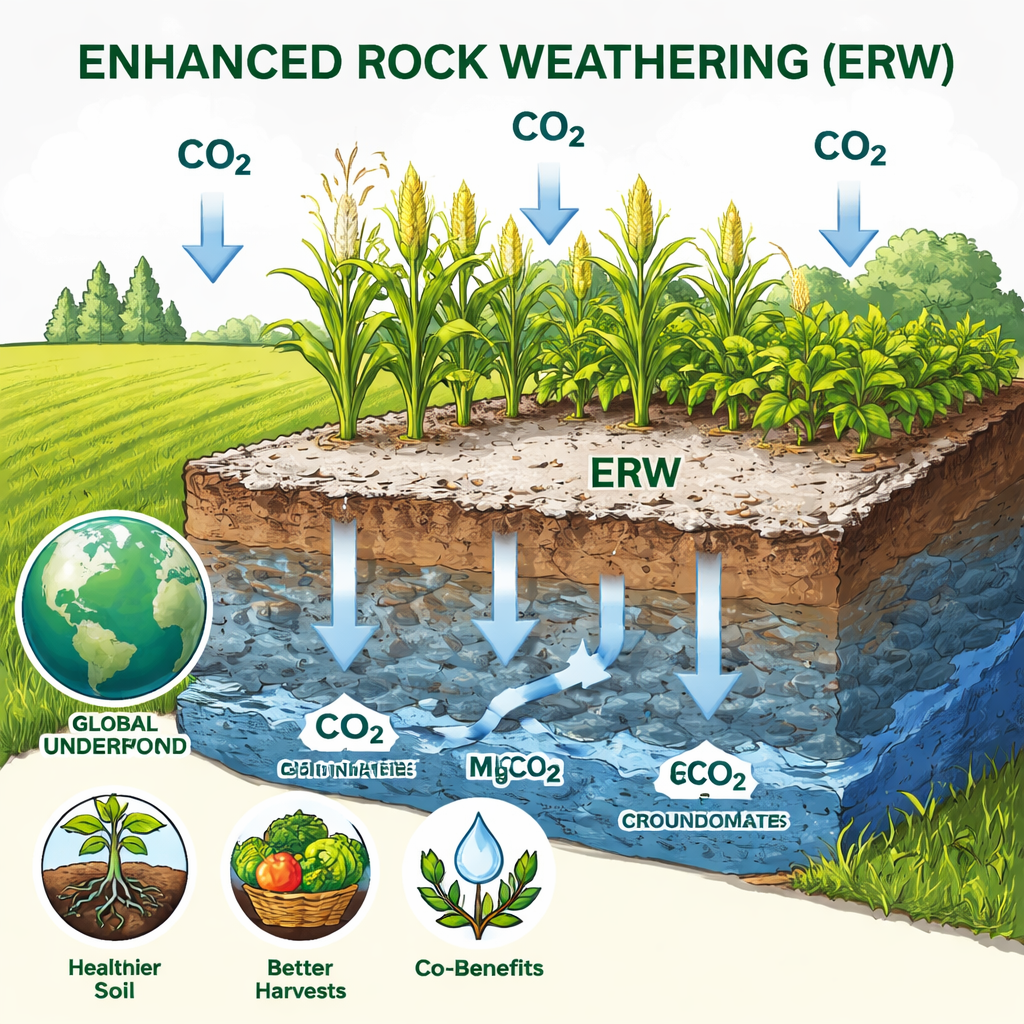
Enhanced rock weathering works by speeding up a natural Earth process. Farmers apply crushed silicate rocks, often leftovers from mining, onto cropland soils. When rainwater and carbon dioxide from the air react with these minerals, they form stable compounds that trap carbon for thousands of years, often carried away in groundwater and locked into bedrock. Beyond carbon removal, these rocks can gently fertilize the soil by releasing nutrients like calcium and magnesium, reduce reliance on synthetic fertilizers, and help counter soil acidification. Major companies are already funding early projects, and scientific bodies now see this approach as one of several promising long-term climate tools.
Looking to History to Predict the Future
Despite the excitement, a key unknown is how fast farmers around the world will actually adopt rock weathering. Instead of guessing, the researchers turned to history. They examined how past agricultural innovations—such as irrigation and fertilizer use—spread across countries over time. These technologies usually follow an S-shaped curve: slow at first, then a rapid surge, and finally a plateau. Using a nonlinear economic model, the team translated these historical “diffusion” patterns into five future scenarios for rock weathering, ranging from business-as-usual to very aggressive global rollout. One special scenario links adoption directly to rising global temperatures, assuming societies respond more decisively once climate impacts become impossible to ignore.
Five Possible Paths for Global Adoption
In their baseline scenario, rock weathering gradually expands to cover about half of the world’s cropland by 2100, with richer regions like North America and Europe leading the charge. Other scenarios explore higher coverage, earlier starting dates, or faster growth rates. The most dynamic scenario adds “human–nature feedbacks”: as global temperatures cross set thresholds (around 1.8, 2.1, and 2.4 degrees Celsius above preindustrial levels), public concern and political will are assumed to strengthen, pushing countries toward more ambitious deployment paths. In these futures, lagging regions such as South Asia and Sub-Saharan Africa start slowly but then accelerate sharply, narrowing the gap with early adopters.
Where the Carbon Removals Come From
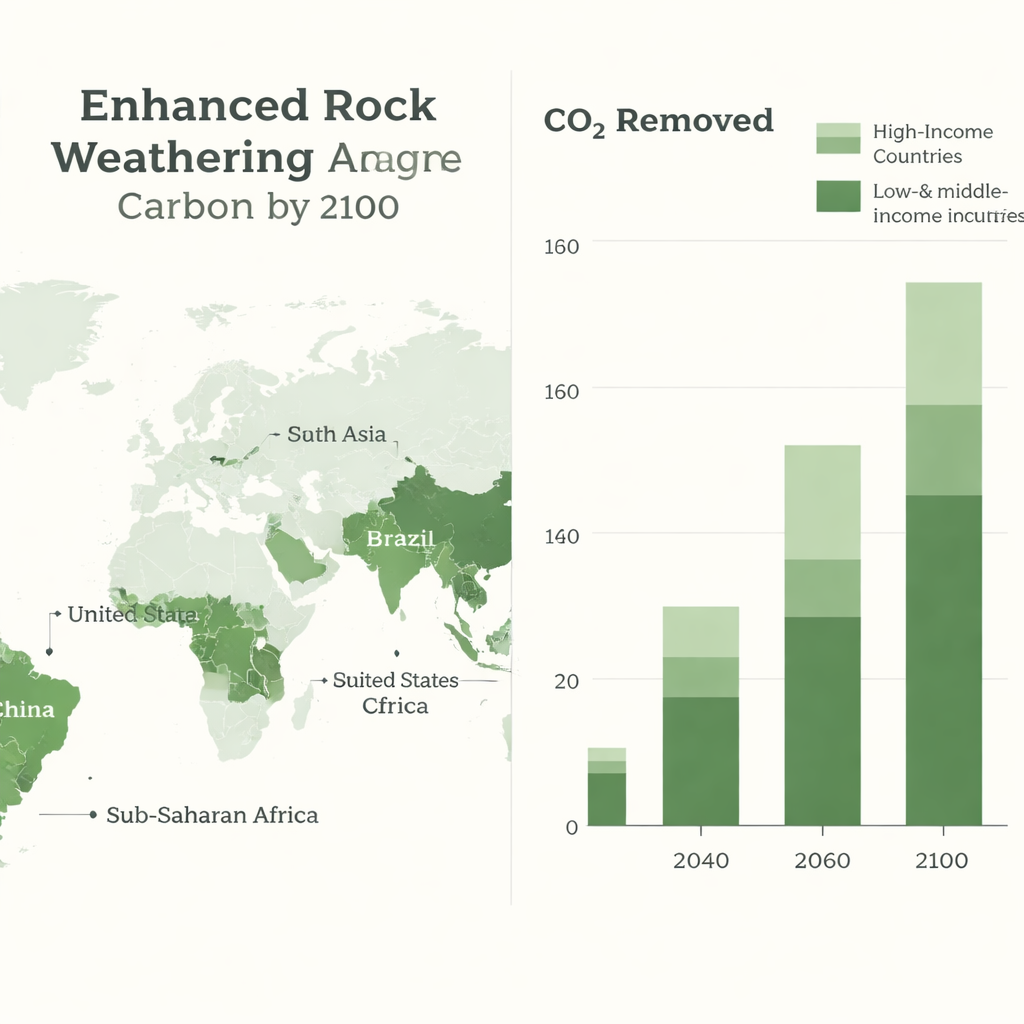
To estimate how much carbon rock weathering might remove, the researchers combined their adoption scenarios with fine-scale maps of climate and cropland. Weathering works best where conditions are warm and wet, so places like the Indo-Gangetic Plain of India and Pakistan, Southeast Asia, equatorial Africa, and southeastern Brazil show particularly high potential per hectare. Across all scenarios, global carbon removal grows steadily through mid-century, then levels off between about 0.7 and 1.1 billion tons of carbon dioxide per year by 2100—significant, but only a slice of what is needed to stabilize the climate. Early on, most of the removal happens in high-income regions, but by the end of the century, the largest total contributions come from countries like India, Brazil, China, and others in the Global South.
From Unequal Start to Fairer Future
Perhaps the most striking result concerns fairness. By 2040, high-income countries are projected to account for up to half of all carbon removed by rock weathering. But as adoption spreads and warm, well-watered croplands in lower-income regions come online, that balance flips. By 2100, low- and lower-middle-income countries could be responsible for roughly 60% of global carbon removal from this method. The study stresses that this more equitable outcome is not automatic: it depends on deliberate support, including technology transfer, training, fair climate finance, and better infrastructure so that rock dust can actually reach farmers’ fields.
What This Means for Everyday Life
For non-specialists, the message is twofold. First, enhanced rock weathering is not a silver bullet that solves climate change on its own, but it could become an important piece of a broader strategy—especially because it can also improve soils and crop yields. Second, whether this tool deepens or reduces global inequality depends on choices made now. If wealthier nations help build capacity in poorer regions, farmers from India to Brazil to Sub-Saharan Africa could help drive a more just and effective response to climate change, turning everyday croplands into quiet workhorses for cleaning the air.
Citation: Tu, Y., Rafols, R., Xu, Y. et al. Scaling up enhanced rock weathering for equitable climate change mitigation. Commun. Sustain. 1, 32 (2026). https://doi.org/10.1038/s44458-026-00034-w
Keywords: enhanced rock weathering, carbon dioxide removal, climate justice, sustainable agriculture, technology adoption