Clear Sky Science · en
A corn shaped ultrasonic meta-buffer rod design for online temperature monitoring in additive manufacturing
Keeping 3D Printers on Temperature Track
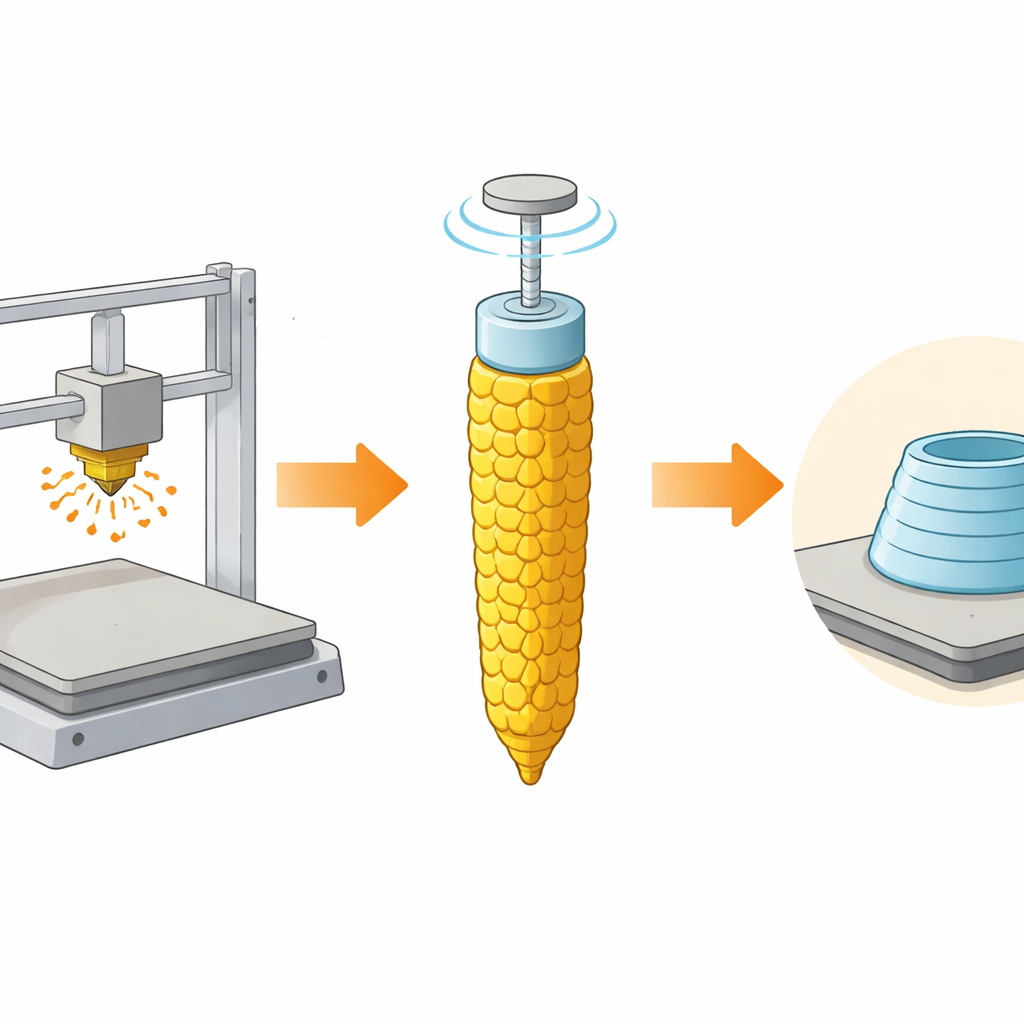
Additive manufacturing—better known as 3D printing—has moved from labs into factories, hospitals, and even homes. But one stubborn problem remains: it is surprisingly hard to know exactly how hot the plastic is as it melts and flows through a printer nozzle. When that temperature swings up and down, printed parts can warp, crack, or weaken. This paper introduces a compact, corn-shaped metal insert that lets engineers monitor those temperatures in real time, even in the harsh, hot environment right next to the nozzle, without damaging sensitive electronics.
Why Heat Control Matters in Everyday 3D Printing
Many popular 3D printers use fused deposition modeling (FDM), where a solid filament is pushed through a heated nozzle, melted, and laid down layer by layer. If the molten filament is too cool, it may not bond well between layers; if it is too hot, it can sag or clog the nozzle. Conventional temperature sensors, such as thermocouples or built‑in thermistors, only measure at a point on the metal block, not inside the moving stream of plastic. Cameras that infer temperature from infrared light struggle with reflections and changing surface properties. As printers become faster and start combining multiple materials in a single part, this lack of reliable, in‑process temperature information becomes a serious bottleneck for quality and safety.
A Corn-Inspired Metal Rod with Two Jobs
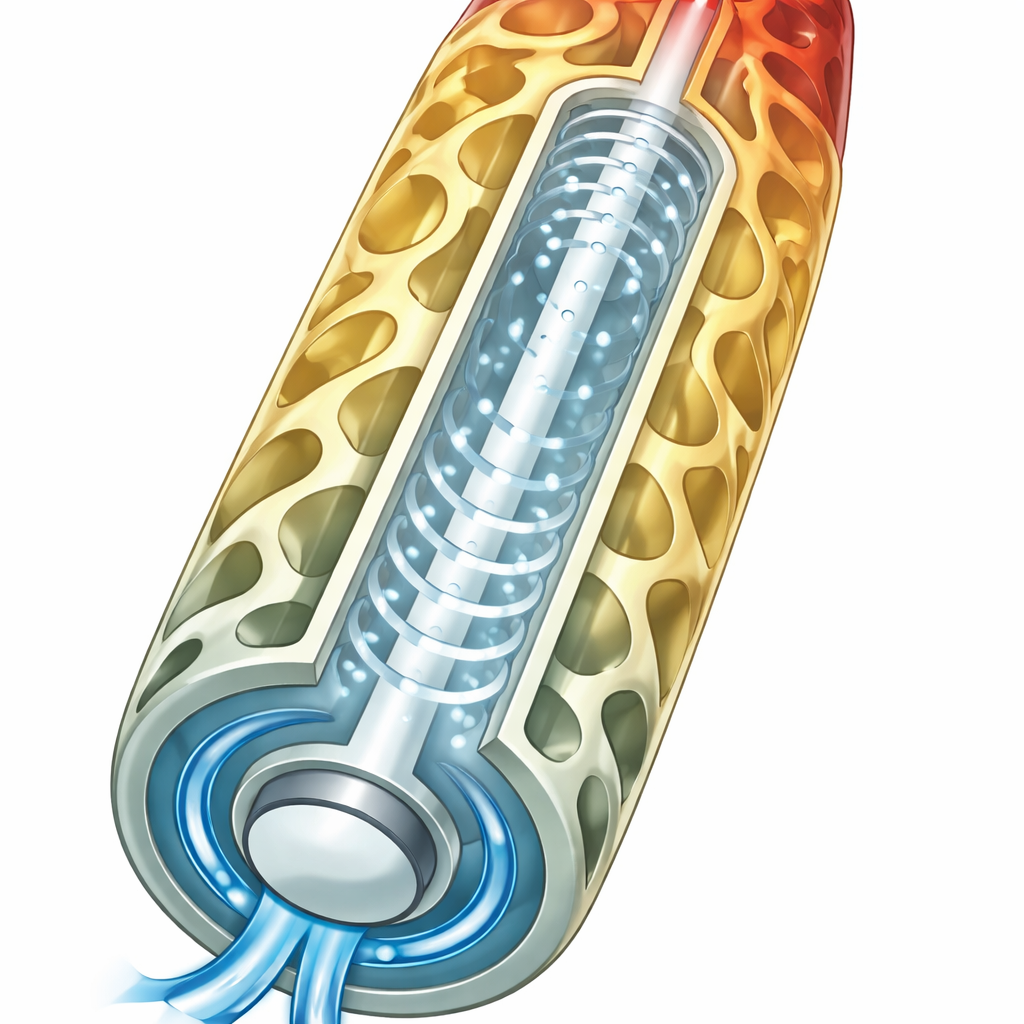
The authors propose a “meta‑buffer rod,” a short metal cylinder shaped like an ear of corn, that sits between the hot nozzle block and an ultrasonic sensor. The rod takes inspiration from corn’s repeating kernels: its outer region is carved into a regular, sponge‑like pattern that guides heat, while its inner region forms a path for sound waves. This design has two goals at once: it must keep the sensor cool enough to survive, and it must carry ultrasonic signals that are sensitive to temperature changes along the rod. By carefully sculpting the interior with a special repeating surface and drilling many tiny holes in the sound channel, the device becomes both a heat‑management element and a high‑performance thermometer.
Using Smart Design to Tune Heat and Weight
To shape the outer “thermal channel,” the team used a mathematical surface known for its high heat transfer efficiency and turned it into a 3D pattern, then relied on a machine‑learning model to fine‑tune its details. They varied parameters that control pore size, cell size, and wall thickness, and trained a neural network to predict how each combination would affect both the temperature at the cool end of the rod and its overall mass. An optimization algorithm searched this virtual design space and found a configuration that kept the sensor contact temperature near 51 °C while cutting the rod’s weight by about 61 percent compared with an initial design—important for mounting on lightweight printer heads that move rapidly.
Listening to Heat with Scattered Sound Waves
For the inner “ultrasonic channel,” the authors drilled nearly a hundred small holes into the metal. When an ultrasonic pulse travels down this perforated path, it scatters repeatedly, bouncing between cavities and walls to create a rich, long‑lasting pattern of waves. As the rod heats and cools, its material properties and dimensions shift slightly, altering the timing of those scattered echoes. By comparing the incoming waveform to earlier ones using established signal‑matching techniques, the researchers can infer the average temperature within the rod. They also developed correction strategies to handle both gentle and rapid temperature swings, adjusting how often they reset their reference signals and which parts of the waveform they ignore when distortions become too strong.
Proving Performance on a Real 3D Printer
The meta‑buffer rod was 3D‑printed in titanium alloy and tested first on a simple heated stage and then on an actual FDM printer. In both cases, thermocouples placed along the rod provided reference measurements. After applying their corrections, the ultrasonic readings matched the average thermocouple temperatures within about a degree Celsius on the slow stage test and within roughly one and a half degrees during fast heating and cooling on the printer. Crucially, the rod allowed the researchers to estimate the true “extrusion temperature” near the plastic flow up to about 190 °C, while the ultrasonic sensor itself stayed much cooler and unharmed. The device also remained lightweight enough not to interfere with typical printing speeds.
What This Means for Better 3D-Printed Parts
In plain terms, the study shows that a small, cleverly structured metal insert can act as both a thermal shield and a volumetric thermometer for 3D printers. By combining advanced geometry, metal 3D printing, and ultrasonic sensing, it gives operators a continuous readout of how hot the material really is where it matters most—inside the nozzle, not just at the heater block. This could lead to more reliable prints, easier tuning of multi‑material processes, and future systems where arrays of such rods map temperature across complex printer heads. The corn‑shaped meta‑buffer rod is thus a step toward smarter, self‑monitoring 3D printers that can automatically keep their melt zone in the sweet spot for strong, uniform parts.
Citation: Zhu, Q., Li, H., Zhang, H. et al. A corn shaped ultrasonic meta-buffer rod design for online temperature monitoring in additive manufacturing. npj Metamaterials 2, 12 (2026). https://doi.org/10.1038/s44455-026-00024-x
Keywords: 3D printing, fused deposition modeling, ultrasonic sensing, temperature monitoring, metamaterials