Clear Sky Science · en
Mechanics of reinforced concrete column confinement with architected auxetic steel lattices
Stronger columns for safer buildings
Modern buildings and bridges rely on concrete columns to carry enormous loads, especially during earthquakes and extreme events. Yet concrete is brittle: once it cracks, its strength can collapse suddenly. This paper explores a new way to make concrete columns tougher and more reliable by embedding them with specially shaped steel lattices that behave in a counterintuitive, “auxetic” way—getting thicker when squeezed. The result is a composite column that can carry much higher loads and deform safely instead of failing abruptly.
A new type of steel skeleton
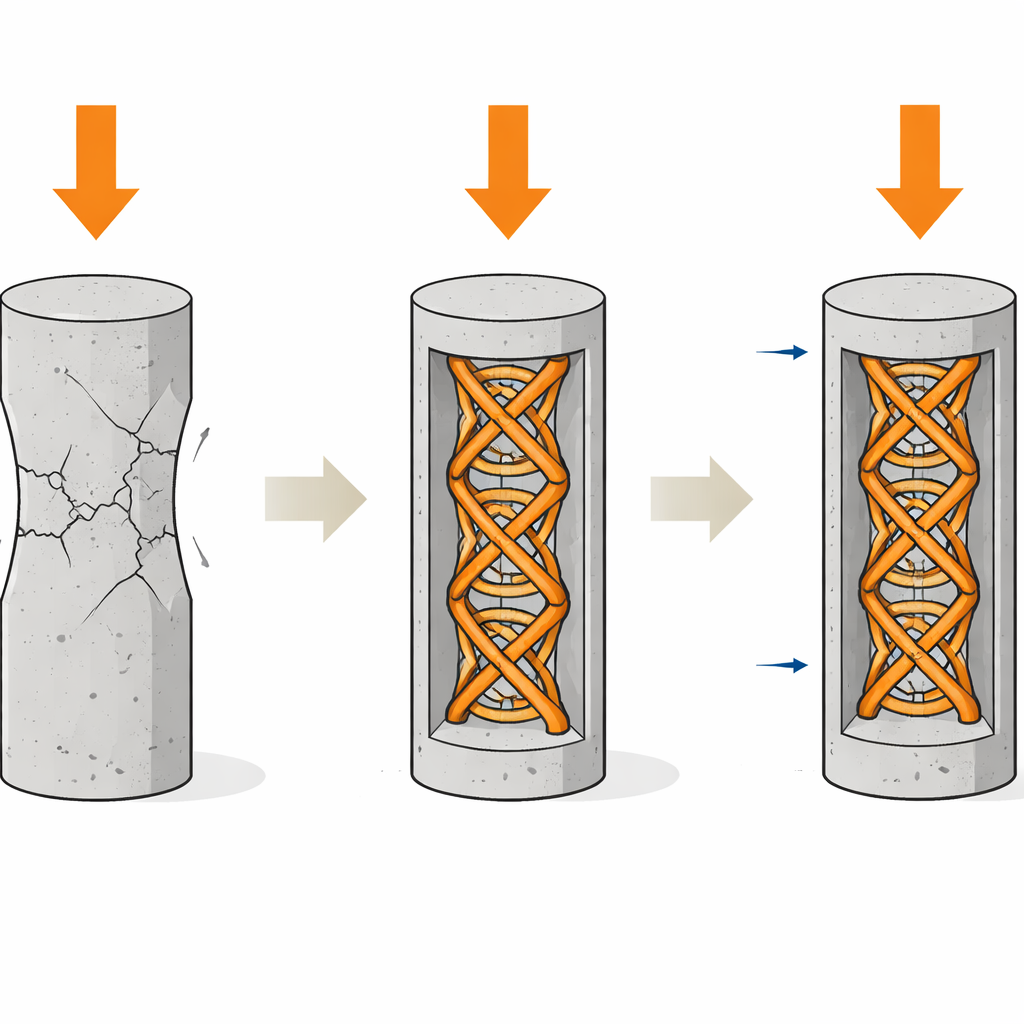
The researchers start with a three-dimensional steel framework built from repeating “bowtie” units, a lattice whose geometry gives it a negative Poisson’s ratio. Unlike ordinary materials that bulge outward when compressed, this auxetic lattice pulls inward on its sides as it shortens. Using metal 3D printing, they created tall, column-like versions of this lattice and cast them inside a cement-based mortar, forming reinforced prisms similar in size and aspect ratio to real structural columns. The lattice was made slightly denser and stiffer near the supports at the top and bottom, guiding damage to occur in the middle of the column where it could be studied and compared fairly to traditional confinement methods.
How the new columns behave under crushing loads
To see how these auxetic columns perform, the team first crushed plain mortar specimens and then columns containing the lattices under steadily increasing axial loads. The confined columns carried more than three times the compressive strength of the unreinforced mortar and showed very consistent stress–strain curves from test to test. As the load rose, the thin outer “cover” of mortar cracked and flaked away, but the core—wrapped by the auxetic lattice—remained strongly confined. The columns ultimately failed along clean, inclined shear planes, with almost no loose material falling away from the sides. This indicates that nearly the entire mortar core was effectively engaged in carrying the load, rather than only a limited inner region as in many conventional reinforced columns.
Resisting repeated loading and damage
Real-world columns face not only single overloads but also repeated cycles of loading during earthquakes or heavy traffic. The authors therefore subjected additional auxetic columns to controlled loading–unloading cycles, gradually increasing the peak load until failure. These specimens reached even higher strengths than those loaded only once and showed remarkable resistance to stiffness loss. After an initial conditioning phase where cracks in the outer cover form and stabilize, the columns maintained most of their stiffness through many cycles, even deep into the inelastic range where permanent deformation accumulates. The geometry of the densely interconnected lattice spreads damage and prevents large portions of the concrete core from becoming ineffective, allowing the structure to continue carrying load safely.
Why auxetic lattices outperform traditional hoops
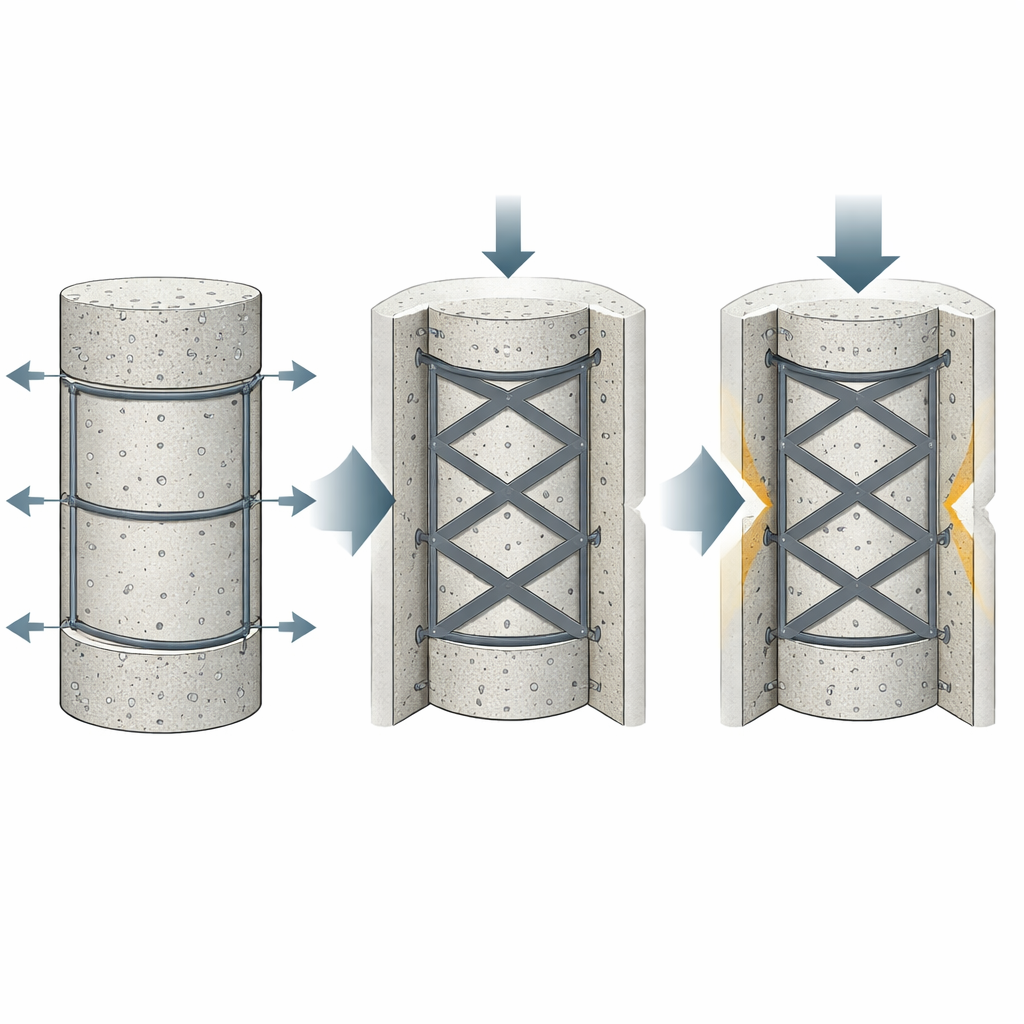
To understand why the new system works so well, the team used detailed computer simulations to compare auxetic lattices with conventional steel hoop reinforcement inside concrete. In traditional columns, lateral pressure on the concrete core only builds up after the concrete has expanded outward enough to stretch the hoops, and once a hoop fractures, confinement is largely lost. By contrast, the auxetic lattice actively increases lateral pressure as it is compressed: its angled struts rotate and pull inward on the concrete, raising the internal hydrostatic pressure that makes brittle materials stronger and more ductile. Simulations showed that this effect boosts the column’s peak strength by up to about 85 percent in mortar and 61 percent in normal-strength concrete, far beyond what standard design formulas predict for the same total amount of steel. The lattice also improves shear resistance, a key factor for columns that must withstand bending and sideways forces.
From laboratory insight to design tools
Building on these experiments and simulations, the authors adapted classic reinforced-concrete confinement theory to this new class of architected materials. They derived simple expressions that predict how much extra load an auxetically confined column can carry at yield and at its ultimate capacity, incorporating geometric features like the lattice angle and how much of the core is effectively confined. When tested against both their own experiments and established benchmark data, these formulas matched measured strengths within a few percent on average. For a lay reader, the takeaway is that engineers now have both a promising physical technology—a 3D-printed auxetic steel skeleton inside concrete—and a practical mathematical framework to design with it. Together, they point toward future columns that are lighter, tougher, and more resilient in the face of earthquakes and other extreme demands.
Citation: Vitalis, T., Gerasimidis, S. Mechanics of reinforced concrete column confinement with architected auxetic steel lattices. npj Metamaterials 2, 13 (2026). https://doi.org/10.1038/s44455-026-00023-y
Keywords: auxetic lattices, reinforced concrete columns, architected metamaterials, structural confinement, 3D printed steel reinforcement