Clear Sky Science · en
Penetration and macroscale “hardness” of fully dense FCC granular crystals: experiments and models
Why this study matters
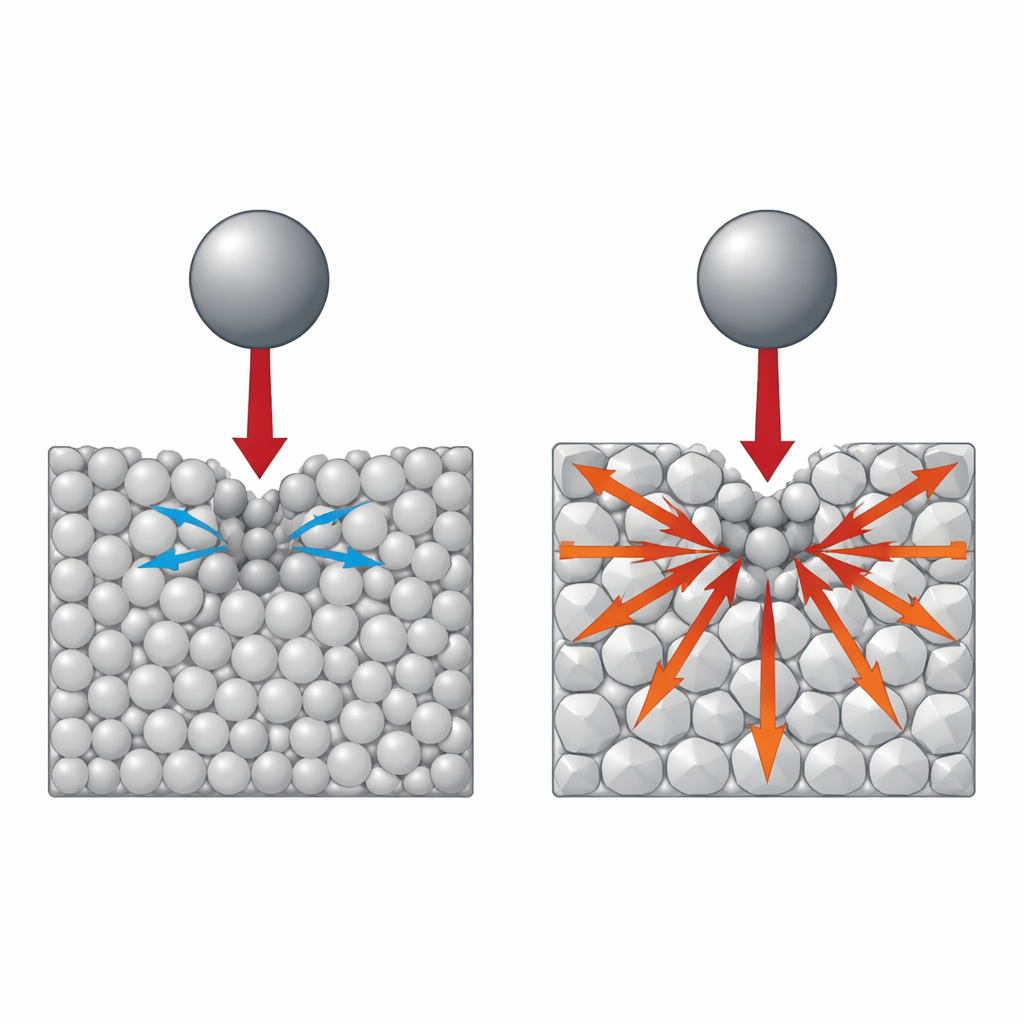
From animal feet running across sand to protective armor stopping a bullet, many technologies depend on how easily a sharp object can push into loose grains. Most sands and powders behave almost like thick fluids: they flow out of the way instead of firmly pushing back. This article explores a new kind of “granular crystal” made from tightly packed, identically shaped building blocks that behave more like a solid metal than a pile of sand, resisting puncture up to a thousand times better than ordinary granular materials.
From loose grains to engineered crystals
Traditional granular materials are made of separate, usually round particles with lots of empty space between them. When something presses in, forces travel only along a few thin paths, while most grains carry almost no load. As a result, the grains simply shuffle and roll aside, offering modest resistance. The researchers asked what would happen if the grains were carefully shaped and arranged into a perfectly packed three-dimensional pattern, transforming a loose pile into a highly organized “granular metamaterial” that bridges the gap between sand and solid.
Building artificial crystals from plastic grains
To test this idea, the team 3D-printed thousands of millimeter-sized plastic grains shaped like rhombic dodecahedra—faceted polyhedra that fit together without gaps. When poured into a vibrating box, these grains self-assembled into fully dense, face-centered cubic (FCC) crystals, with two main orientations of the internal pattern relative to the surface. For comparison, the researchers also prepared beds of plastic spheres, both randomly packed and close-packed, matching the grain volume and material. They then drove a rounded cylindrical indenter slowly into the top of each sample while measuring how much force was needed as penetration depth increased.
Unexpected strength and explosive failures
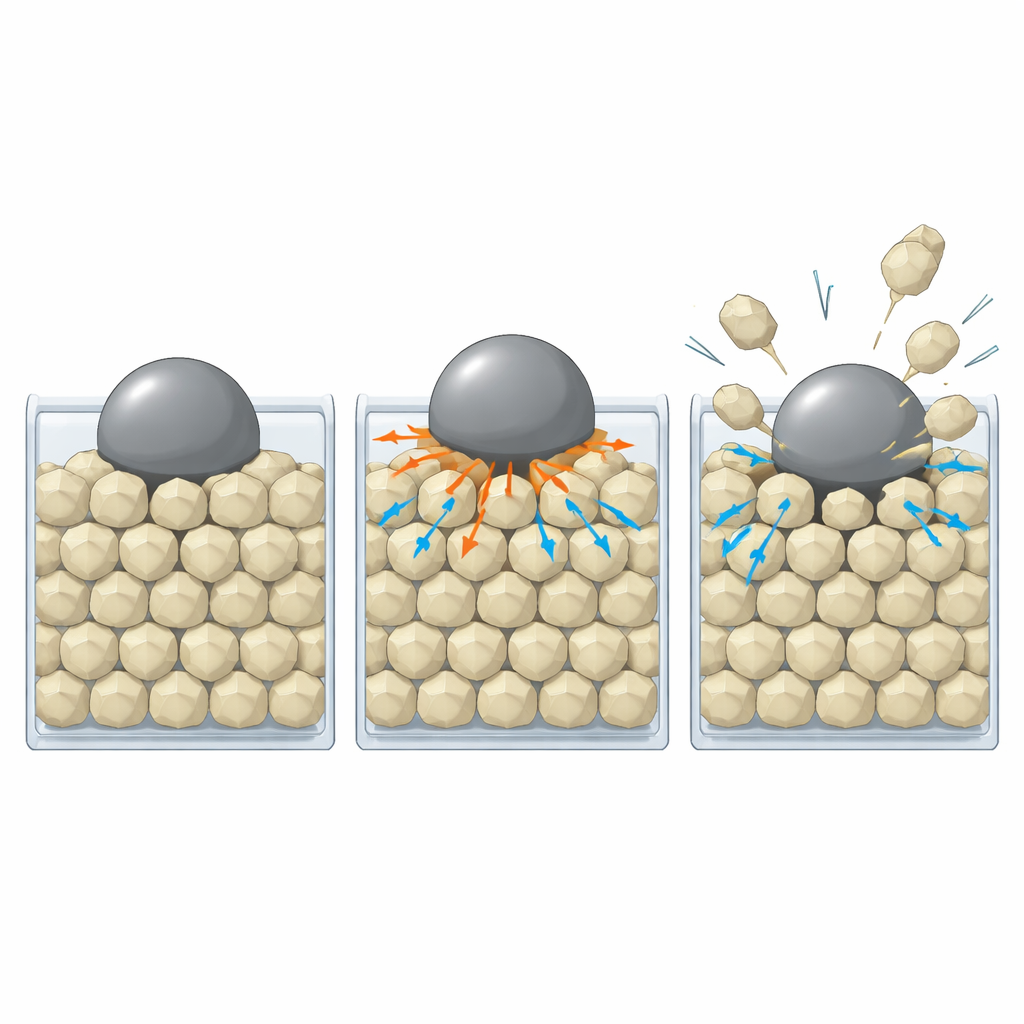
The results were striking. Close-packed spheres were already stiffer and stronger against penetration than randomly packed ones, but the FCC crystals of faceted grains were in a different league: off-axis crystals required roughly 660 times more force than random spheres, and on-axis crystals about 1600 times more. Instead of a smooth, steady push, the force in the crystals rose nonlinearly up to a sharp peak and then suddenly dropped to near zero in a repeating pattern. High-speed images revealed why: as the indenter wedged itself between the top grains, it squeezed them sideways, building strong in-plane compression until the surface layer buckled and “exploded,” ejecting grains outward. After a layer failed, the indenter engaged the next one below, and the cycle repeated.
How the grains move and slide inside
Although the overall response looked violent, the individual grains hardly deformed and remained elastic. Most of the energy was absorbed through frictional sliding and rearrangement along specific internal planes rather than permanent damage. Cyclic loading tests showed clear hysteresis—evidence that energy was dissipated and not fully recovered—much like indentation in metals that yield plastically. Lubricating the grain surfaces with oil reduced both the apparent stiffness and the maximum penetration force, confirming that friction helps stabilize the crystal and delay buckling. Computer simulations using discrete element modeling reproduced the key features of the tests and revealed detailed patterns of sliding and compression. Depending on how the crystal was oriented, different families of internal planes carried the sliding motion, and compressed zones beneath the indenter and near the container walls triggered buckling of the top layers.
Crystals that can heal and be reused
One of the most surprising findings is that these granular crystals are both tough and repairable. After repeated puncture tests that destroyed several surface layers, the researchers simply vibrated the box again. The loose grains reassembled into a nearly perfect crystal with no measurable loss in strength, even after multiple damage–healing cycles. Because the resistance arises from elastic deformation and frictional sliding—processes that do not weaken the grains themselves—the material can be reset many times before wear becomes an issue.
What this could mean in the real world
In everyday terms, the study shows that by carefully choosing grain shape, packing pattern, and friction, engineers can turn a loose collection of particles into a reusable, self-healing shield that strongly resists sharp penetration. These macroscale granular “metamaterials” could be scaled up or down and tuned much like metals are strengthened at the atomic level, but with the added benefit of rapid assembly and disassembly via simple vibrations. Potential uses range from temporary yet robust construction elements to lightweight, reconfigurable protective layers for buildings, vehicles, and body armor.
Citation: Karuriya, A.N., Barthelat, F. Penetration and macroscale “hardness” of fully dense FCC granular crystals: experiments and models. npj Metamaterials 2, 11 (2026). https://doi.org/10.1038/s44455-026-00021-0
Keywords: granular metamaterials, penetration resistance, self-assembling crystals, friction and buckling, protective materials