Clear Sky Science · en
Asymmetric tension–compression connectivity governs deformation delocalization in truss-based metamaterials
Why breaking without cracking matters
From airplane wings to car frames and body armor, many structures eventually fail the same way: damage concentrates in a narrow band or crack, and once that happens the whole piece quickly gives out. This paper explores a new kind of man‑made material, built from tiny struts arranged in a lattice, that can bend and crush without forming such dangerous weak spots. Understanding why these “metamaterials” spread out damage instead of focusing it could lead to lighter, safer, and more durable structures in everyday technology.
Building strength from geometry
Unlike traditional materials, whose behavior is set mostly by chemistry, mechanical metamaterials draw their unusual properties from architecture—the way many small beams, plates, or shells are connected in space. The authors focus on truss-based lattices, three‑dimensional frameworks of thin struts, inspired by structures called tensegrities, where a balance between tensioned and compressed elements gives remarkable stability. By adjusting a single geometric parameter—the twist, or “chirality,” of a repeating building block shaped like a truncated octahedron—they create a family of related lattices, called TOTI lattices, that can be tuned from one mechanical behavior to another without changing the base material.
Watching lattices crush in the lab and on the computer
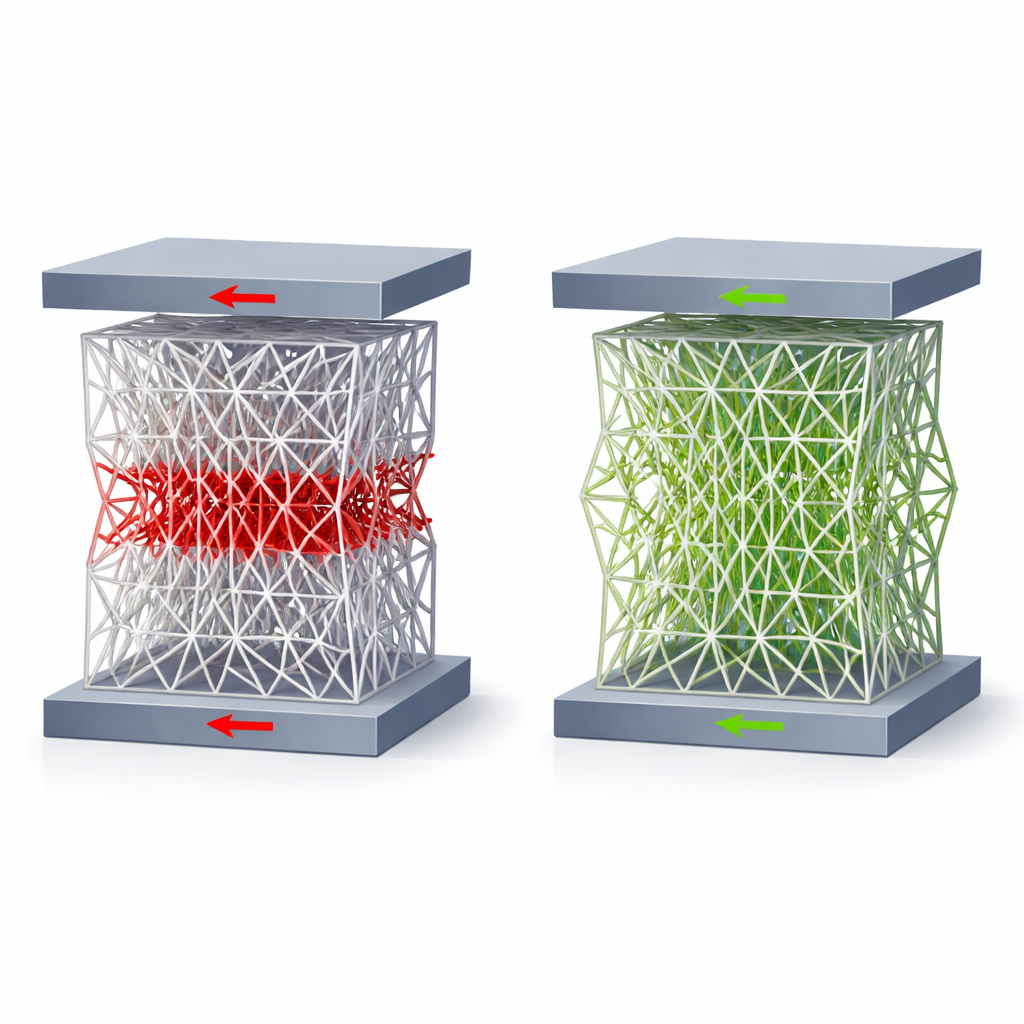
To see how these lattices fail, the team 3D‑printed samples with different twist angles and squeezed them between smooth plates while measuring force and overall shortening. They also ran detailed computer simulations that mirror the experiments, treating each strut as a beam and tracking how it bends and stretches. For some twist angles, the force steadily rises as the lattice compresses and the deformation remains evenly spread. For others, the force curve flattens and then drops, signaling that part of the structure has given way and that the crushing is concentrating in one region—a clear sign of localization. Despite some differences in exact stress levels, the experiments and simulations agree on which lattices localize and when.
Hidden tension and compression pathways
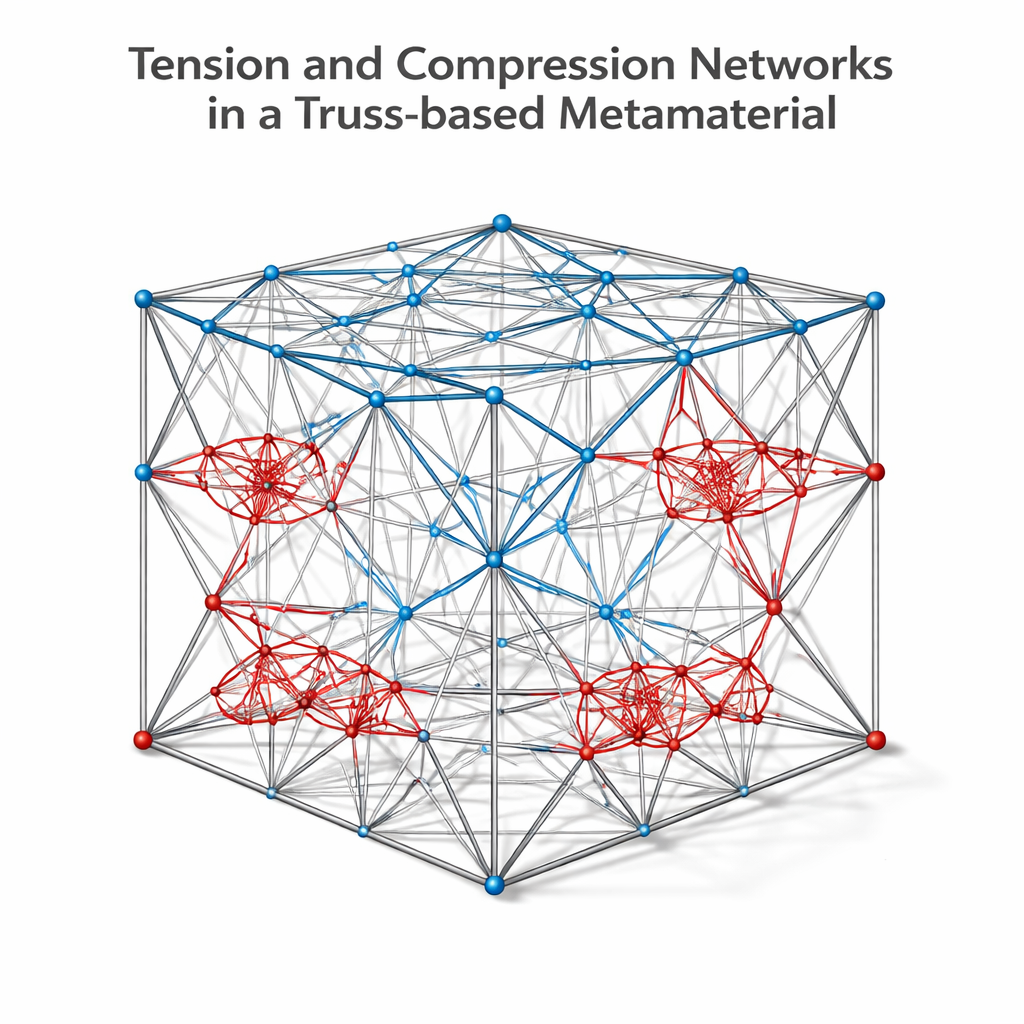
To understand why some lattices stay uniform while others localize, the authors look inside the deformation in an unusual way: they treat the structure as two overlapping networks. One network contains all the struts in tension (being stretched), and the other all those in compression (being squashed). Each network is analyzed using ideas from graph theory, the mathematics of nodes and links used to study everything from social media to power grids. A key measure, called global efficiency, reflects how easily forces can spread through the network via many short paths. The striking result is that delocalized deformation appears when the tension network is more strongly connected—has higher efficiency and fewer disconnected pieces—than the compression network. When the compression network is more connected, deformation concentrates and localization occurs.
A simple number that predicts spreading or failure
From these insights, the authors define a single “localization factor,” f, which is the ratio of the tension network’s efficiency to that of the compression network. When f is greater than one, the tension pathways form a continuous, robust backbone that can redistribute loads widely, and the lattice crushes in a smooth, uniform way. When f is less than one, compressed struts dominate the connectivity, force redistribution becomes limited, and a localized crush band or failure zone forms. This rule holds not only for the new TOTI lattices but also for two well-known lattice types, the Kelvin and Octet structures, which are known to localize and indeed have f below one in the simulations.
Designing safer architected materials
For a non-specialist, the main message is that failure resistance in these intricate lattices is governed less by the raw material and more by how tension and compression pathways are wired together. If the “stretching network” stays continuous while the “squeezing network” is broken into smaller clusters, the structure can absorb large deformations without forming a single fatal crack-like zone. This graph-based view provides a practical design rule: arrange the geometry so that the tension network is always more connected than the compression network. Following this principle could guide the creation of next-generation metamaterials for vehicles, protective gear, and other applications where spreading out damage, rather than letting it focus and run away, is the key to keeping structures safe.
Citation: Ruffini, F.N., Rimoli, J.J. Asymmetric tension–compression connectivity governs deformation delocalization in truss-based metamaterials. npj Metamaterials 2, 10 (2026). https://doi.org/10.1038/s44455-026-00020-1
Keywords: mechanical metamaterials, lattice structures, strain localization, tensegrity, graph theory