Clear Sky Science · en
Shaping stress: how curvature governs the mechanics of film-substrate systems undergoing volumetric expansion
Why bending shapes matter for future batteries
Many of the devices we rely on—from smartphones to medical implants—use tiny functional coatings laid over porous supports. As these coatings swell and shrink during use, they can crack or peel away, slowly killing performance. This study asks a deceptively simple question with big consequences: can we design the underlying 3D shapes so that the coating survives better, without sacrificing energy storage or flexibility? By using computer simulations, the authors show that the curvature of the supporting structure—whether it bulges out like a dome or dips in like a saddle—strongly controls how damaging stresses build up in expanding thin films.
Everyday devices with hidden coatings
Porous backbones with conformal coatings appear in advanced batteries, flexible electronics, and biomedical implants. The porous scaffold supplies strength and large internal surface area, while the thin film carries out the key task: storing charge, conducting electricity, or protecting tissue. But when the film expands—for example, when silicon in a lithium-ion battery swells by up to 300% during charging—it pushes against the much stiffer backbone. That mismatch creates high stresses that can cause the film to crack, buckle or detach. Traditionally, engineers have tried to fix this by changing the coating’s thickness or material. Those tweaks often reduce how much active material can be loaded or weaken other properties. The authors propose a different lever: tune the 3D architecture of the substrate itself.
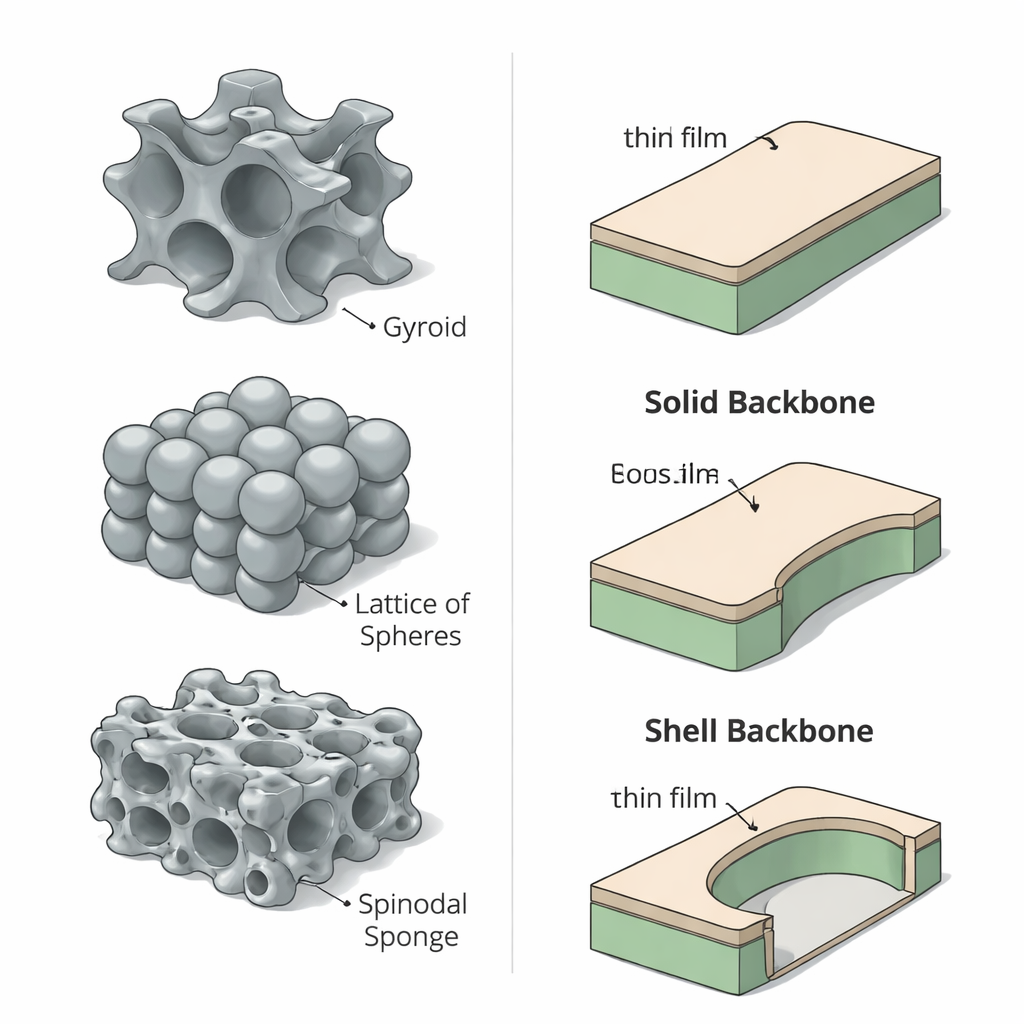
Shaping the backbone: domes, cups, ridges and saddles
Using detailed computer models, the team studied a wide “vocabulary” of curved shapes that commonly appear inside porous materials: domes and cups (bulging or hollow bowls), ridges and ruts (one direction curved, the other flat), and saddles (bending in opposite directions, like a Pringles chip). They compared two basic backbone types. In a solid backbone, the coating sits only on the outside of a thick support. In a shell backbone, both the inner and outer surfaces of a thin wall are coated. For each geometry, they simulated a silicon film bonded to nickel that undergoes a huge volume increase, mimicking how real battery anodes behave. They tracked the highest local stresses and the stored strain energy, which serve as warning signs for cracking and delamination.
How curvature amplifies or calms damaging stress
The simulations reveal that curvature is not neutral: it powerfully steers where and how stress concentrates. On solid backbones, convex shapes with positive curvature, like domes and cups, amplify the in-plane compression in the expanding film and raise its strain energy. These regions are prime candidates for buckling, wrinkling and the coating peeling away. Concave regions and saddles, which have negative overall curvature, let stresses redistribute along different directions, lowering both peak stress and stored energy. When the authors combined two standard geometry measures into a single metric, they found that the stresses on solid backbones follow simple linear trends with this curvature–shape descriptor, allowing broad design rules to be drawn.
Shell-like walls trade cracking for peeling
Shell backbones—thin walls coated on both sides—behave differently. Here, the expanding films can pull and push the shell itself, so the stress pattern is more balanced between tension and compression. Overall, shell backbones show somewhat higher peak tensile stresses in the film, which raises the chance of cracking, but significantly lower strain energy, which lowers the risk of catastrophic delamination. Within this family, the type of curvature again matters. Shells dominated by domes or cylinders (positive or zero curvature) show strong stress build-up in the coatings. In contrast, saddle-shaped shells with negative curvature spread out the stresses and respond much more gently even when the curvature is quite sharp or asymmetric between the inner and outer surfaces. A single parameter that mixes curvature strength with inner–outer asymmetry captures these trends and follows a predictable logarithmic scaling.
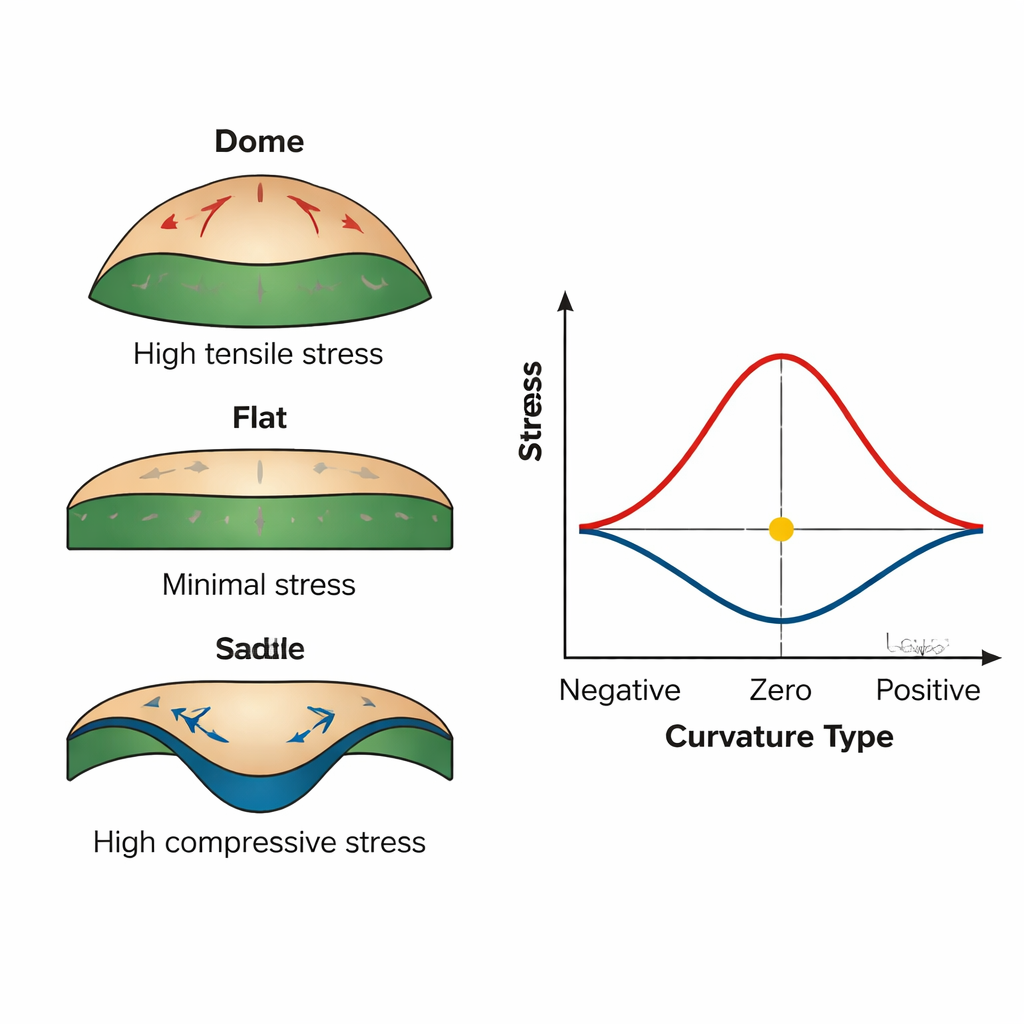
Design lessons: why saddles are the sweet spot
By comparing all shapes and configurations, the study highlights a clear winner for mechanically tough, high-surface-area systems: saddle-shaped shell backbones. These “negative curvature” architectures keep both stresses and stored energy low, and they are relatively insensitive to how sharply they curve or how uneven the inner and outer surfaces are. That makes them especially promising for silicon-based battery anodes, where large volume changes are unavoidable, as well as for other expanding coatings in electronics and biomedical devices. Conversely, porous architectures dominated by dome- and cup-like features are mechanically fragile and should be avoided when durability is critical.
What this means for better batteries and devices
In simple terms, the paper shows that not all porosity is equal: the way a structure bends in three dimensions can make the difference between a coating that fails quickly and one that endures repeated swelling. Instead of only asking “what material and how thick?”, engineers can now also ask “what kind of curvature?”. The answer, supported by this work, is to favor saddle-like, shell-based architectures that resemble minimal surfaces. These shapes offer a powerful route to longer-lived batteries, more reliable flexible electronics, and robust implants by harnessing geometry itself to tame mechanical stress.
Citation: Gross, S.J., Valdevit, L. & Mohraz, A. Shaping stress: how curvature governs the mechanics of film-substrate systems undergoing volumetric expansion. npj Metamaterials 2, 9 (2026). https://doi.org/10.1038/s44455-026-00019-8
Keywords: battery anodes, thin film coatings, porous materials, curved surfaces, mechanical degradation