Clear Sky Science · en
Nonreciprocal nonlocal metasurface for multifunctional image processor
Sharper, Cleaner Pictures with a Paper-Thin Device
Modern technologies—from medical scans and security cameras to self-driving cars—depend on fast, accurate image processing. Today this work is mostly done by power-hungry digital chips. This paper explores a radically different approach: a paper-thin engineered surface that can clean up noisy pictures or highlight their edges instantly, using only light itself and no conventional computing.
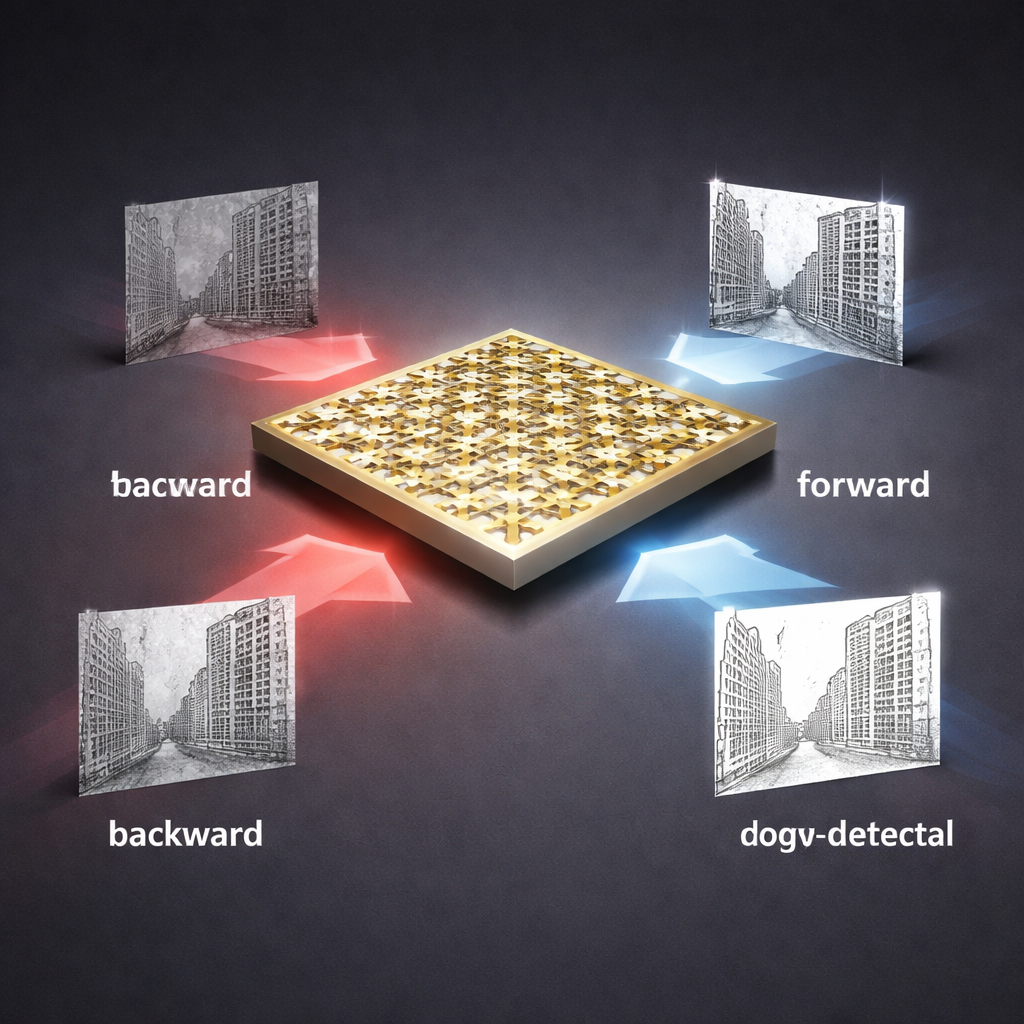
A Tiny Sheet That Thinks with Light
The researchers design a special “metasurface,” a flat layer patterned with tiny metal shapes smaller than the wavelength of microwaves. When waves carrying an image hit this patterned sheet, they do not simply pass through or reflect—they are selectively reshaped. By carefully arranging the building blocks of the surface and adding a magnetic material in the middle, the team makes the sheet behave like a smart filter that can process images as they propagate, without lenses, bulky optics, or digital electronics.
Two Different Tricks Depending on Viewing Side
A key feature of this metasurface is that it is nonreciprocal: it treats waves coming from one side differently than waves coming from the opposite side. When a noisy picture illuminates the sheet from the “backward” side, the device acts like an edge detector, emphasizing borders and outlines where brightness changes sharply. When the same noisy picture comes from the “forward” side, the metasurface instead smooths the image, suppressing tiny fluctuations and acting as a noise reducer. This dual behavior is achieved by magnetizing a thin layer of yttrium iron garnet, a magneto-optical material whose properties change under a steady magnetic field, and by shaping the metal patterns so that they boost this directional effect.
How It Filters Details in Space
Images can be thought of as built from different spatial “notes,” from slow variations (broad shapes) to fast variations (fine details and noise). The metasurface is engineered to control which of these spatial notes pass through. For waves arriving from the backward side, transmission is very weak for small angles but grows strongly for larger angles, meaning the device blocks broad, smooth features and lets sharp variations through—ideal for edge detection. From the forward side, the opposite happens: small angles pass and large angles are blocked, which blurs away the fine-grain noise while preserving the main structure of the image. Although the response is not perfectly uniform in all directions, it is carefully balanced so that useful edges are kept while much of the noise is suppressed.
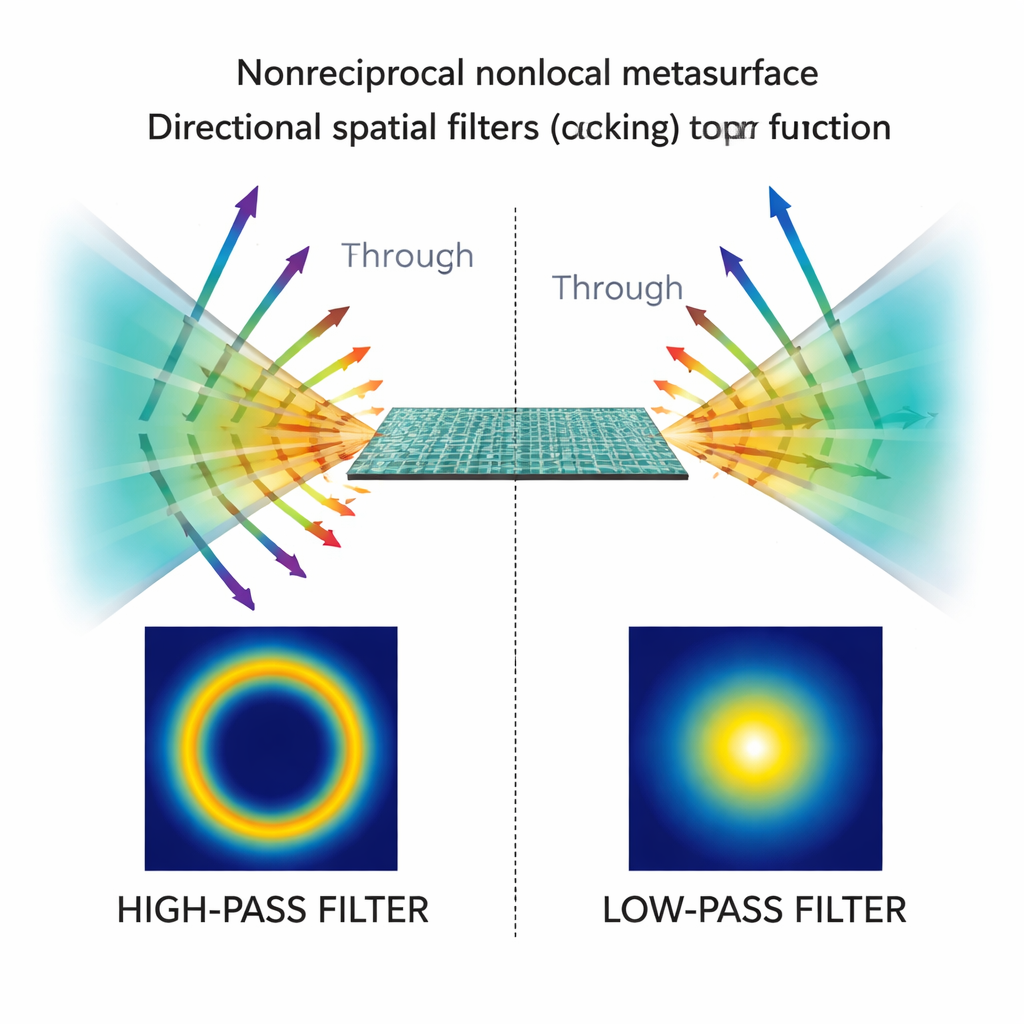
Performance on Noisy Pictures and Robust Operation
To test their design, the authors simulate how the metasurface processes a noisy photograph of a building. A standard digital edge detector fed with that noisy input mostly amplifies the noise and fails to show clean outlines. In contrast, when the image illuminates the metasurface from the backward side, the output contains clear building edges even though the input is heavily corrupted. From the forward side, the metasurface produces a denoised image whose quality closely matches that of an ideal smoothing filter widely used in image processing. The device maintains these behaviors over a practical range of magnetic field strengths, meaning it does not require perfectly tuned conditions to work well.
What This Means for Future Imaging Devices
For non-specialists, the main message is that image processing does not always need to happen in a power-hungry chip after a picture is taken. This work shows that a single, ultrathin, passive surface can both sharpen edges and clean up noise—depending on which side you look from—by harnessing carefully engineered materials and magnetism. In the future, similar concepts could lead to compact components that sit directly in front of cameras or sensors, giving clearer, more informative pictures in real time for uses like augmented reality, remote sensing, and medical imaging, all while saving energy and space.
Citation: Kiani, M., Goh, H. & Alù, A. Nonreciprocal nonlocal metasurface for multifunctional image processor. npj Metamaterials 2, 7 (2026). https://doi.org/10.1038/s44455-026-00018-9
Keywords: metasurface, optical image processing, edge detection, noise reduction, nonreciprocal optics