Clear Sky Science · en
Tension-compression asymmetry in brittle lattice metamaterials
Why breaking can be so surprising
From airplane heat shields to battery foams, many advanced technologies rely on tiny, repeating 3D frameworks called lattice metamaterials. These structures are incredibly light yet can tolerate extreme temperatures and chemical environments. But there is a catch: when made from brittle substances like ceramics or rigid plastics, they can fail suddenly and catastrophically. This article explores a subtle puzzle—why these lattices often have very different strengths in tension (being pulled) versus compression (being squeezed)—and shows how to predict when and how they will break.
Building strength from a fragile material
The researchers focus on two archetypal lattice designs: the Kelvin lattice, which looks like a foam of boxy cells with beams that like to bend, and the octet truss, a crisscross of diagonal struts that mostly stretch. Both are 3D-printed from a brittle photopolymer and tested under pull and push. To avoid misleading failures where the specimen breaks near the metal grips instead of in its working region, the team thickens the beams near the ends, creating a gentle density gradient. Computer simulations confirm that this design choice moves the highest stresses away from the boundaries and into the central “gauge” region where the material is meant to be evaluated. 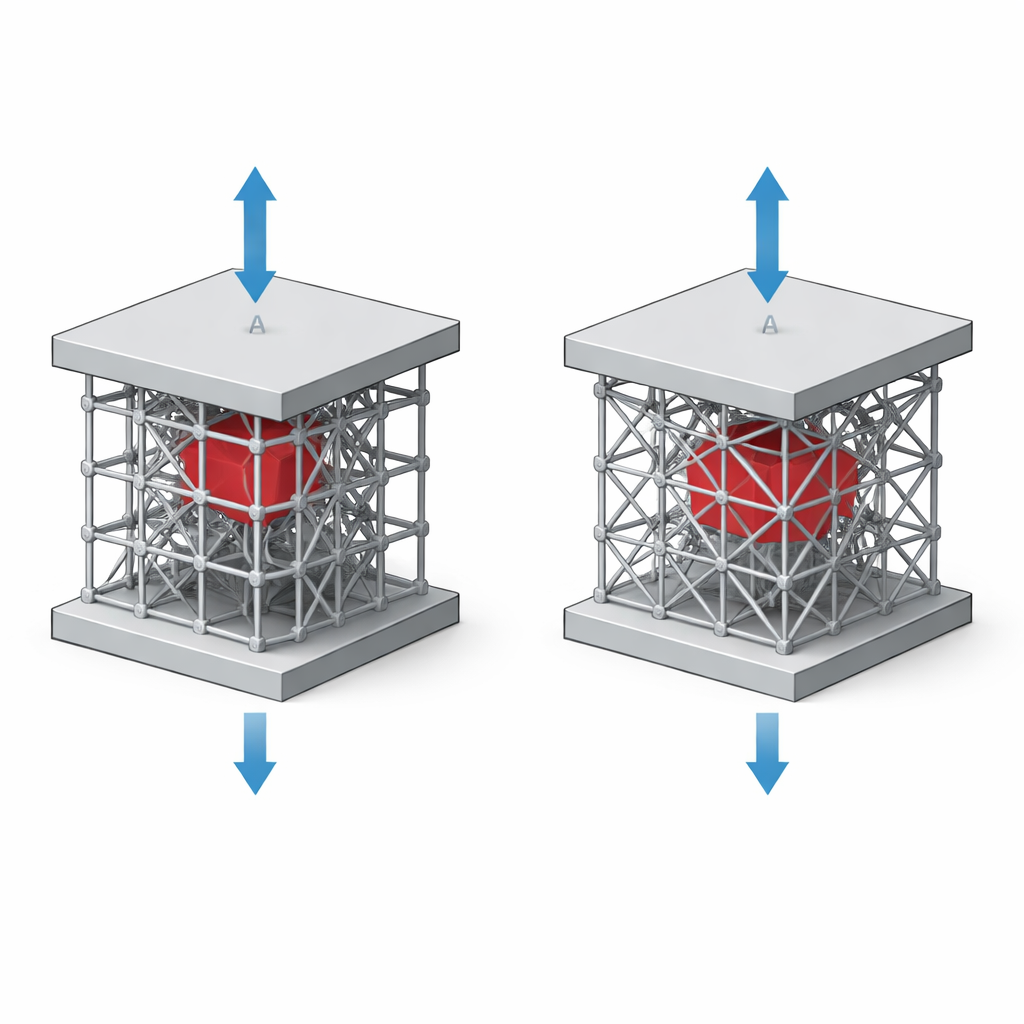
Watching tiny frameworks snap
Experiments reveal that both lattices behave almost like perfect springs until, at small overall strains of about one percent, they shatter abruptly. Yet the way they fail depends both on the lattice pattern and on whether they are pulled or pushed. The Kelvin lattice is stiffer in a similar way in both directions, but it withstands higher loads in compression than in tension and fails at larger compressive strains. The octet lattice, by contrast, is stronger in tension than in compression at low density. High-speed imaging of broken samples shows distinct fracture paths: in the Kelvin case, tension produces nearly flat break surfaces, while compression creates slanted, shear-like bands; in the octet, tension causes widespread breaking of diagonal rods, whereas compression fractures march along horizontal layers.
Measuring how the base material fails
To understand these behaviors, the team steps down from the whole lattice to the level of a single beam of the parent solid. Brittle materials do not have a single “strength”: they are typically weaker in pure tension and stronger when the load is mainly bending, because bending concentrates peak stresses into smaller regions. The authors design special test pieces that experience different mixtures of stretching and bending and use a combination of physical tests and detailed simulations to measure the fracture stress for each case. They show that the base material’s breaking strength increases almost linearly as bending becomes more dominant. This simple relation becomes a key ingredient in predicting when each individual lattice strut will fail.
Capturing real-world imperfections
No 3D-printed lattice is perfectly shaped. Using micro–computed tomography, the authors scan reduced-size versions of their structures to see how far the manufactured beams and junctions deviate from the computer designs. In the Kelvin lattice, the beam cross-sections and joints are close to ideal; in the octet, resin tends to build up at the highly connected nodes, slightly thickening some regions. By quantifying changes in beam area and shape, and by adjusting how rounded the junctions are in their computer models, the team builds “as-manufactured” digital twins of the lattices. These refined models capture how local stress hotspots shift around the nodes and along the beams, which strongly affects where the first cracks appear. 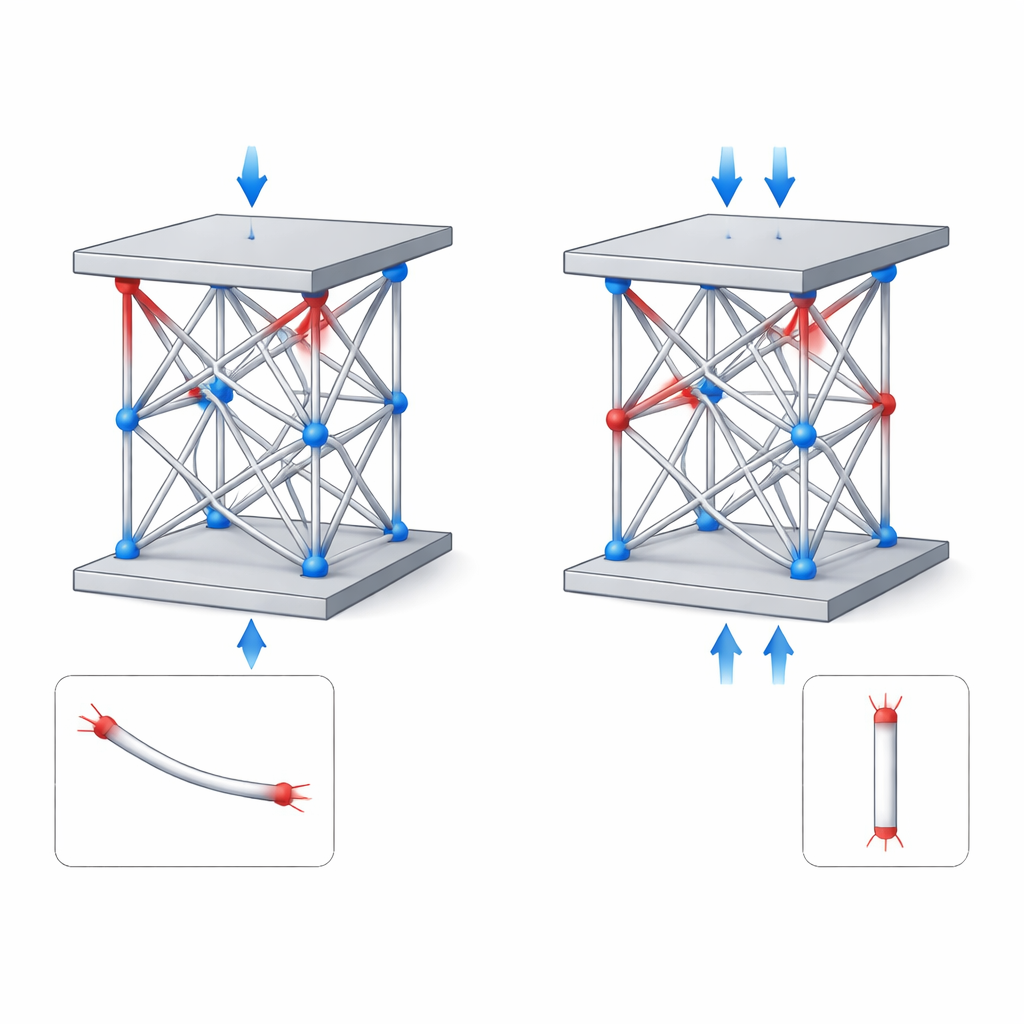
A simple recipe to predict breaking
Armed with a realistic geometry and a map of how the base material’s strength depends on bending versus stretching, the researchers run high-fidelity computer simulations that mimic both tension and compression tests. They find that each lattice fails when a single “critical” strut reaches its own microscopic breaking stress. This insight leads to a compact rule: the macroscopic strength of the lattice is just that strut-level failure stress divided by how much the internal stress is amplified relative to the applied load. By computing this amplification factor and the bending-to-stretching mix for different lattices and densities, the authors accurately reproduce all measured strengths and even capture a striking reversal: as the octet lattice gets denser, it switches from being stronger in tension to stronger in compression.
What this means for future designs
For non-experts, the key message is that how a lightweight, brittle framework breaks is governed not only by its overall shape, but also by how individual beams share bending and stretching, how stress concentrates at joints, and how the base solid reacts to different loading modes. By tying these ingredients together in a clear formula, this work offers engineers a practical way to design next-generation thermal shields, filters, and energy devices that are both featherlight and reliably strong, without having to simulate every crack in detail.
Citation: Chen, E., Luan, S. & Gaitanaros, S. Tension-compression asymmetry in brittle lattice metamaterials. npj Metamaterials 2, 8 (2026). https://doi.org/10.1038/s44455-025-00017-2
Keywords: lattice metamaterials, brittle fracture, 3D printing, mechanical strength, cellular materials