Clear Sky Science · en
High-frequency ultrasound combined with deep learning enables identification and size estimation of microplastics
Why tiny plastic bits matter to all of us
Plastic breaks down into particles so small we can’t see them, yet they’re now turning up in oceans, soil, air, and even inside human organs. Tracking these “microplastics” is crucial for understanding how they move through the environment and what they might be doing to our health. But today’s lab tests are slow, expensive, and hard to deploy outside controlled settings. This study explores a faster, non-destructive way to spot and measure microplastics using sound waves and artificial intelligence, opening the door to real-time monitoring in rivers, lakes, and treatment plants.
Listening for plastic with sound
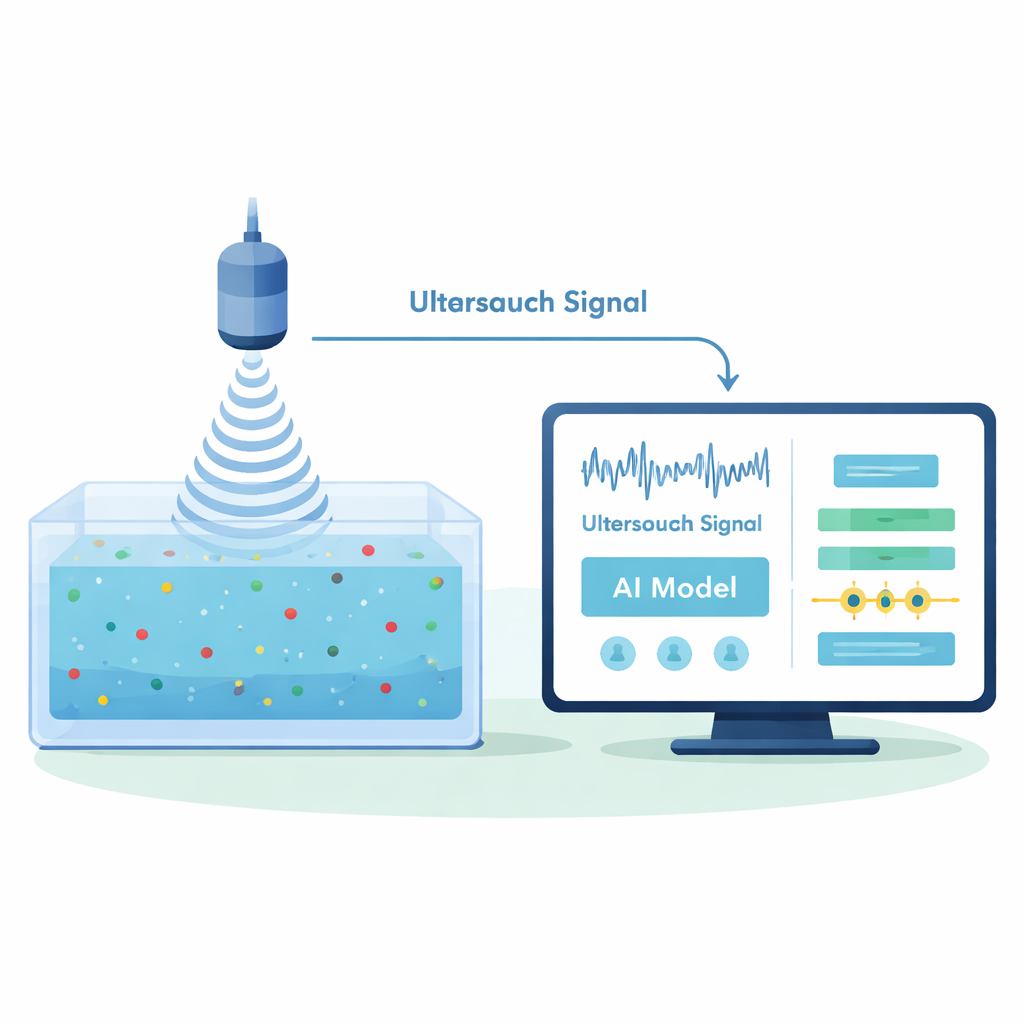
Instead of shining light on particles, the researchers used high-frequency ultrasound—sound waves far above what humans can hear—to probe tiny spheres made of different plastics and reference materials. When an ultrasound pulse hits a particle, some of the sound scatters back to the detector. The exact pattern of this echo depends on the particle’s size and what it is made of, including its density and stiffness. By operating at frequencies similar to the particle size, the team ensured that the returning echoes carried rich, distinguishable signatures that encode both material type and size.
From raw echoes to labeled particles
To turn this idea into a working system, the team embedded plastic (PE and PMMA) and non-plastic (glass and steel) microspheres in a soft gel that mimics water. A single ultrasound transducer scanned the sample point by point, collecting a three-dimensional block of data: two spatial directions plus time. A custom “peak extraction” algorithm then combed through this block to find the strongest echoes, which correspond to individual particles. Each detected echo was cross-checked against matching microscope images to confirm that the algorithm was really locking onto single particles rather than noise or clumps, achieving a detection accuracy of about 96 percent.
Teaching computers to recognize plastic
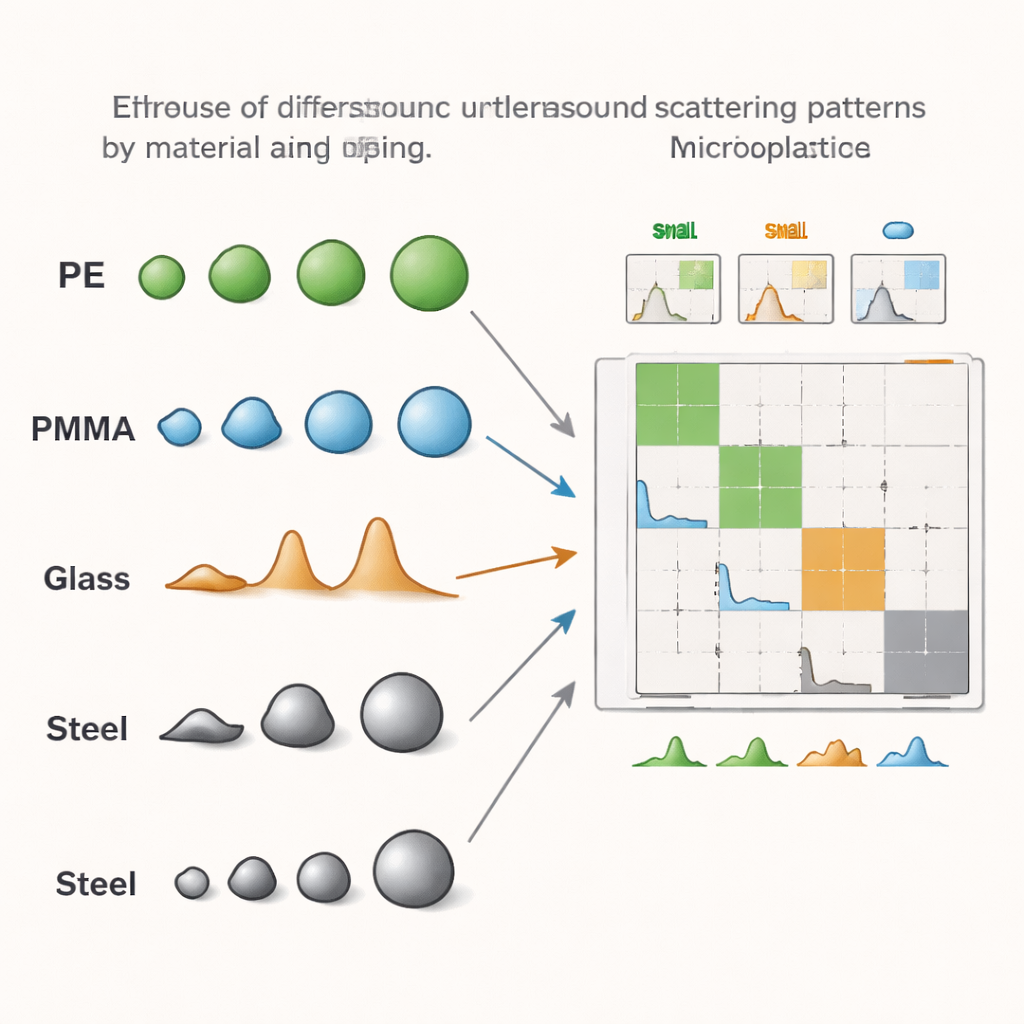
Once the particle-specific echoes were isolated, the researchers looked at the signals in both time and frequency. They calculated a set of simple numerical features—such as how spread out the signal’s frequencies were and where most of its energy sat. These features differed in characteristic ways from one material to another. The team trained several standard machine-learning models on these features and also built a one-dimensional convolutional neural network (1D-CNN) that learned patterns directly from the raw frequency data. Across many tests, the CNN performed best, correctly identifying the material of individual particles with an average particle-level accuracy of about 97 percent, even in mixed samples containing several materials at once.
Measuring size as well as type
Beyond telling materials apart, the method can also estimate how big each particle is. The shape of the backscattered ultrasound spectrum stretches in a predictable way as particle diameter changes. To capture this, the researchers trained small neural networks called multilayer perceptrons, one for each material, to sort particles into four size ranges from about 20 micrometers up to around 300 micrometers. These models reached an average accuracy above 99 percent, with nearly perfect performance for most materials. Importantly, all training and test data were separated at the particle level, ensuring that the models were truly tested on particles they had never “seen” before.
Steps toward real-world monitoring
Although the current experiments used stationary particles embedded in gel, the underlying approach is well suited to flowing water systems. The ultrasound hardware is compact, and the analysis pipeline can process over a thousand signals per second, fast enough to keep up with continuous streams. The main remaining challenges involve detecting very small particles with weak echoes and handling crowded regions where particles overlap. Still, the study shows that high-frequency ultrasound, paired with modern AI, can act like a “sonar for microplastics,” rapidly identifying what they are made of and how big they are without chemicals or complex optics.
What this means for everyday life
For non-specialists, the key message is that we may soon have tools that can watch microplastics in real time rather than only after slow lab work. This could help track pollution from factories, wastewater plants, or storm runoff, and give regulators and communities better data on where plastics are accumulating. By listening to how tiny particles scatter sound, this method offers a practical path toward monitoring and eventually managing one of the most pervasive forms of modern pollution.
Citation: Zarrabi, N., Strohm, E.M., Rezvani, H. et al. High-frequency ultrasound combined with deep learning enables identification and size estimation of microplastics. npj Emerg. Contam. 2, 9 (2026). https://doi.org/10.1038/s44454-026-00029-1
Keywords: microplastics, ultrasound sensing, deep learning, environmental monitoring, particle size analysis