Clear Sky Science · en
From passive survival to active development: an evolutionary thermal energy architecture for sustainable lunar bases
Why living on the Moon is really a heat problem
Plans for permanent Moon bases often focus on rockets and habitats, but one of the toughest challenges is simply staying warm. The Moon has no air, almost no weather, and two-week-long nights when temperatures plunge far below anything on Earth’s surface. This review article asks a deceptively simple question: how do you keep people, machines, and factories alive through those bitterly cold, sunless nights—not just for days, but for years—and proposes a step‑by‑step energy strategy to make that possible.
The brutal rhythm of lunar day and night
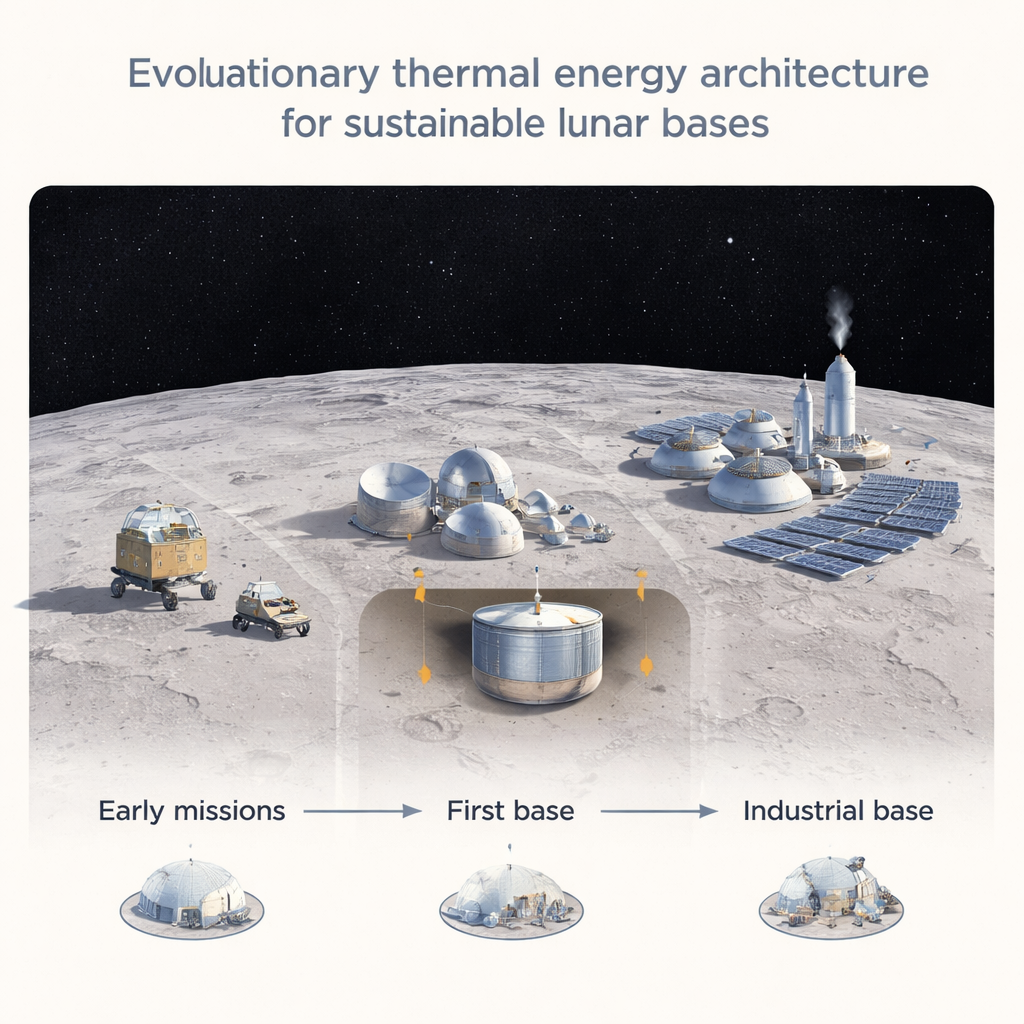
The Moon’s surface swings between scorching days and nights so cold that heat leaks straight into deep space. During the 14‑day lunar night, temperatures can drop to around –180 °C, and without air there is no breeze to spread warmth. Early missions survived by combining thick thermal blankets with small nuclear heat sources that slowly released radioisotope energy. These systems worked for short‑lived landers and rovers, whose main goal was to keep instruments from freezing for a few weeks, not to run a village. As space agencies now aim to build lasting bases that host people, labs, and industry, the problem grows from keeping a single suitcase‑sized box warm to heating whole underground neighborhoods.
From quick visits to long stays
The authors divide the path to a lunar base into three stages. First are short missions, where the priority is simple survival using proven tools: multilayer insulation, compact radioisotope heaters, and clever ways to hibernate instruments at night. Next comes a “primary permanent base,” a small but lasting outpost where robots and humans begin building with local materials. Here the heat demand jumps to tens of kilowatts, far beyond what traditional radioisotope units can deliver economically. Finally, in a “future permanent base” that supports industry and continuous habitation, nightly heat needs could reach hundreds of kilowatts or more. At that scale, no single approach is enough; engineers must weave together several energy sources into a coordinated system.
Turning moon dust into a heat battery
A central idea in the paper is to use lunar soil—regolith—as a giant thermal battery. In its natural form, regolith is fluffy and a good insulator, which makes it excellent for burying habitats but poor for moving heat around. Laboratory work shows that if this soil is compacted, mixed with additives, or melted and re‑hardened using concentrated sunlight or lasers, its ability to store and conduct heat improves dramatically. Daytime solar power can then be focused into tanks of treated regolith, charging them up like a stone stove. At night, heat is drawn back out through pipes or heat exchangers to keep equipment and living spaces warm. Models suggest such systems could cover much of a small base’s heating and power needs, but real‑world tests on the Moon will be needed to confirm performance in true vacuum and low gravity.
Bringing in nuclear power and smart shielding
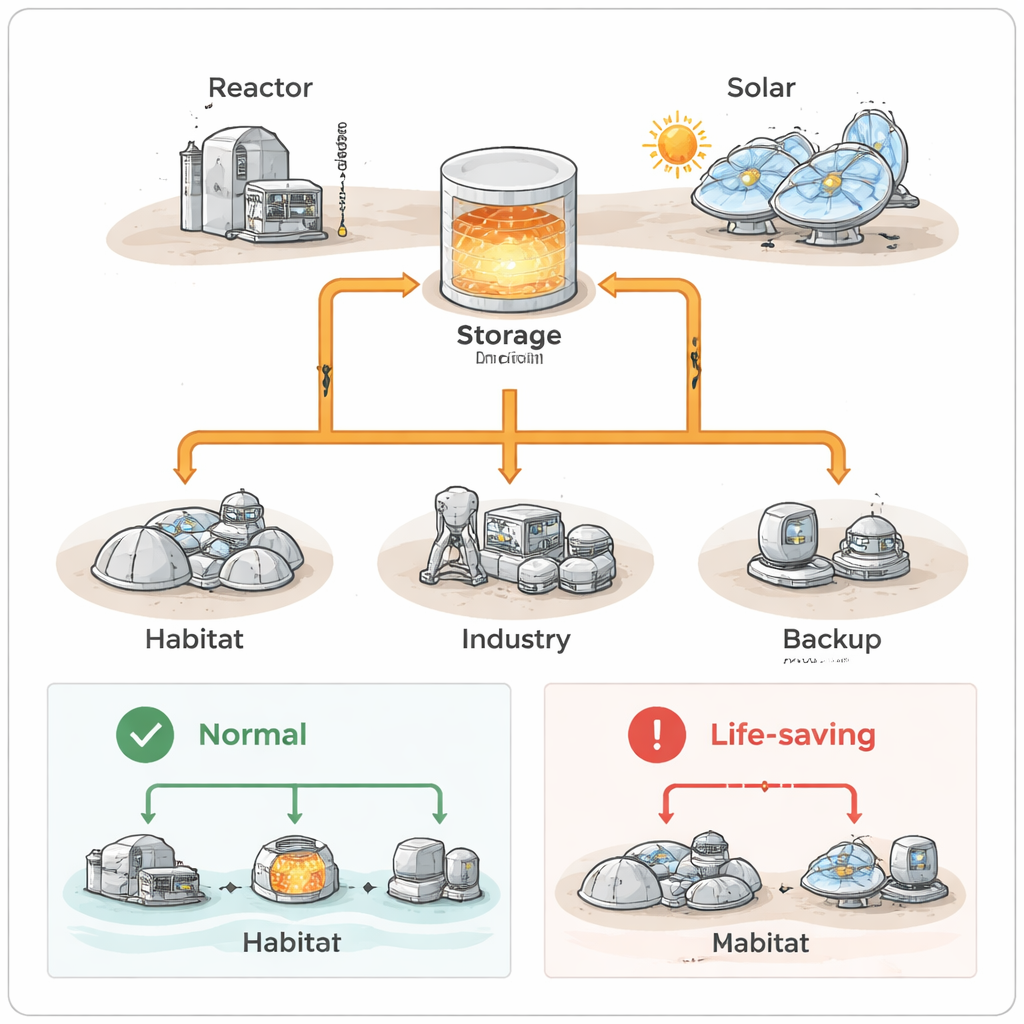
For large, industrial‑scale bases, the review argues that nuclear fission reactors will likely provide the backbone of the energy supply. Unlike solar power, they work day and night and can deliver steady, megawatt‑level heat and electricity. The waste heat they produce, which cannot all be turned into electricity, can be fed into regolith‑based storage, turning the ground itself into a long‑lasting heat reservoir. Around this active core, passive measures such as burying habitats under meters of soil and using walls filled with phase‑change materials help smooth the huge temperature swings, reducing how hard the active systems must work. The authors stress that such a multi‑source system is complex, with many possible failure paths, so it must be overseen by intelligent control that can switch operating modes and shed non‑essential loads when needed.
How all the pieces fit into a long‑term plan
To compare options fairly, the paper uses a scorecard that weighs technical maturity, launch mass and cost, heating power, ease of deployment, and maintenance needs. Small radioisotope generators rank best for early, lightweight missions. Solar‑charged regolith storage looks most attractive for the first permanent outpost, where launch mass is precious and local materials can do much of the work. High‑power nuclear reactors, though heavier and more complex, become the preferred choice once factories, laboratories, and large habitats demand round‑the‑clock energy. In its final vision, the base runs in a normal mode where all sources cooperate to power science, industry, and comfort, and a backup “life‑saving heat” mode that focuses scarce energy on life support and control systems during emergencies. In plain terms, the article concludes that a sustainable Moon base will only be possible if its thermal energy system grows in stages—from simple, rugged heaters to a smart blend of solar, nuclear, and buried heat stores—that evolves alongside the base itself.
Citation: Che, L., Cao, J., Peng, J. et al. From passive survival to active development: an evolutionary thermal energy architecture for sustainable lunar bases. npj Space Explor. 2, 10 (2026). https://doi.org/10.1038/s44453-026-00026-z
Keywords: lunar base, thermal energy, in situ resource utilization, nuclear power, space habitat