Clear Sky Science · en
Robotic prefab 3D printing buildings in extreme environments toward Martian habitats
Why Building Design Matters on Earth and Mars
As climate change intensifies storms, heat waves, and cold snaps, we are also looking toward settling the Moon and Mars. In both cases, the same question looms: how do we build shelters that keep people safe and comfortable without pouring more carbon into the atmosphere? This paper tackles that puzzle by connecting real-world hotels in Earth’s harshest climates with cutting-edge robotic 3D printing and designs for future Martian habitats.
What Extreme Hotels Can Teach Us
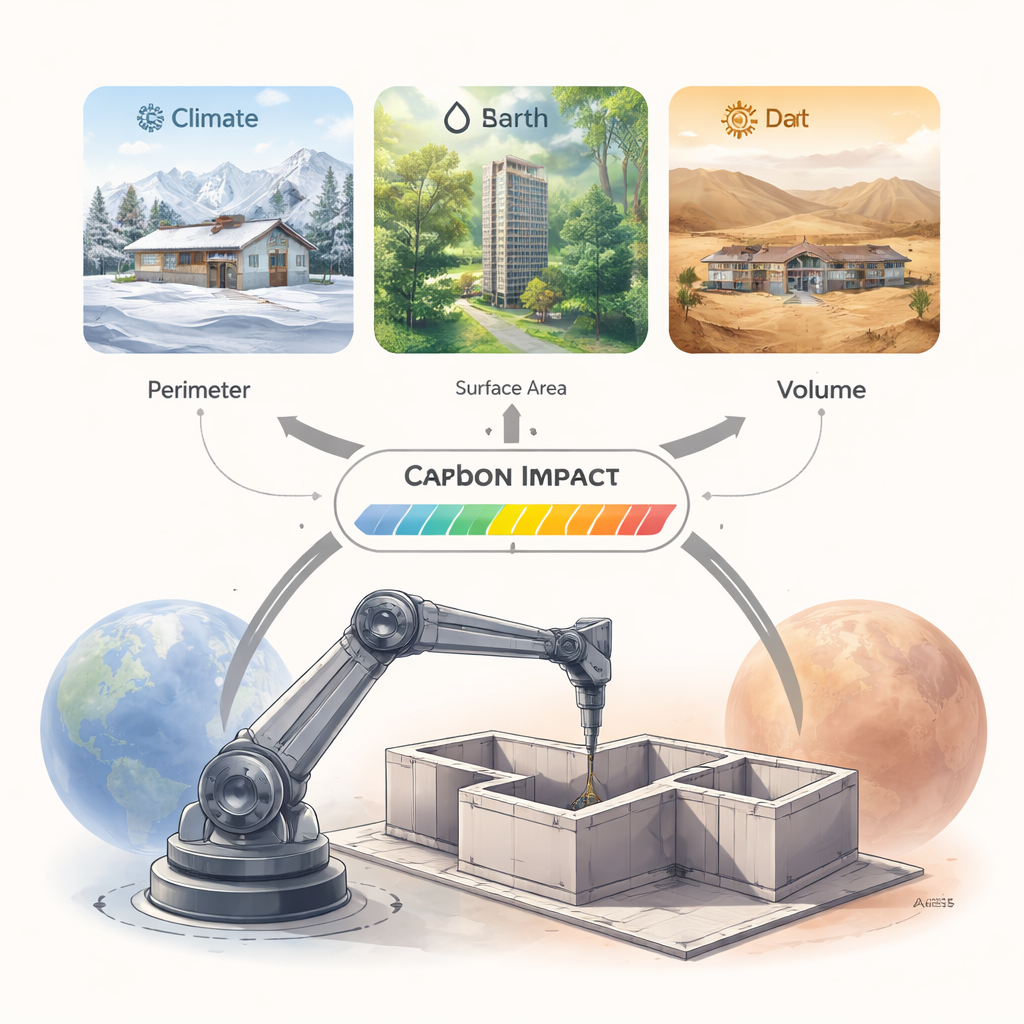
The authors began with an unusual laboratory: 100 hotels scattered across some of the most punishing environments on Earth, from Arctic ice to high mountains, deserts, and steamy tropics. By measuring basic features such as how wide a building spreads, how tall it is, and how jagged or smooth its outline appears, they found clear climate fingerprints. Cold-climate hotels tend to be compact and tightly wrapped, limiting exposed surfaces so warmth stays in. Desert and tropical hotels are the opposite: broader, more open, and often surrounded by shaded outdoor areas that help air flow and heat escape. A machine-learning analysis showed that simple geometric traits—perimeter, surface area, and overall volume—strongly predict how much carbon is used in the making and refurbishing of these buildings. In general, simpler, more compact shapes waste less energy and material than complex, decorative forms.
How Prefab and 3D Printing Cut Carbon
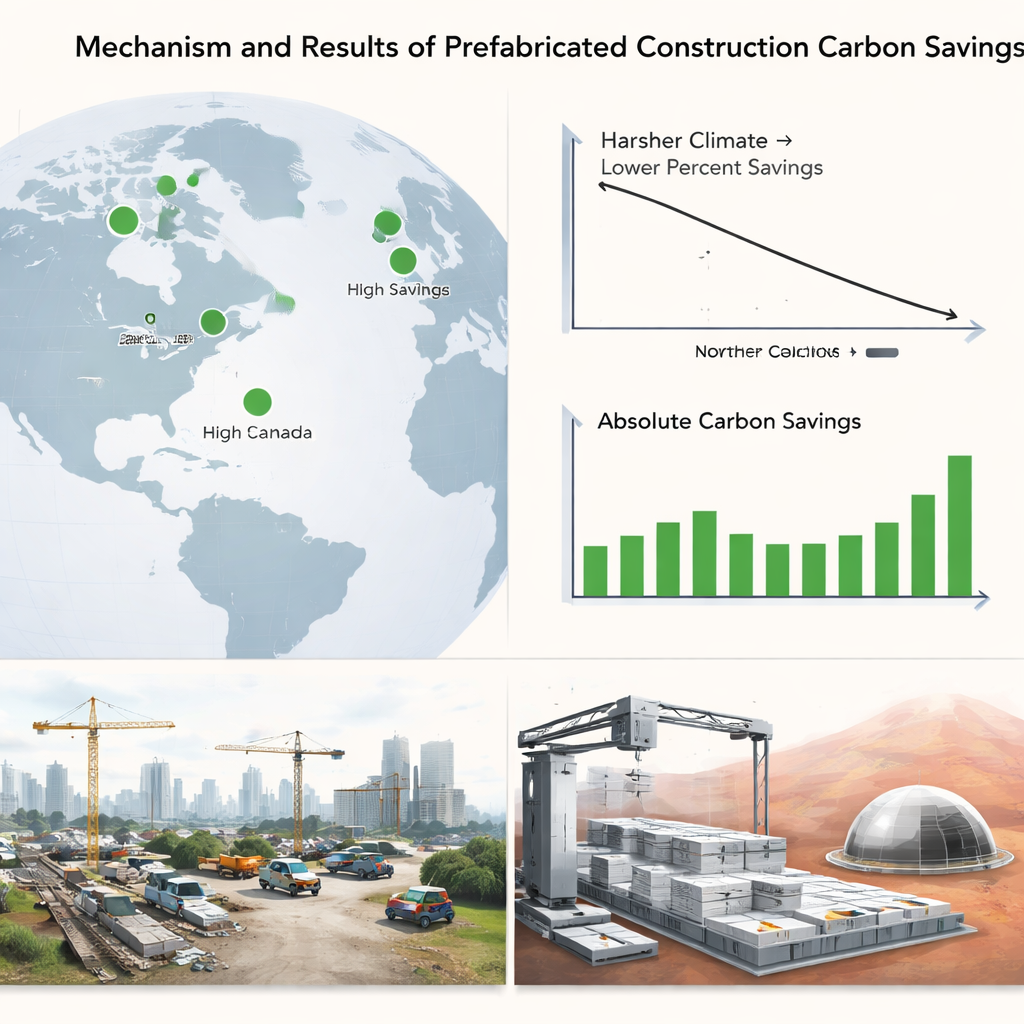
Next, the study examined 631 hotel projects around the world that used prefabricated construction—where major parts are made in factories and assembled on-site—and compared them with similar buildings built the traditional way. The focus was not on day-to-day energy use, but on “embodied carbon”: all the emissions tied up in making, transporting, and installing materials, especially during renovations. The results show that prefabrication almost always lowers total carbon, and it can do so dramatically in remote or rugged locations. Mountain and polar cities at the ends of long, difficult supply lines saw some of the biggest savings because factory-made parts reduce waste, cut transport trips, and simplify complex engineering tasks.
When Harsh Environments Complicate the Picture
The picture becomes more nuanced when the authors looked at how extreme the local environment is. They created an “extremeness index” that blends elevation, temperature swings, and humidity. In milder regions, prefabrication often reduced refurbishment-related emissions by up to a quarter. In the harshest zones, however, the percentage gains shrank and sometimes even turned slightly negative. Extra structural reinforcement, long-distance shipping, and ruggedized components can eat into the relative advantage. Yet, importantly, the absolute carbon savings—measured in kilograms of emissions avoided per cubic meter of building—remained positive in most cases. This means that even where prefab does not look spectacular on a percentage chart, it still keeps large amounts of carbon out of the atmosphere in real terms.
Rise of Construction Robots and Martian Habitats
To see where the industry is heading, the researchers mapped 56 companies developing construction robots, especially 3D-printing systems that can “draw” buildings layer by layer. These firms are clustered in Europe, China, and North America, fueled by venture capital and rapid technological growth. At the same time, the team sifted through 517 scientific studies on Martian habitats. Most work focuses on ways to 3D print shelters using local Martian soil and other in-place resources, to avoid hauling heavy materials from Earth. Materials like sulfur-based concrete, polymer resins, and basalt fiber composites stand out as promising candidates. However, much less research links these construction methods to life support, radiation shielding, or the everyday needs of people living inside. In other words, we are learning how to build strong shells on Mars faster than we are figuring out how to make them truly livable.
What This Means for Future Homes on Earth and Mars
For a layperson, the main takeaway is that the shape of our buildings and the way we assemble them matter as much as what powers them. Compact, climate-tuned designs paired with prefabrication and robotic 3D printing can substantially cut the hidden carbon cost of construction, especially in remote or difficult areas. The same toolkit—smart geometry, factory-built modules, and on-site robots—could one day let us print durable shelters from Martian soil itself. But to turn these habitats into real homes, engineers must work more closely with experts in biology, medicine, and human behavior. Only by uniting low-carbon building methods with healthy, human-centered interiors can we create structures that are both planet-friendly and people-friendly, whether they stand in a polar desert on Earth or on the red plains of Mars.
Citation: Cai, G., Sun, L., Xu, H. et al. Robotic prefab 3D printing buildings in extreme environments toward Martian habitats. npj Space Explor. 2, 11 (2026). https://doi.org/10.1038/s44453-025-00025-6
Keywords: prefabricated construction, 3D printing buildings, embodied carbon, Martian habitats, construction robotics