Clear Sky Science · en
Mechanical anisotropy in compressive-stress shape-programmed liquid crystal elastomers and polymer-dispersed liquid crystal elastomer composites
Soft materials that remember their shape
Imagine a rubbery block that not only changes shape when you squeeze or heat it, but also "remembers" that new shape and responds differently depending on the direction you press it. This study explores such shape‑memory soft materials built from liquid crystal elastomers and their composites. The work shows how simply compressing these materials can program them with built‑in directional strength, offering ideas for future soft robots, adaptive cushions, and protective components that react smartly to forces.
Building blocks of a smart rubber
The core ingredient is a special rubber called a liquid crystal elastomer. Inside this rubber, tiny rod‑like molecules can organize themselves, a bit like grains of wood that all point in a similar direction. When heated, the material softens dramatically; when cooled, it stiffens and locks in whatever shape it held at high temperature. The researchers first studied a solid block made only of this material. By cycling its temperature while pressing on it, they could squeeze the block into a new shape and then cool it so that the new geometry was frozen in. This process let them choose how the internal molecular rods ended up oriented and, in turn, how the block behaved when pushed from different directions. 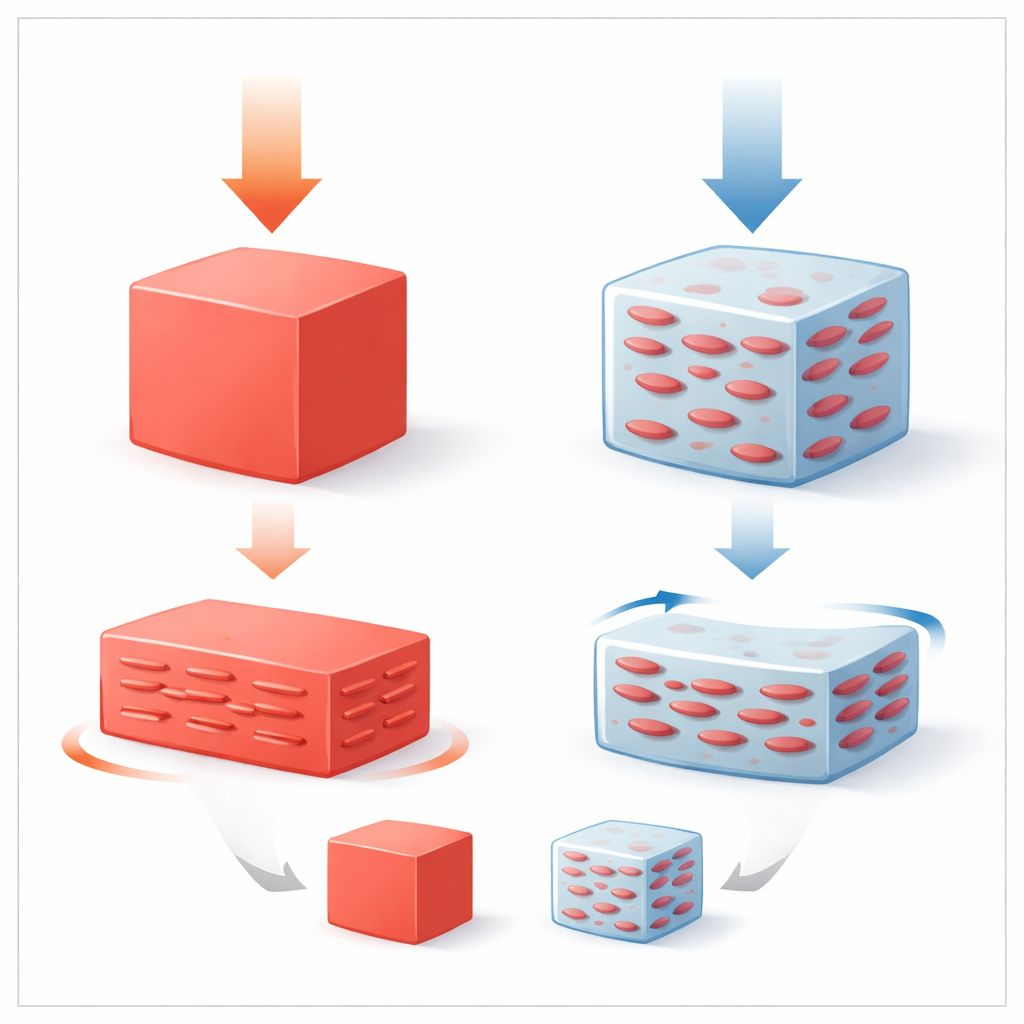
Teaching a material to resist in one direction
When the team compressed the pure liquid crystal rubber, they found that its stiffness became strongly directional. The material grew softer along the direction in which it had been squashed and stiffer in the sideways directions. This behavior revealed that the internal rods had rotated into a pattern that lies mostly across the squeeze direction rather than along it. In the language of physics, this is a "negative" ordering state that is hard to reach by stretching alone. Using mechanical measurements and existing theory, the authors estimated that, under strong compression, the internal rods approach an almost perfectly sideways arrangement. Heating the material back above a certain transition erased both the shape and this directional behavior, showing that the effect is fully reprogrammable.
Spreading smart particles in a soft matrix
Next, the researchers embedded tiny pieces of the same liquid crystal rubber inside an ordinary silicone similar to commercial sealants, creating a composite known as a polymer‑dispersed liquid crystal elastomer. In this mixture, the silicone behaves like a soft, direction‑blind background, while the tiny inclusions carry the shape‑memory and directional features. When the composite block was compressed and thermally cycled, it too remembered its new shape. Its stiffness again dropped along the squeeze direction and rose sideways, although the changes were gentler than in the pure material because the silicone matrix dilutes the effect. Microscopy revealed that the inclusions, initially more or less round, flattened into disk‑like shapes whose internal rods lay within the disk plane, all aligned sideways with respect to the applied stress.
How particle shape and spacing control behavior
The team then examined how the amount and spacing of these smart particles affect the composite’s response. At moderate loading, where particles almost but not quite touch each other, the composite showed strong directional behavior similar to the pure rubber. At low loading, each particle could deform more freely, again producing noticeable directional effects, but the overall stiffness stayed lower because there was more soft silicone between particles. At very high loading, where particles crowded together, the composite still memorized its shape but became nearly direction‑independent again: there was not enough room for each particle to flatten and line up in an orderly way. To interpret these trends, the authors adapted a standard engineering model that links a composite’s stiffness to particle shape, orientation, and concentration, and showed that both the changing geometry of the particles and their internal molecular alignment are crucial.
What this means for future soft devices
In everyday terms, this work shows how to tune a soft, rubber‑like material so that it can be compressed into a desired shape and, at the same time, programmed to be stiffer in some directions than others. The pure liquid crystal rubber offers the strongest directional changes, but mixing it into a silicone matrix makes the material easier to mold, cheaper, and still quite programmable. By choosing how much of the active particles to add and how the material is compressed, designers can dial in anything from nearly uniform response to strongly one‑sided stiffness, all in a re‑settable way. Such control could underpin next‑generation soft machines, wearable supports, and impact‑absorbing parts that adapt over time to how they are used. 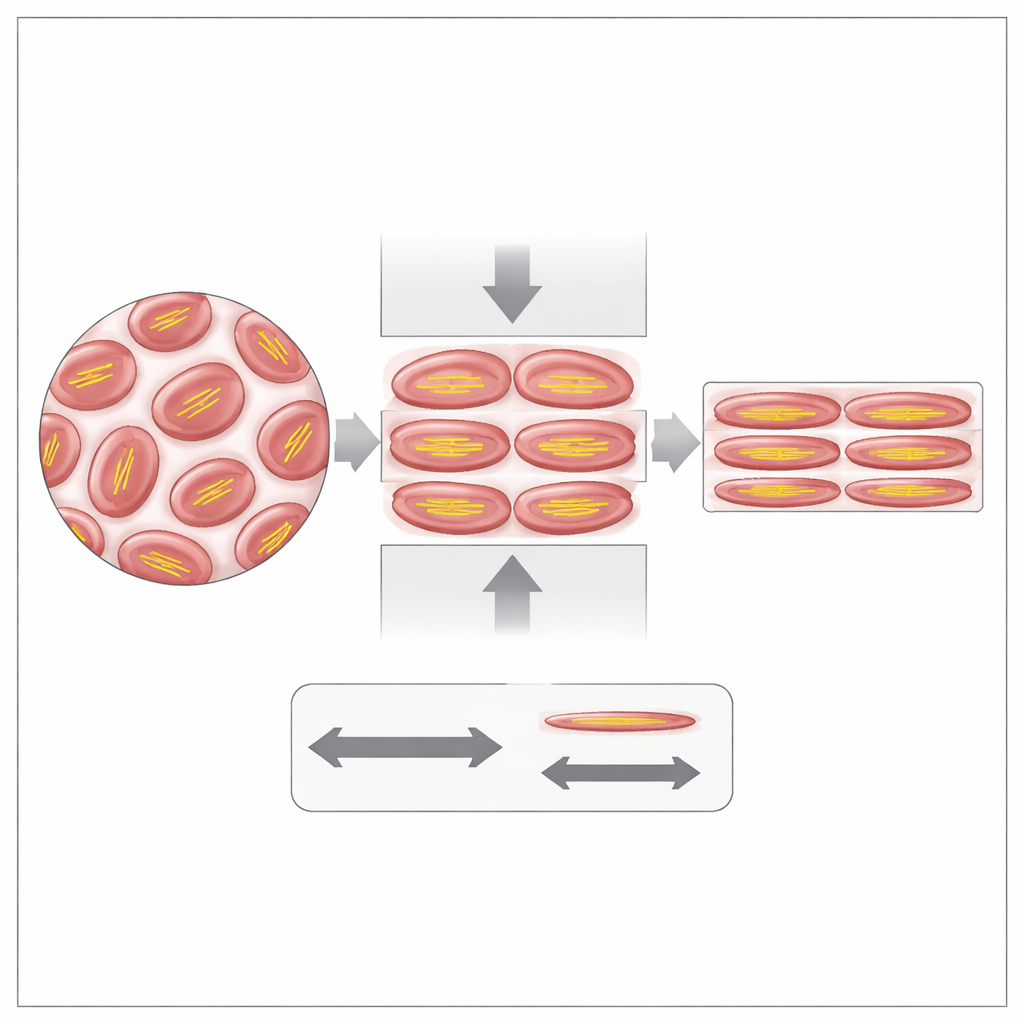
Citation: Lavrič, M., Racman Knez, L., Domenici, V. et al. Mechanical anisotropy in compressive-stress shape-programmed liquid crystal elastomers and polymer-dispersed liquid crystal elastomer composites. npj Soft Matter 2, 8 (2026). https://doi.org/10.1038/s44431-026-00022-z
Keywords: liquid crystal elastomers, shape memory materials, soft composites, mechanical anisotropy, smart polymers