Clear Sky Science · en
Quadrupolar gyration of a Brownian particle in a confining ring
Spinning from random motion
When we watch dust dance in a sunbeam or pollen jitter on water, the motion seems completely random. Yet this study shows that even simple random jiggling can be coaxed into organized, swirling patterns if the environment is carefully shaped. By confining a microscopic particle to a ring and giving it slightly different "temperatures" along two directions, the authors reveal a new kind of ordered motion they call quadrupolar gyration: four tiny whirlpools of motion that arise from noise alone.
A tiny bead on a circular racetrack
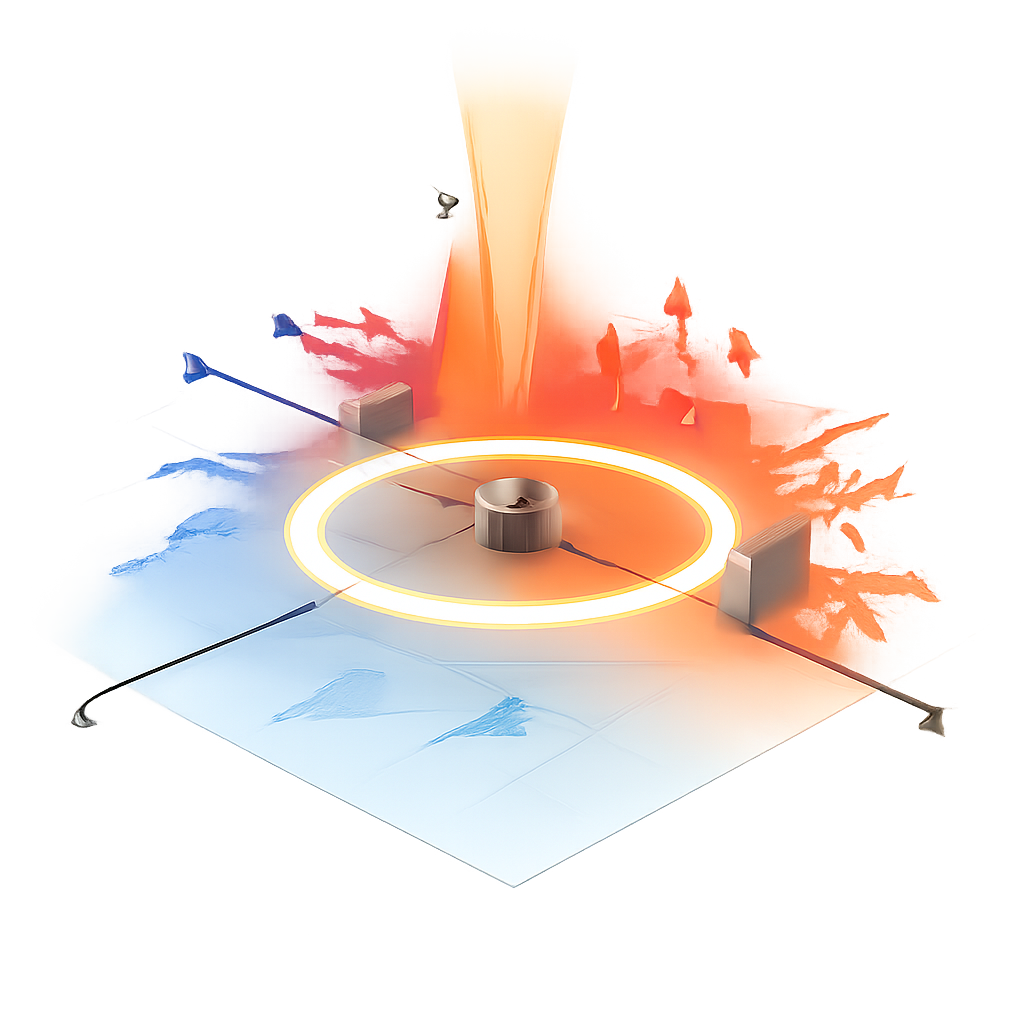
The work focuses on a single Brownian particle—a micron-scale bead constantly buffeted by molecules in a fluid. Instead of letting it wander freely in a flat plane, the particle is tightly confined to a ring-shaped trap, so it can mostly move only around the circle. The clever twist is that the random kicks it receives are not the same in all directions: along one horizontal axis the environment is effectively cooler, while along the perpendicular axis it is hotter. This temperature imbalance breaks the usual balance of microscopic motion, pushing the system out of equilibrium without any applied force or torque.
Turning uneven noise into patterned flow
Because the particle is stuck near a fixed radius, the different strengths of random kicks along the two Cartesian directions are projected into the radial (in-out) and tangential (along-the-ring) directions in a position-dependent way. Near some angles on the ring, the tangential motion is more strongly stirred; at others, radial motion is favored. Using a mathematical description called the Fokker–Planck equation, the authors show that this position-dependent stirring produces steady probability currents: the particle is more likely to move one way than the other at each point, even though no net drift around the ring is allowed. The result is a non-equilibrium steady state where motion is constantly recycled in loops.
Four whirlpools around the ring
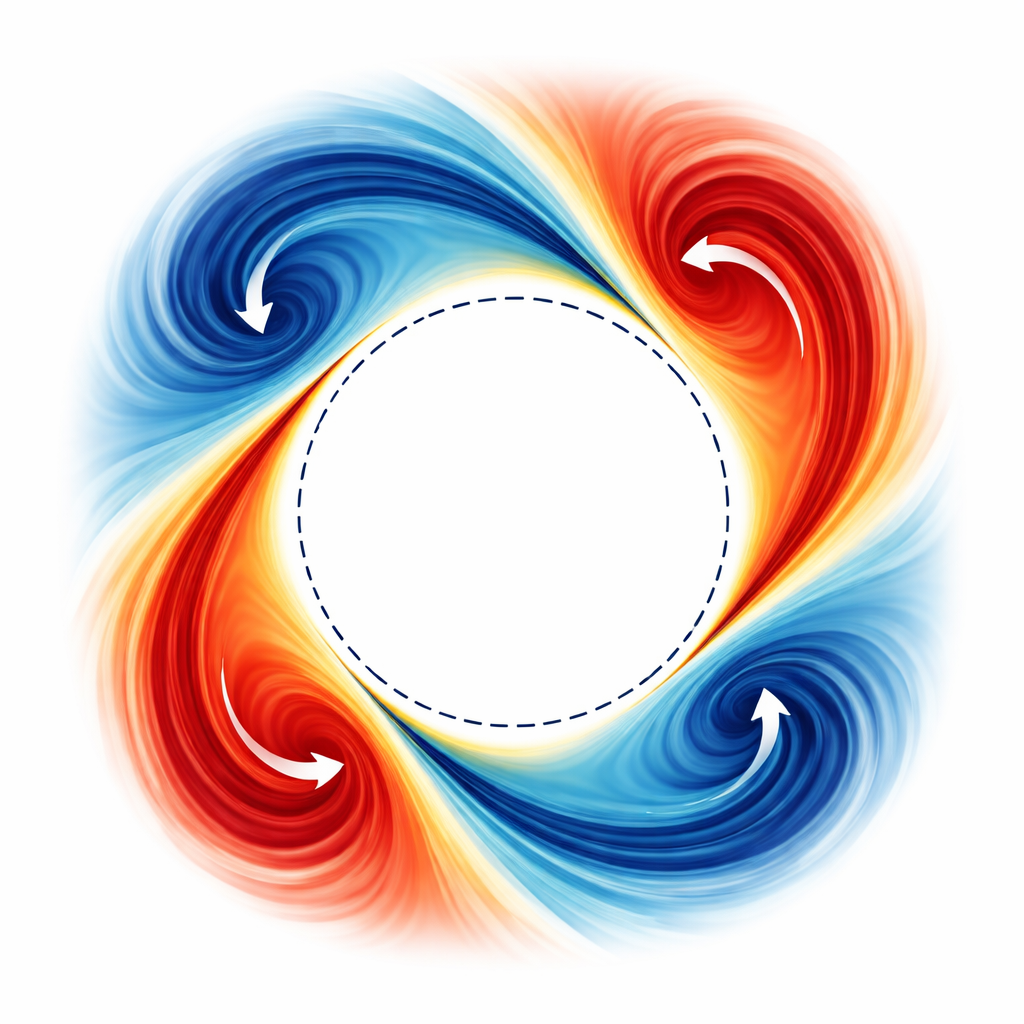
The central discovery is that these steady currents arrange themselves into four alternating vortices around the ring. In each of the four quadrants, the particle’s likelihood of moving traces out a local circulating loop—clockwise in one sector, counterclockwise in the next, and so on. Together, these four loops form a quadrupolar pattern, reminiscent of a four-petaled flower of circulation. The authors derive approximate analytic formulas for the particle’s spatial probability distribution, the in-out and along-the-ring components of the current, and the local rate at which the system produces entropy—a measure of irreversibility. All of these quantities show a clear four-fold angular structure tied to the imposed temperature anisotropy and the ring radius.
Tracing microscopic irreversibility
The study goes beyond just mapping where the particle tends to go. By combining the currents with the local "diffusivity"—how easily the particle moves in different directions—the authors compute how much entropy is produced at each point in space. This spatially resolved entropy production reveals that dissipation is not uniform: it clusters into lobes that mirror the four vortices of motion and can even dip near the most probable radius where the particle tends to sit. These patterns scale with the square of the temperature difference between the two directions, confirming that all irreversibility in this system is driven purely by anisotropic thermal noise. Numerical simulations of individual particle trajectories closely match the theoretical predictions, confirming the robustness of the quadrupolar gyration effect.
From basic physics to future tiny machines
Although this is a highly idealized system, it is not purely abstract. The authors outline how modern optical setups can create ring-shaped traps for colloidal particles and how fluctuating electric fields can effectively raise the temperature along one direction, bringing this scenario into reach of tabletop experiments. The findings show that simple changes in geometry and temperature can organize random motion into structured circulation patterns, without engines, motors, or external driving forces. For a layperson, the key takeaway is that noise is not always mere disorder: in the right setting, it can be sculpted into controllable microscopic whirlpools. This insight may eventually help in designing tiny thermal machines and sensors that harvest energy or information from fluctuations themselves.
Citation: Abdoli, I., Löwen, H. Quadrupolar gyration of a Brownian particle in a confining ring. npj Soft Matter 2, 5 (2026). https://doi.org/10.1038/s44431-025-00015-4
Keywords: Brownian motion, nonequilibrium physics, microscale heat engines, optical traps, stochastic thermodynamics