Clear Sky Science · en
Linking anthropogenic chlorine emissions to regional air quality in India
Hidden ingredient in India’s dirty air
India’s choking winter smog is usually blamed on smoke from fields, traffic, and industry. This study shines a spotlight on a lesser-known culprit: man‑made chlorine released from burning waste, fuels, and other everyday activities. Using a state‑of‑the‑art computer model, the authors show how this invisible chemical helps build fine particles and subtly reshapes ozone pollution over India, especially across the densely populated Indo‑Gangetic Plain. Their work suggests that tackling chlorine could be an overlooked lever for cleaner air and better health.
Where the chlorine comes from
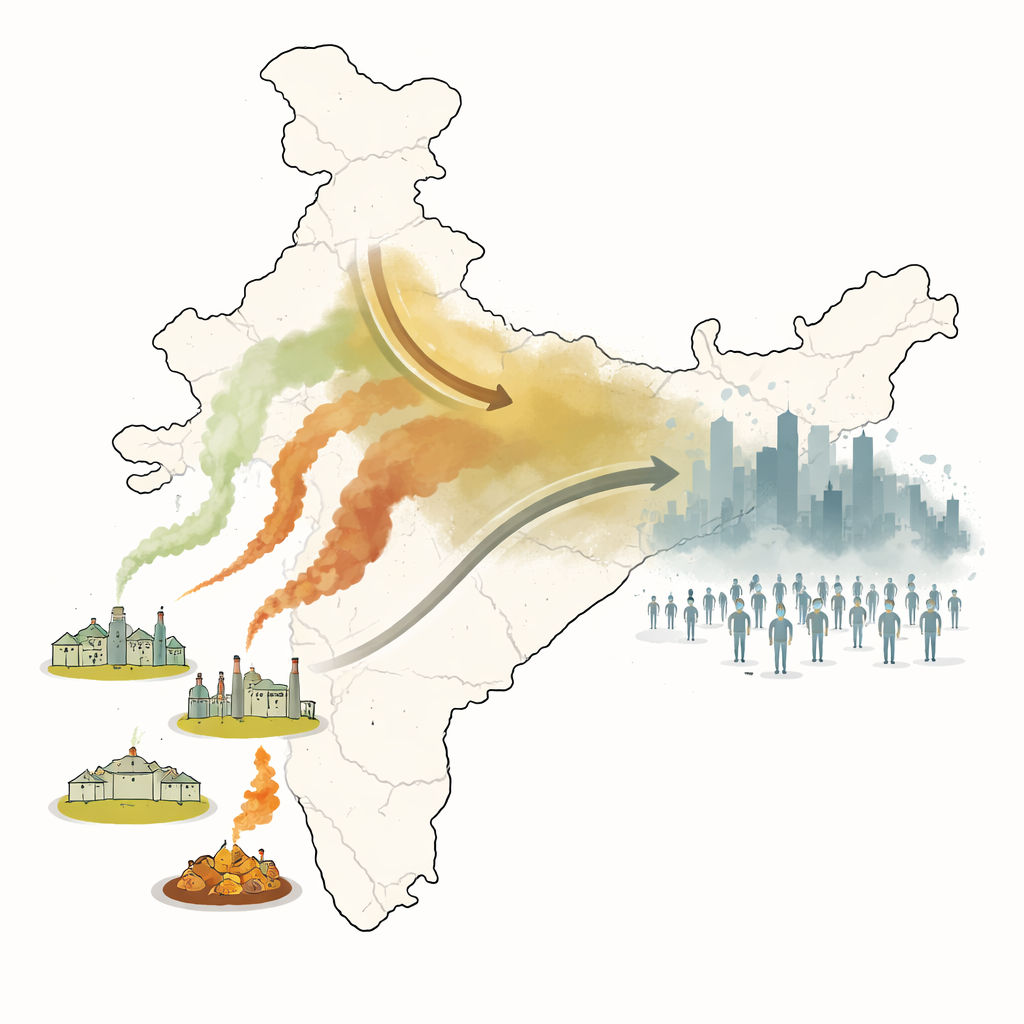
Chlorine in the atmosphere is not just sea salt carried inland by winds. Over India, most of it is produced on land by people. The study pulls together a detailed inventory of these sources, including indoor biofuel stoves, coal power plants, brick kilns, crop‑residue and biomass burning, and open burning of municipal waste. These activities release hydrogen chloride gas and tiny particles containing chloride. India emerges as one of the world’s largest emitters of such chlorine, second only to China, with particularly intense emissions stretching across the Indo‑Gangetic Plain where hundreds of millions of people live.
Turning gas into particles you can breathe
Using the GEOS‑Chem chemical transport model at high resolution, the researchers compared two scenarios for the year 2018: one with these human‑made chlorine emissions and one without them. The biggest differences appeared over northern India. In the real‑world scenario with emissions, hydrogen chloride gas readily combined with abundant ammonia from agriculture and livestock to form ammonium chloride particles. Cool temperatures and humid air in winter and autumn favored this gas‑to‑particle conversion, trapping more chloride in fine particles that can be inhaled. As a result, wintertime fine particle levels over the Indo‑Gangetic Plain increased by up to about 5 micrograms per cubic meter—enough to noticeably worsen already severe pollution episodes.
Nighttime chemistry and a subtle ozone twist
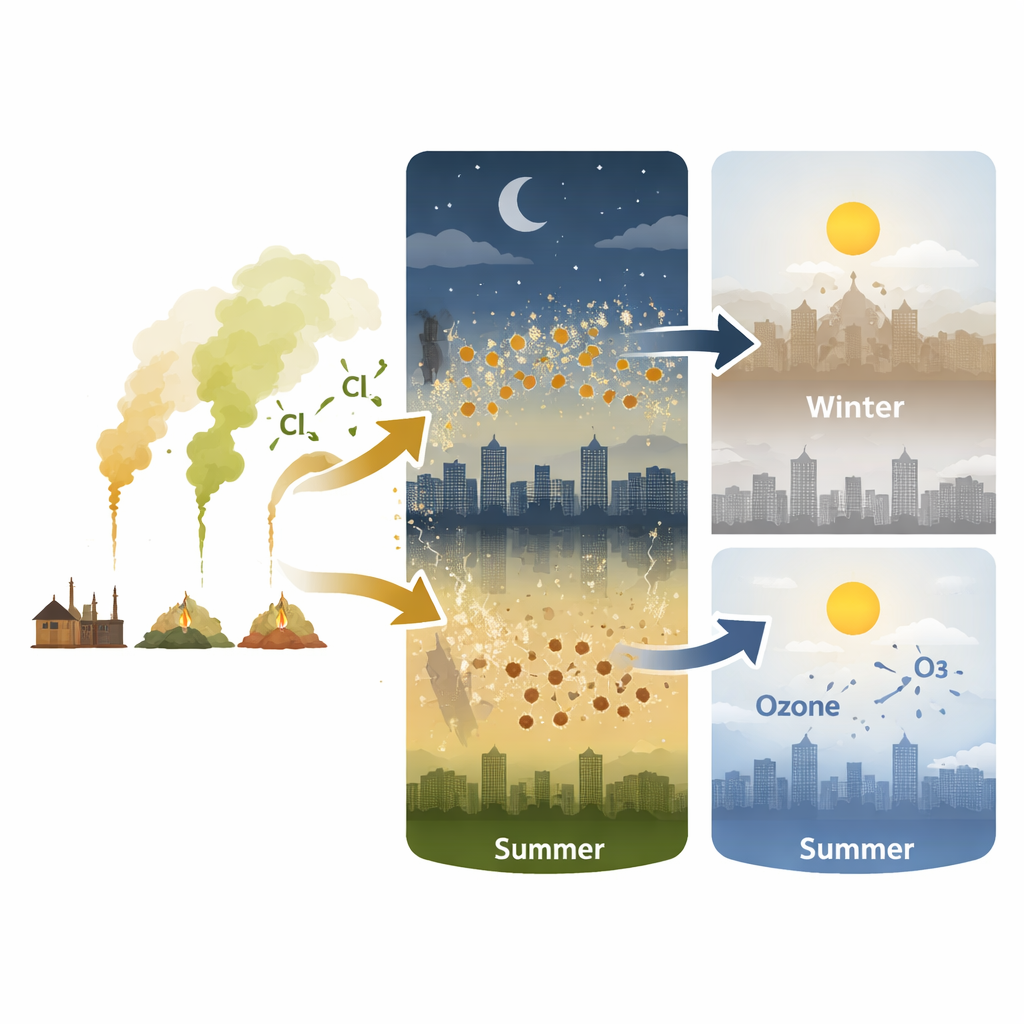
Chlorine does more than just build particles; it also fuels a complex nighttime chemistry. At night, nitrogen compounds in polluted air react on the surface of chloride‑rich particles to form nitryl chloride, a reactive reservoir species. When the sun rises, nitryl chloride breaks apart, releasing chlorine atoms that rapidly oxidize gases and can help create ozone. The model shows that including human‑made chlorine boosts nighttime nitryl chloride by roughly threefold across many parts of India. Even so, the effect on surface ozone is modest overall: small increases in winter over the Indo‑Gangetic Plain, and slight decreases in summer over much of the country. These patterns reflect how temperature, sunlight, and nitrogen oxides together control whether chlorine chemistry tends to make or destroy ozone.
What it means for health and haze
For people on the ground, the most direct consequence of anthropogenic chlorine is more fine particulate pollution. On average across India, the added chlorine raises annual fine particle levels by about 1 to 3 percent, with stronger spikes in winter and in northern hotspots. Much of this extra burden comes from ammonium chloride, which also helps particles absorb more water and grow, thickening winter haze and further cutting visibility. At the same time, shifts in ozone—especially earlier morning peaks tied to nighttime chlorine chemistry—could nudge health risks higher during commuting hours when many people are outdoors.
New targets for cleaning the air
By making chlorine’s role visible, this work argues that standard air‑quality models and policies for India are missing an important piece. Because it is difficult to curb ammonia in a farming‑heavy country, the authors suggest focusing on direct chlorine sources instead: cracking down on open burning, tightening waste management, and requiring better emission control technologies in industry. They also call for more field measurements of chlorine‑containing gases and particles to refine models. In plain terms, cutting chlorine emissions—especially over the Indo‑Gangetic Plain—could modestly but meaningfully reduce dangerous winter smog and help protect the health of hundreds of millions of people.
Citation: Patel, A., Reddy, M.C., Zhang, B. et al. Linking anthropogenic chlorine emissions to regional air quality in India. npj Clean Air 2, 23 (2026). https://doi.org/10.1038/s44407-026-00066-5
Keywords: air pollution, chlorine emissions, India, PM2.5, ozone