Clear Sky Science · en
Cross-regional PM2.5 sulfate transport to the Pearl River delta: dynamics and chemistry
Why Distant Air Can Shape the Air You Breathe
People living in coastal megacities often assume their air pollution mainly comes from local cars and factories. This study shows that, for the busy Pearl River Delta region of South China, a large share of harmful sulfate particles actually arrives from far away. By combining advanced weather and chemistry models, the researchers reveal how changing winds, storms, and humidity control both the movement and the creation of these particles in the air, with direct implications for health and air-quality policy.

Tiny Particles with Big Health Impacts
The work focuses on fine particulate matter called PM2.5—particles small enough to reach deep into the lungs and bloodstream. One key ingredient of PM2.5 is sulfate, a substance that makes particles more acidic and more toxic and that can also damage ecosystems, reduce visibility, and influence climate. Most sulfate in the air does not come out of smokestacks fully formed. Instead, it is created when sulfur dioxide gas, largely from burning fossil fuels, is chemically transformed in the atmosphere. This can happen in clear air, where it reacts with highly reactive molecules, or inside tiny droplets in clouds and fog, where a different set of reactions takes over.
Following Pollution as It Moves and Mixes
The team used a pair of linked computer models—one for weather and one for air chemistry—to simulate a month in autumn 2015, a time known for frequent haze events in the Pearl River Delta. They examined how much sulfate came from local activities, how much was blown in from other parts of China and beyond, and how much was produced during the journey. The results were striking: during polluted periods, 76 to 88 percent of sulfate in the region’s PM2.5 was due to pollution transported from outside the local area. Local sources contributed less than a quarter of the total, even though the region itself is heavily industrialized.
The Hidden Role of Vertical Air Motions
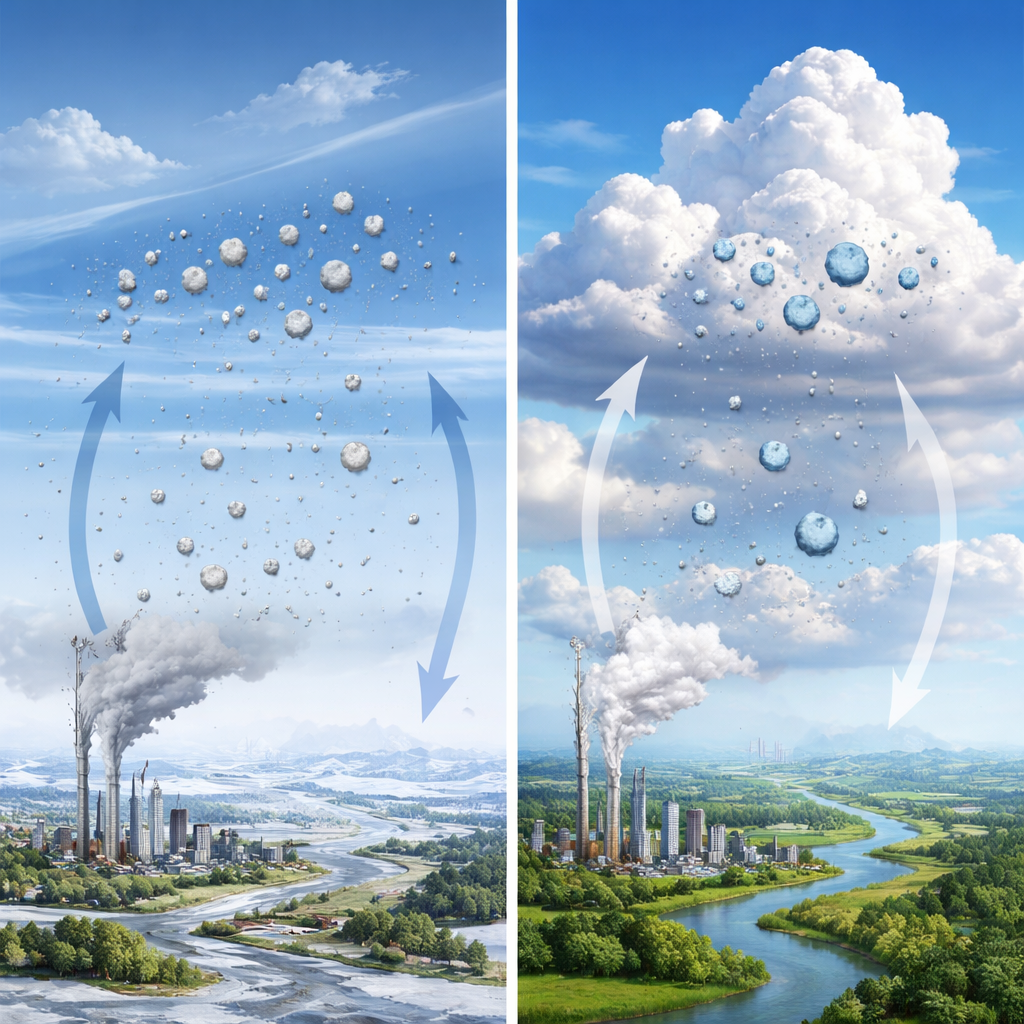
Most people think of pollution blowing in horizontally with the wind. This study shows that vertical movements of air, between the surface and the layers above, are just as important. During the day, the sun warms the ground, the lower atmosphere grows deeper, and air from higher up is mixed downward. The analysis found that this vertical exchange across the top of the boundary layer was the main pathway by which sulfate entered and left the Pearl River Delta, far outweighing direct sideways inflow near the surface. Surprisingly, strong vertical exchange occurred not only when strong northerly winds pushed polluted air southward, but also during stagnant episodes when air seemed to barely move.
Two Ways to Build Sulfate: Dry Skies vs. Cloudy Skies
To understand how chemistry changed inside these moving air masses, the researchers traced air parcels backward in time and followed the reactions taking place along their paths. In one type of episode, linked to the outer edges of typhoons, cold and dry air masses rushed in from the northeast. These plumes were rich in powerful oxidants such as ozone, which favored gas-phase reactions that turned sulfur dioxide into sulfate high in the sky. In the other type of episode, under a subtropical high-pressure system, air above the region was warmer, more humid, and moved slowly or even recirculated. Here, sulfate formed mainly inside cloud and fog droplets, driven by reactions involving hydrogen peroxide and other dissolved chemicals. Even though conditions were favorable for chemical production in these humid episodes, low sulfur dioxide levels meant that simple accumulation of existing polluted air, rather than fresh chemical formation, was the main cause of high sulfate near the ground.
What This Means for Cleaner Air
For residents and policymakers, the main message is that sulfate pollution in the Pearl River Delta is not just a local problem. Distant power plants, industries, and weather systems can work together to deliver large amounts of sulfate-rich air, which then mixes down to street level as the daytime atmosphere deepens. Because the dominant chemical pathways depend on whether the air is cold and dry or warm and humid, future changes in climate and weather patterns may shift how and where sulfate is formed. The study concludes that lasting improvements in air quality will require coordinated emission cuts across regions and better tracking of how storms, stagnant conditions, and vertical mixing move pollution—not just tighter controls within a single city.
Citation: Qu, K., Wang, X., Yan, Y. et al. Cross-regional PM2.5 sulfate transport to the Pearl River delta: dynamics and chemistry. npj Clean Air 2, 14 (2026). https://doi.org/10.1038/s44407-026-00057-6
Keywords: PM2.5 sulfate, air pollution transport, Pearl River Delta, atmospheric chemistry, boundary layer dynamics