Clear Sky Science · en
Hybrid transformer and physics-informed neural operator for correcting TEMPO NO2 biases over North America
Why Cleaner Air from Space Matters
Air pollution is usually something we notice at street level—traffic, smokestacks, summer smog. But increasingly, our clearest view of harmful gases comes from space. This study tackles a hidden problem in satellite measurements of nitrogen dioxide (NO2), a pollutant tied to asthma, heart disease, and premature death. By blending cutting‑edge artificial intelligence with the physics of how sunlight travels through the atmosphere, the authors show how we can sharpen our view of NO2 over North America, hour by hour, in a way that is accurate enough to support health research and policy.

Watching City Air from Above
NO2 is released mainly when we burn fuel in cars, power plants, and industry, and it tends to build up over busy urban areas. For decades, satellites have scanned the globe to track NO2 levels, but most fly in polar orbits and only pass over a given location once a day. NASA’s newer TEMPO mission sits in geostationary orbit over North America, taking hourly snapshots of air pollution at neighborhood‑scale resolution. This offers a powerful way to follow morning rush‑hour peaks, industrial cycles, and pollution episodes—but only if the measurements are accurate.
The Hidden Weak Link in Satellite Numbers
Satellites do not measure NO2 directly; they detect how sunlight is absorbed and then calculate how much gas lies in a column of air from the ground to the top of the atmosphere. A crucial conversion step uses something called the air mass factor, which describes how long and through what parts of the atmosphere sunlight travels before reaching the satellite. That factor depends on clouds, tiny particles, surface brightness, the height of pollution in the air, and the angles of the sun and instrument. Because these ingredients are imperfectly known, small mistakes in the air mass factor can snowball into large, systematic errors in the final NO2 numbers—especially over polluted cities or at certain times of day.
Teaching a Smart Model to Respect the Physics
Rather than simply “fixing” the final NO2 values with a black‑box algorithm, the researchers designed a hybrid machine‑learning model that focuses directly on correcting the air mass factor itself. They trained it using nearly 75,000 pairs of measurements where TEMPO data could be compared to high‑quality readings from Pandora ground spectrometers across North America. One branch of the model, based on transformer technology, learns patterns in flat, map‑like information such as viewing geometry and surface brightness. A second branch, known as a Fourier neural operator, is designed to understand full vertical profiles of the atmosphere, including how NO2 and scattering properties change with height. These two perspectives are fused and then guided by a built‑in physics rule: corrections are rewarded only if they stay consistent with established radiative‑transfer theory, enforced via a carefully chosen loss function.
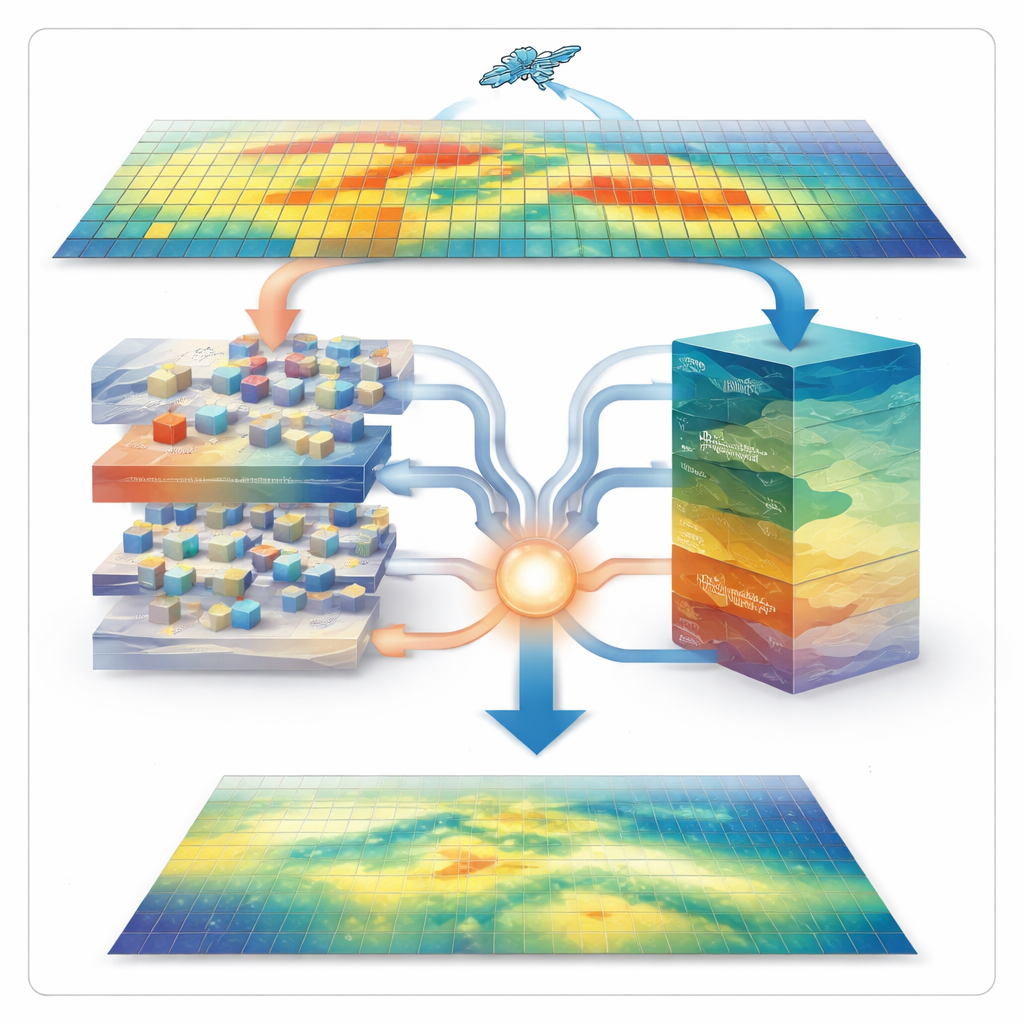
Sharper Pictures in All Seasons and Places
When this physics‑aware model was tested, it substantially tightened the match between TEMPO and Pandora observations. The fraction of variation explained (R²) rose from about 0.58 to 0.80, and overall error dropped by roughly 30 percent. The gains held across seasons—even during summer, when complex mixing and lightning‑generated NOx make the atmosphere harder to model. Importantly, the method also worked well at locations the model had never “seen” during training, including urban, suburban, and rural sites. While a few stations showed little or even reduced improvement, the majority experienced noticeably better agreement, suggesting that the approach can handle a wide range of surface conditions and emission patterns.
What This Means for People on the Ground
By correcting the physics in the middle of the retrieval process rather than repainting the final numbers, this framework produces satellite NO2 data that are more trustworthy and easier to interpret. Once trained, it runs using only TEMPO’s own inputs, enabling near‑real‑time, bias‑corrected maps of NO2 across North America every hour. For non‑specialists, the takeaway is simple: the study shows a practical way to combine physical understanding with advanced AI to give us clearer, more reliable pictures of harmful pollution from space. That improved clarity can strengthen health studies, sharpen emission inventories, and ultimately support smarter decisions aimed at cleaning the air we all breathe.
Citation: Kayastha, S.G., Park, J. & Choi, Y. Hybrid transformer and physics-informed neural operator for correcting TEMPO NO2 biases over North America. npj Clean Air 2, 15 (2026). https://doi.org/10.1038/s44407-026-00056-7
Keywords: nitrogen dioxide, satellite air quality, machine learning, remote sensing, atmospheric pollution