Clear Sky Science · en
TransNet: a transport-informed graph neural network for forecasting PM2.5 concentrations across South Korea
Why cleaner air forecasts matter
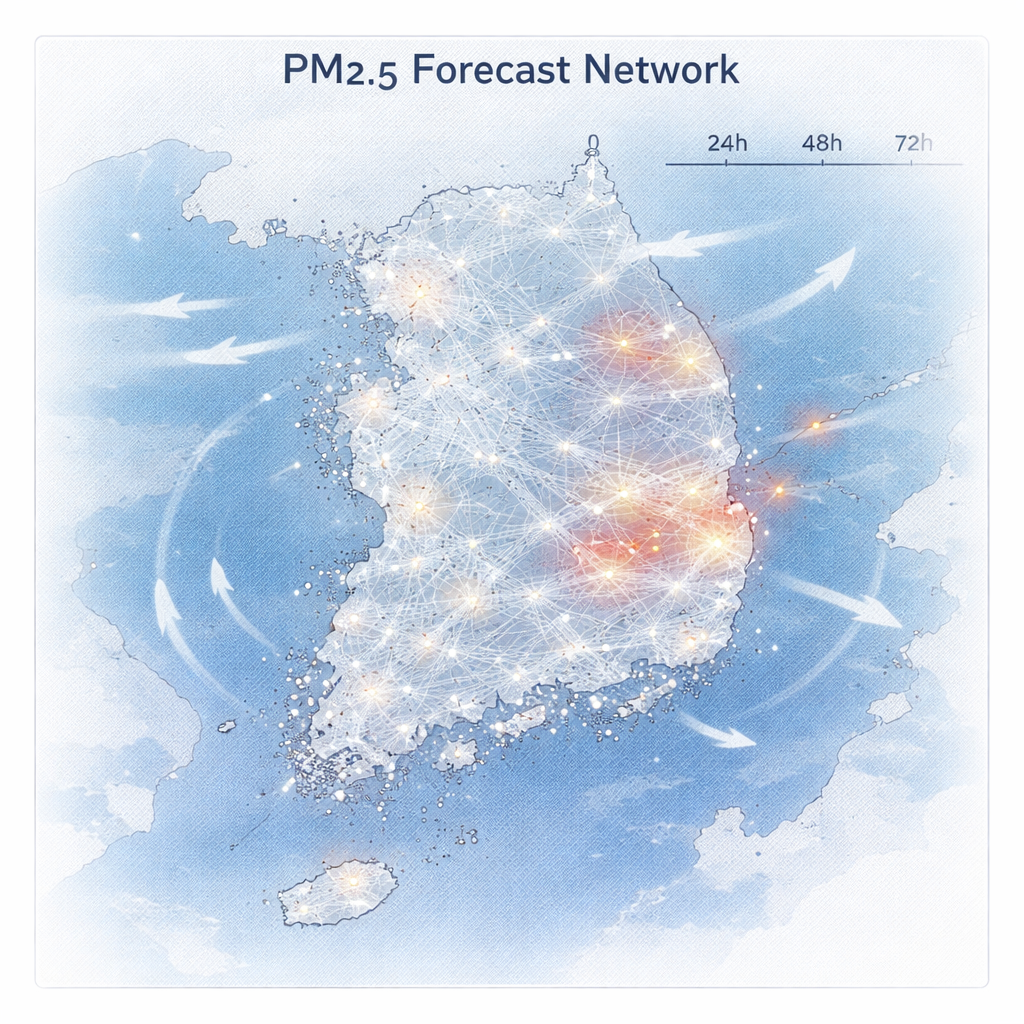
Fine particles in the air, known as PM2.5, are tiny enough to slip deep into our lungs and bloodstream, raising the risks of heart and lung disease and even early death. South Korea, a highly urbanized and industrial nation, has made progress in cutting these particles, but dangerous spikes still occur and can drift across borders. To protect people’s health, officials need fast and reliable forecasts of PM2.5 levels hours to days ahead—detailed enough for each city, yet quick and cheap enough to run every day. This study introduces a new forecasting tool, TransNet, that uses ideas from physics and artificial intelligence to predict PM2.5 across South Korea without relying on slow, expensive supercomputer models.
A new way to read the air
Traditional air pollution forecasts follow two paths. One uses large computer models that simulate how pollutants move, mix, and react in the atmosphere, but these can take hours of supercomputer time to run. The other relies on statistical or machine-learning methods that learn patterns from past data, which are faster but often miss sudden shifts in weather and emissions. TransNet, short for Transport-Informed Graph Neural Network, aims to combine the strengths of both. It treats each air quality station in South Korea as a point in a network and learns how pollution travels between them, guided by weather data such as wind, temperature, and rainfall. This lets the model mimic the physics of pollution spread while keeping the speed of modern AI.
How the smart network follows the wind
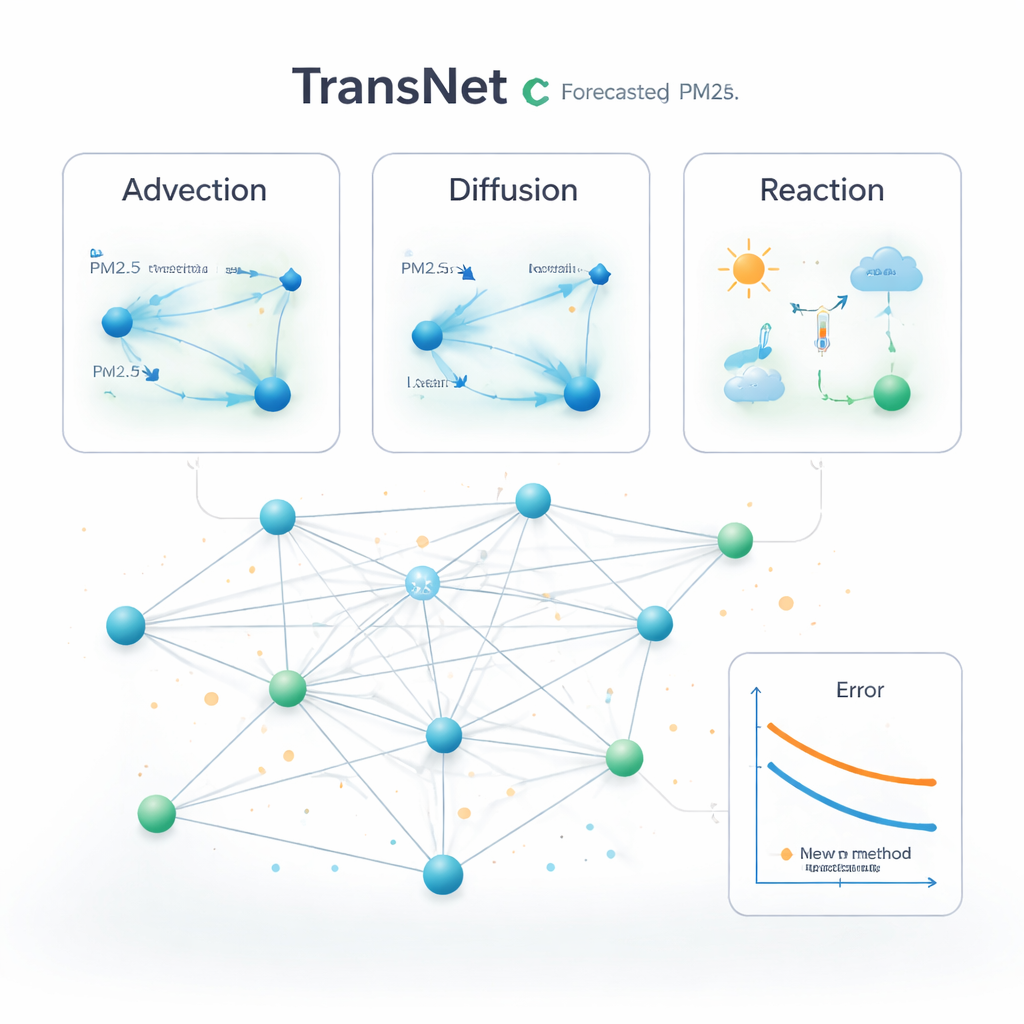
At the heart of TransNet are three linked processes that mirror how pollutants behave in the real atmosphere: movement by wind, spreading out, and local change. The model learns “advection,” the way wind pushes pollution from one place to another, by building connections between stations that line up with recent wind directions and speeds. It also learns “diffusion,” the gradual smoothing-out of peaks and valleys in pollution levels across neighboring locations. Finally, it includes a “reaction” step that captures local changes driven by weather and chemical processes, such as particles forming in humid conditions or being washed out by rain. By splitting these processes into distinct steps and updating the state of the air in very small increments, TransNet stays numerically stable and respects basic physical rules like conservation of mass.
How well the new tool performs
The researchers tested TransNet using four years of hourly data from 170 monitoring stations across South Korea, training the model on 2018–2019, tuning it on 2020, and evaluating it on 2021. They compared it to an earlier state-of-the-art system called AGATNet, which corrects the output of a complex chemistry model. For short to medium lead times—from 1 hour up to about 2 days—TransNet produced more accurate forecasts at almost all stations, cutting typical errors by roughly one third to one half and closely tracking observed changes in PM2.5. It was especially strong in coastal areas, where winds and terrain create complicated transport patterns. Over longer periods, however—beyond about 48 hours—AGATNet held an edge, likely because it draws on detailed chemical information from the underlying chemistry model that TransNet does not explicitly represent.
What extreme days reveal
When the team focused on the worst pollution episodes, they found an important trade-off. AGATNet, with its rich chemical input, detected a larger share of very high PM2.5 events, making it useful where catching as many dangerous days as possible is the priority. But it also produced many more false alarms. TransNet missed more of the rare, very severe spikes, especially at longer lead times, yet when it did flag a severe event it was usually correct, showing far higher precision. For everyday conditions—more than 96 percent of the observations—TransNet provided the better overall fit between predictions and reality while remaining independent of any expensive external modeling system.
What this means for cleaner, safer cities
To a non-specialist, the key message is that TransNet offers a practical new way to forecast fine particle pollution: it is fast, relatively simple to operate, and grounded in how air actually moves and changes. For the crucial first one to two days, when authorities must decide whether to issue alerts, adjust traffic, or protect vulnerable groups, TransNet can deliver accurate, nationwide forecasts using only weather data and routine monitoring. Existing tools that lean on heavy-duty chemistry models may still be better for looking several days ahead and for capturing the rarest, most extreme events. In the future, the authors suggest blending TransNet’s efficient, physics-informed design with simplified chemistry and mixing processes, with the goal of creating air quality forecasts that are both sharper and more reliable—helping cities act sooner and more confidently to protect public health.
Citation: Dimri, R., Choi, Y., Singh, D. et al. TransNet: a transport-informed graph neural network for forecasting PM2.5 concentrations across South Korea. npj Clean Air 2, 12 (2026). https://doi.org/10.1038/s44407-026-00052-x
Keywords: air pollution forecasting, PM2.5, graph neural network, South Korea air quality, physics-informed AI