Clear Sky Science · en
Differential effects of fine particulate matter constituents on obstructive sleep apnea severity: A nationwide analysis of smart device-based monitoring
Why air pollution may be keeping you up at night
Millions of people around the world live with obstructive sleep apnea, a nighttime breathing disorder that leaves them exhausted and at higher risk for heart disease, diabetes, and memory problems. At the same time, city dwellers inhale a constant haze of fine air pollution from traffic, power plants, and other sources. This study brings those two problems together, using data from tens of thousands of smartwatch users across China to ask a simple but important question: which ingredients in polluted air are most likely to worsen sleep apnea?
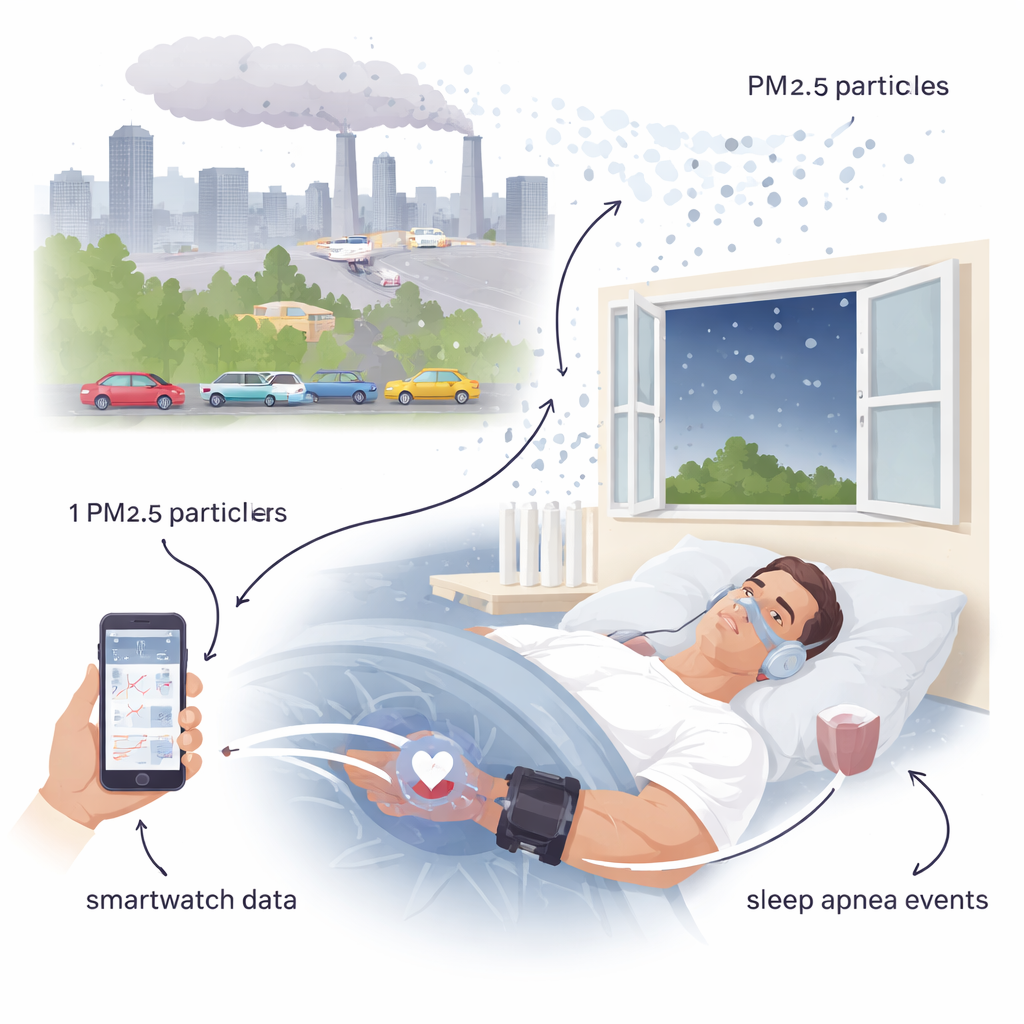
Tracking sleep with everyday smartwatches
The researchers drew on a huge, real‑world dataset from more than 53,000 adults who used Huawei smartwatches linked to a health app. These devices recorded how often people stopped or reduced breathing during sleep (the apnea–hypopnea index, or AHI), whether a night counted as a flare‑up of sleep apnea, and how much their blood oxygen levels dipped. In total, the team analyzed over 6.3 million nights of sleep between late 2019 and late 2022 in 313 cities across China, focusing on people already at moderate‑to‑high risk of sleep apnea.
Looking beyond “how much” pollution to “what kind”
Air pollution is often tracked as a single number: the mass of tiny particles smaller than 2.5 micrometers in diameter (PM2.5). But PM2.5 is actually a mix of different chemical ingredients. This study separated the mixture into five major parts: organic matter and black carbon (soot‑like particles mostly from burning fuels), plus sulfate, nitrate, and ammonium (salty particles formed in the air from gases released by industry and traffic). Using a time‑based statistical design, the scientists compared each person’s bad‑sleep nights with their own better nights, while matching in detailed daily data on local pollution, temperature, and humidity.
Dirty soot stands out as a key culprit
All five types of particles were linked to worse sleep apnea, but two stood out. On days when organic matter or black carbon levels were higher, people were more likely to have a night counted as an apnea “exacerbation,” had slightly more breathing interruptions per hour, and showed small but consistent drops in blood oxygen. By contrast, the sulfate, nitrate, and ammonium components of PM2.5 had weaker effects, even though they still tended to push sleep apnea in the wrong direction. The harmful impact appeared quickly—the same night or the next—suggesting that air quality on any given day can immediately influence how well people with sleep apnea breathe while they sleep.
Who is most affected, and when
The study also explored whether certain groups were hit harder. The links between particle pollution and apnea flare‑ups tended to be stronger in men, in people with lower body weight, and in residents of southern China, where the air is warmer and more humid. The effects were also more pronounced during the warm season. These patterns may reflect differences in how much time people spend outdoors, how easily particles reach the deep parts of the lungs, and how heat and sunlight change the chemistry and toxicity of air pollution. Even so, the researchers did not see a clear “safe” pollution level; the risk of worse sleep apnea rose from very low concentrations and then leveled off at higher ones.
What this means for cleaner air and better sleep
To a layperson, the key message is that not all air pollution particles are equally bad for sleep. Soot‑like carbon particles from burning fuels appear to be especially damaging for people with obstructive sleep apnea, nudging their breathing problems and oxygen dips in the wrong direction night after night. Because the study relied on consumer wearables and modeled pollution data, the exact sizes of these effects are modest and the results apply mainly to urban residents. Still, the findings suggest that policies targeting emissions from traffic, coal, and other combustion sources could do more than protect hearts and lungs—they might also help millions of people sleep and breathe more easily.
Citation: Luo, H., Zhang, Z., Li, A. et al. Differential effects of fine particulate matter constituents on obstructive sleep apnea severity: A nationwide analysis of smart device-based monitoring. npj Clean Air 2, 11 (2026). https://doi.org/10.1038/s44407-026-00050-z
Keywords: air pollution, sleep apnea, PM2.5, black carbon, smartwatch monitoring