Clear Sky Science · en
An artificial intelligence model for sand and dust storm forecast driven by AI weather forecasts
Why forecasting dust storms matters
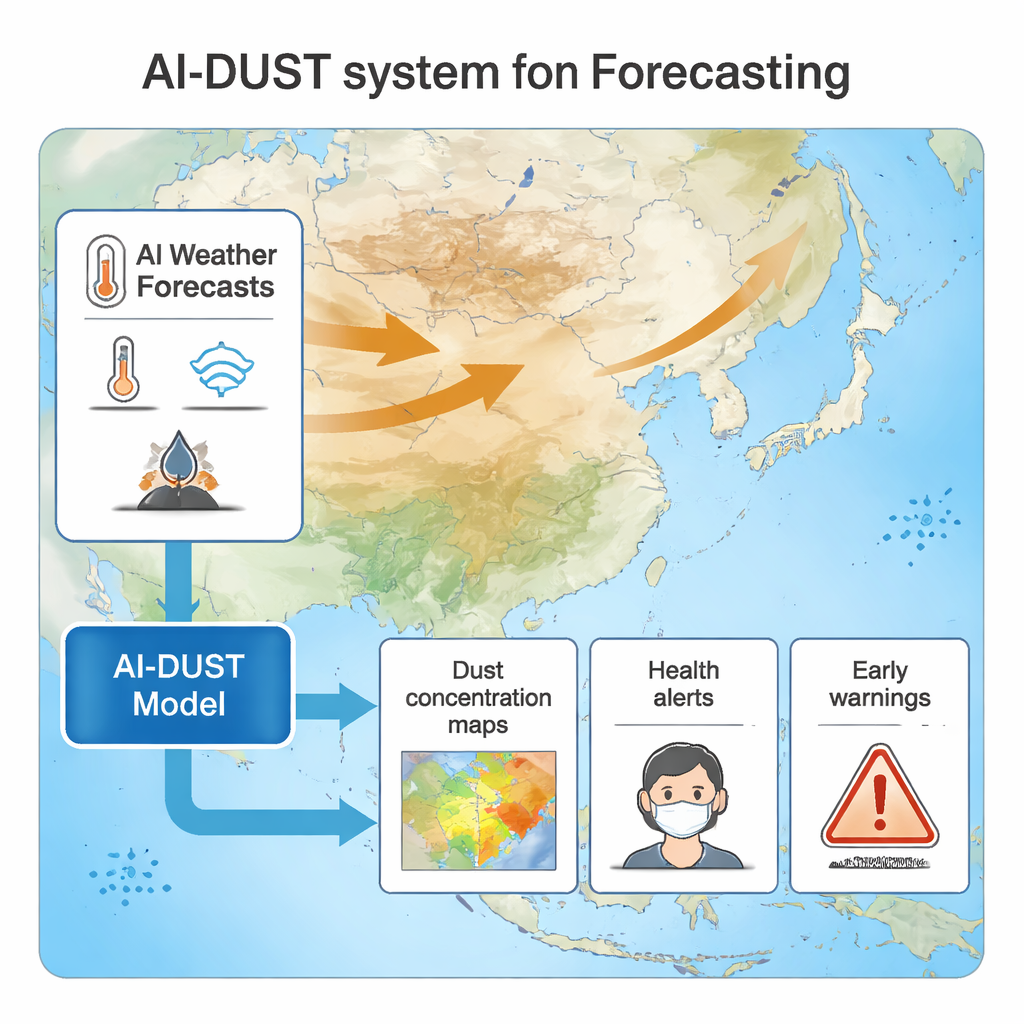
Sand and dust storms are not just dramatic weather spectacles; they can shut down airports, damage crops, worsen air pollution and threaten human health far from the desert regions where they begin. As climate and land-use changes alter dust activity, communities need earlier and more reliable warnings. This paper introduces AI-DUST, an artificial intelligence system that forecasts dust storms days in advance by learning how dust moves and settles in the atmosphere, while running far faster than traditional physics-based models.
A new way to see storms before they form
Conventional dust forecasts rely on massive computer programs that simulate the physics of winds, dust lifting, transport and fallout step by step. These systems are powerful but slow and expensive to run, and their accuracy drops quickly beyond a few days. AI-DUST takes a different approach: it learns the essential behavior of dust from years of detailed simulations and observations, and then uses modern AI-based weather forecasts as its input. Instead of solving every equation directly, it imitates how dust behaves under given wind, temperature and surface conditions, greatly cutting computation time while preserving the most important physical processes.
Teaching an AI to follow dust in the air
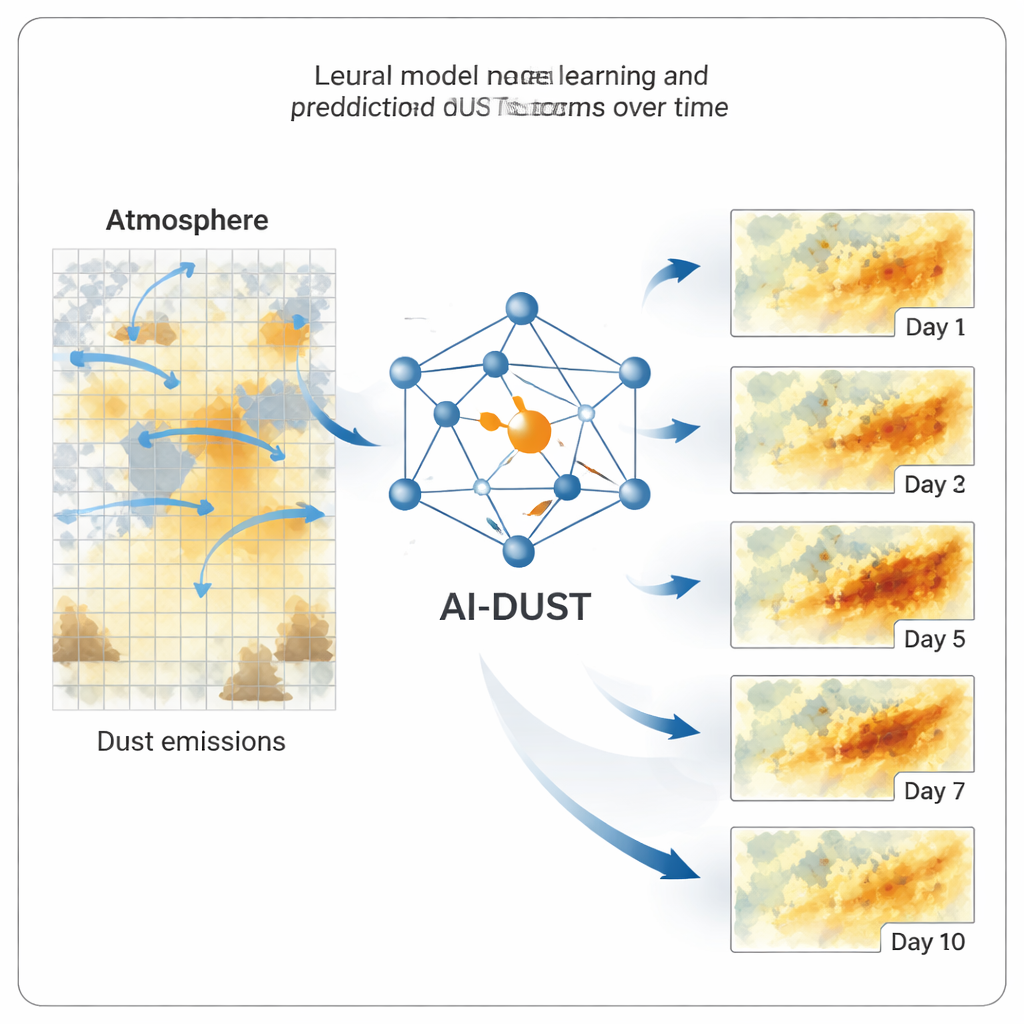
To train AI-DUST, the researchers first generated five years of high-resolution simulations of dust events over East Asia using established weather and air quality models. These simulations provided snapshots of where dust was, how strong the winds were, and how dust was being emitted from deserts or carried across mountains and cities. AI-DUST, built around a type of neural network that works on grids and their connections, learned how dust at one location depends on its neighbors, local winds and emissions. The model is constrained by basic physics, such as mass conservation and realistic dust lifetimes, so that its predictions stay within the bounds of how the atmosphere actually behaves.
Putting the system to the test in real storms
The team then asked AI-DUST to forecast real sand and dust storms during the spring of 2025 across East Asia, driving it only with AI-generated weather forecasts from a European system. For one- and two-day lead times, AI-DUST detected dust storm conditions more reliably than leading operational models used by the World Meteorological Organization, improving a standard warning metric by about 27 percent over 24–48 hours. Remarkably, its 10-day forecasts were as good as, or better than, the 3-day forecasts of many traditional systems. Comparisons with ground-based air pollution monitors and satellite images showed that AI-DUST not only captured when storms would happen, but also where the thickest plumes would travel, even during rare, severe events that carried dust deep into southern China.
From regional tool to global guardian
Although AI-DUST was trained on East Asian conditions, the authors also tested it in faraway regions, including North Africa and the Arabian Peninsula, without any retraining. The model still reproduced key dust plumes seen by satellites, suggesting it had learned general patterns of dust lifting and transport rather than memorizing local quirks. Further experiments showed that AI-DUST responds sensibly when fed different weather forecasts or more detailed maps of how rough or erodible the land surface is, underscoring that it is sensitive to real physical drivers of dust storms rather than just statistical correlations.
What this means for everyday life
For people living downwind of deserts, better dust forecasts can translate into clearer health warnings, smarter traffic and aviation management, and more resilient power and solar energy systems. This study demonstrates that an AI model, carefully designed to respect atmospheric physics, can stand in for much heavier computer simulations while achieving equal or better accuracy—especially at longer lead times. The authors envision extending this framework to include other air pollutants and chemical reactions, paving the way for fast, global air quality systems that run directly on AI weather forecasts and offer earlier, more detailed warnings of hazardous air episodes.
Citation: Wang, J., Hua, C. An artificial intelligence model for sand and dust storm forecast driven by AI weather forecasts. npj Clean Air 2, 10 (2026). https://doi.org/10.1038/s44407-025-00048-z
Keywords: dust storms, air quality, weather forecasting, artificial intelligence, East Asia